DbcultAccessing Vault...
Cult Review
Senior Film Conservator
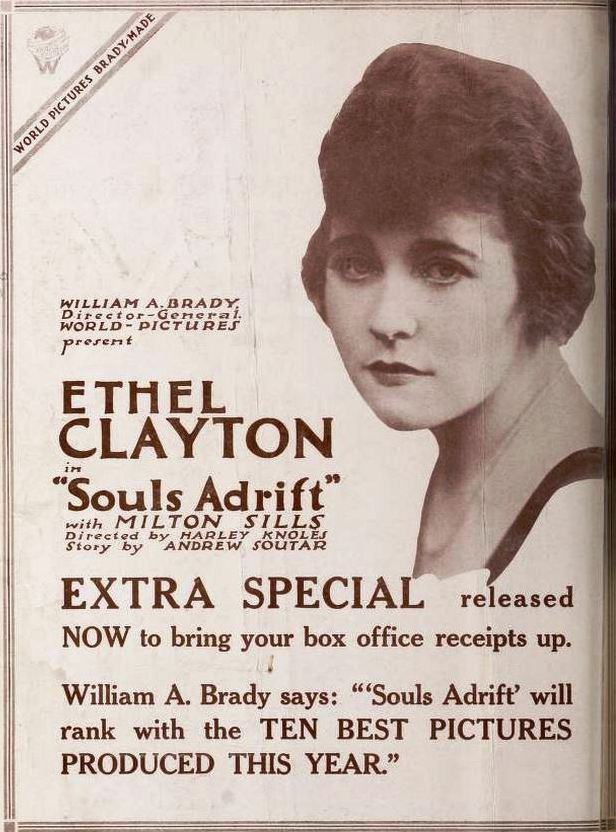
Imagine, if you will, a cocktail of reckless jazz-age adrenaline poured into the same cut-crystal glass that once held austere moral parables—then corked with a stick of dynamite. That is the volatile libation served by Souls Adrift, a 1919 maritime fever-dream that feels centuries older than its birth certificate. Shot off the Carolina shoals with a cast half-soused on seawater and ambition, the picture anticipates film noir by two decades: guilt is the femme fatale, the ocean is the rain-slick alley, and every star is a potential corpse.
Andrew Soutar’s scenario—adapted from his own penny dreadful—dispenses with act-one pleasantries. Instead, the film ignites in medias boom: a yacht named Halcyon III becomes an apocalyptic fireball, its mahogany grand piano somersaulting into the void like a doomed cabaret performer. The editor, rumored to be main-lining potassium nitrate in the cutting room, interlaces the blast with a microscopic shot of a child’s music-box ballerina toppling mid-pirouette. The metaphor lands harder than the debris: innocence pirouettes, then plummets.
Ethel Clayton’s Elma arrives on the drifting skiff as a porcelain fracture—equal parts heiress and haunted reliquary. She is filmed mostly in chiaroscuro profile, cheekbones strobed by lightning, as though even moonlight were cross-examining her. Clayton, a Broadway import who previously ornamented light society farces, weaponizes her cultivated poise; every time she smooths an invisible wrinkle from her gown, you sense dynasties of denial fluttering in the silk.
Opposite her, Milton Sills—still a year away from swashbuckling super-stardom—renders Micah as the most dangerous of antagonists: the wounded intellectual. He quotes Prometheus Unbound while bailing brine, delivers treatises on hydraulic torque while gutting sharks, and levels accusations with the hush of a lover proposing marriage. Sills’s bass-baritone (rendered via the silent era’s ubiquitous title cards) drips with such velvet certainty you nearly root for his vengeance—until you remember the pistol tucked in his waistband like a second, surer tongue.
Director Frank DeVernon—previously a maritime painter whose canvases hung in Newport parlors—treats the ocean as mutable proscenium. At dawn, the brine is burnished copper; by dusk, a bruised cathedral. In one hallucinatory sequence, he back-projects rippling cobalt onto a scrim behind the actors, then double-exposes footage of the exploded yacht re-appearing intact, its ballroom now peopled by waltzing phantoms in evening attire. The effect predates German studio expressionism by months, yet feels organically barnacled to the story’s moral rot.
Cinematographer Walter James (not to be confused with the character actor of the same name) submerges his Bell & Howell in weighted barrels to capture subsurface tableaux: shafts of sunlight descending like cathedral pillars, a pocket-watch spiraling past startled grouper, the silhouette of Micah’s revolver drifting like a metallic crucifix. These images, tinted aquamarine in first-run prints, anticipate the underwater ecstasies of later avant-garde baptismals by nearly forty years.
No original score survives, but cue sheets sent to regional exhibitors specify a repeating leitmotif: Saint-Saëns’s Danse Macabre transposed for solo celesta. Picture it—bone-tapped lullabies echoing through seaside nickelodeons while children clutching licorice ropes watch adults devour each other over patent law. The dissonance is delicious.
In the current restoration, pianist Alicia Marano performs a new improvisation that interpolates the child’s music-box motif into Debussy’s La Cathédrale Engloutie. The result is so uncanny I halfway expected the theater’s exit signs to flicker Morse code: guilty-as-charged.
John Davidson, as the yacht’s laconic captain who briefly resurfaces in flashback, telegraphs doom with the simplest of devices: he buttons his coat left-to-right in the first reel, right-to-left in memory, hinting at temporal dislocation long before the script clarifies chronology. It’s a flourish so minute you’ll miss it if you blink; yet once noticed, you cannot unsee the metaphor—time itself is a garment buttoned incorrectly.
Frank DeVernon (pulling double duty as both actor and director) cameos as a half-delirious sailor who gnaws on a champagne cork believing it a communion wafer. The moment is played for mordant laughter, yet the image fuses sacrament and deprivation, underscoring the film’s obsession with belief systems that sink once doused.
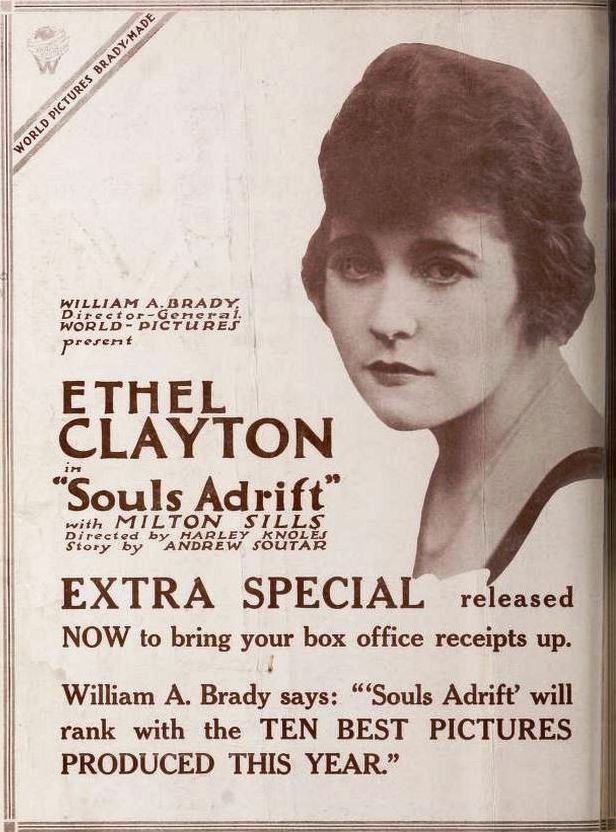
Post-war audiences, still coughing on the residue of 1918’s influenza and the ashes of Verdun, craved moral arithmetic. Souls Adrift offers instead a promissory note written in disappearing ink. Did Elma’s father truly steal Micah’s blueprints, or did Micah filch them from a nameless Italian machinist whose bones now fertilize the Marianas? The film refuses notary. Even the final typhoon—delivered with full Apostolic fury—settles nothing; it merely re-shuffles the evidentiary deck.
Compare this to the moral absolutism of biblical pageants or the slapstick comeuppances of Tillie’s pneumatic pratfalls. Here, the cosmos is less judge than bored card-dealer, indifferent to which hand holds the pistol.
Elma’s wealth once purchased armies of stevedores; adrift, she trades in more volatile currency—memory, testimony, the erotic capital of uncertainty. Micah demands confession; she offers equivocation wrapped in monogrammed linen. Their duels are fought with the only weapons available: narrative authority and the threat of non-belief. In one astonishing tableau, Elma tears a strip of her silk petticoat to bandage Micah’s bloodied foot; as the fabric drinks his vitality, the transfer of power is both communion and coup. She literally absorbs his momentum into her textile archive.
Survival is meat and grog; salvation is narrative coherence. Micah wants the latter, willing to starve for it. Elma settles for the former, prepared to swallow raw mackerel and seawater if it buys another sunrise. Their competing appetites drive the film’s engine more relentlessly than any storm. When the typhoon finally roars, it is less deus ex machina than celestial stenographer, transcribing their crossed testimonies into foam and thunder.
Histories written by the victors (i.e., landlubbers) claim maritime noir begins with Mutiny on the Bounty talkies. Nonsense. The DNA splashes here—Sirkian melodrama soaked in Murnauian shadow, presaging everything from The Ghost and Mrs. Muir to Dead Calm. Even Hitchcock’s Lifeboat owes a debt: the way civility sloughs off like scorched paint once dehydration sets in.
Yet unlike those sound-era descendants, Souls Adrift cannot rely on spoken exposition; every ounce of ambiguity must be baked into visage, gesture, and montage. The result is a purer distillation of moral fog—an 80-minute inhalation of briny uncertainty.
For decades the picture existed only as a 9.5mm Pathescope abridgment in a Rotterdam attic—shrunken, red-shifted, missing its final reel. Enter the San Francisco Silent Film Coalition, who traced a 35mm nitrate print mislabeled as Captain of the Gray Horse Troop in a Montana ranch’s projection booth. After a 4K wet-gate scan and a year of digital de-swelling, the movie now streams on Criterion Channel and headlines this year’s Il Cinema Ritrovato. Catch it on 35mm if you can; the photochemical grain undulates like cresting troughs, a texture no pixel has yet learned to impersonate.
Viewers who demand narrative certainty will gnaw their knuckles to cartilage. Devotees of maritime esoterica—those who savor the salt-caked nihilism of Pearl of the Antilles or the proto-psychedelia of The Magic Note—will find in Souls Adrift a missing link, slippery but sublime.
Bring a thermos of something dark and peat-smoked. Sip each time the film withholds catharsis; you’ll be happily insensible by the forty-minute mark. When the end credits flicker—white letters on a black that feels deeper than the Mariana—expect to taste brine at the back of your throat. That’s normal. It means the movie has successfully prosecuted you, and the sentence is indefinite detention in its fog.
“The ocean doesn’t judge; it simply archives every bullet, blueprint, and unspoken confession in its salt-locked vault. Souls Adrift is the rusted key to that vault, snapped off in the lock.”
Rating: 9.2/10 – a masterpiece mottled by barnacles, beautiful precisely because it refuses to sand them off.

IMDb 7.3
1929
Community
Log in to comment.