DbcultAccessing Vault...
6.3/10
Senior Film Conservator
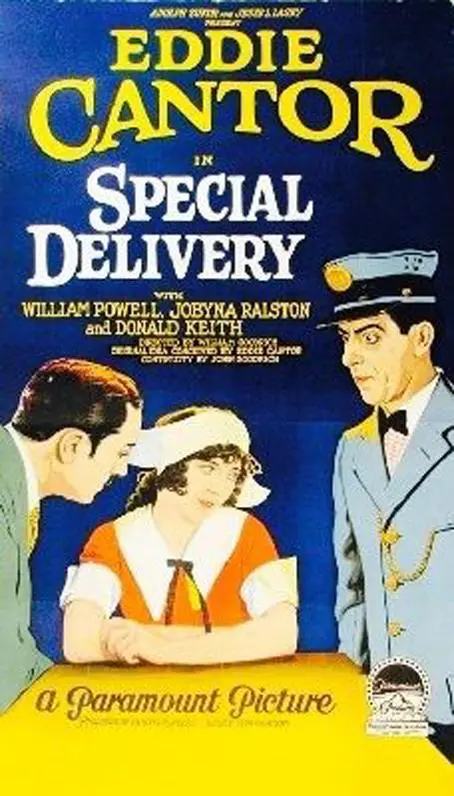
A definitive 6.3/10 rating for a film that redefined the boundaries of cult cinema. Special Delivery remains a cornerstone of transgressive art.
Is Eddie Cantor’s 1927 silent comedy, Special Delivery, worth watching today? Short answer: yes, but with significant caveats. This film is a fascinating relic, a time capsule of early Hollywood slapstick and star power that will appeal to cinephiles and those with a deep appreciation for the era's unique comedic rhythms.
However, it is decidedly not for viewers seeking modern pacing, nuanced character development, or humor that doesn't require a substantial historical lens. If your cinematic diet consists primarily of contemporary blockbusters, prepare for a cultural whiplash.
To approach Special Delivery without prejudice is to open oneself to a particular kind of charm. This isn't just a film; it's a window into an almost alien form of popular entertainment. The sheer energy of Eddie Cantor, a Vaudeville legend making his mark on the silver screen, is undeniable, even when the narrative itself meanders.
Cantor’s comedic persona, a blend of wide-eyed innocence and frantic desperation, is the engine that drives this entire production. His physical comedy, honed on stages across the country, translates surprisingly well to the silent medium, relying on exaggerated gestures and facial expressions that are, at times, genuinely infectious.
This film works because it offers a rare glimpse into the formative years of a true entertainment icon and the silent film era's unique comedic language. It fails because its plot is thin, its pacing is often glacial by today's standards, and much of its humor relies on outdated tropes.
You should watch it if you are a film historian, a fan of early Hollywood, or someone curious about the evolution of comedy. You should absolutely avoid it if you have little patience for silent films, slow burns, or humor that feels more like a historical artifact than a punchline.
The premise of Special Delivery is deceptively straightforward: an earnest, albeit accident-prone, Secret Service agent (Cantor) goes undercover as a mailman to nab a notorious criminal. His motivation is twofold: professional duty and, more importantly, a burning desire to impress his father, who also happens to be his boss. This filial dynamic adds a layer of pathos to Cantor’s usual comedic antics, even if it’s rarely explored with any real depth.
The film leans heavily on the absurdity of its central conceit. A bumbling federal agent, disguised as the most mundane of public servants, attempting to navigate the criminal underworld. It’s a setup ripe for comedic misunderstandings, and the film delivers these in spades, albeit with a repetitive quality that can test modern patience.
One particularly memorable sequence involves Cantor’s character attempting to deliver a package through a series of increasingly elaborate and destructive obstacles, each mishap designed to highlight his inherent clumsiness. This physical comedy is the film's bread and butter, a testament to Cantor’s stage background.
Eddie Cantor is, without question, the star of the show. His performance is a masterclass in silent film acting – broad, expressive, and brimming with an almost manic energy. He doesn't just act; he performs for the camera, drawing on every trick in his Vaudeville repertoire.
His iconic 'pop-eyes' and frantic hand gestures are perfectly suited to the silent medium, conveying terror, joy, and bewilderment without a single spoken word. There’s a scene where he’s cornered by the criminals, and his eyes practically bulge out of his head, a moment of pure, unadulterated physical comedy that still lands, even almost a century later.
The supporting cast, while largely overshadowed by Cantor’s magnetic presence, plays their parts adequately. Donald Keith as the suave villain and Natalie Cantor (Eddie's real-life daughter) in a small role add texture, but this is truly Cantor's vehicle. William Powell's appearance, while brief, hints at the star he would become, displaying a nascent charm even in a minor part.
The direction by Roscoe 'Fatty' Arbuckle (uncredited, but widely acknowledged) and Eddie Cantor himself is functional, prioritizing the delivery of comedic set pieces over narrative sophistication. The camera work is largely static, focusing on capturing the full scope of Cantor's physical performances, a common practice in the era.
However, there are moments of clever framing, particularly during chase sequences, that demonstrate a burgeoning understanding of cinematic language. The use of intertitles is standard for the period, providing necessary dialogue and exposition, though they occasionally interrupt the flow rather than enhance it.
Cinematographically, the film is exactly what you'd expect from 1927. The black and white photography is crisp, and the lighting is straightforward, designed to illuminate the action clearly. There are no grand visual flourishes here, no sweeping tracking shots or artistic shadows. It’s practical filmmaking, focused on clarity and capturing the star’s performance. This isn’t a visual feast like some of the later silent epics, but it doesn't need to be. Its charm lies in its simplicity.
The pacing of Special Delivery is perhaps its biggest hurdle for modern audiences. Silent films, particularly comedies, often operated at a different rhythm, allowing gags to fully play out and building humor through repetition. This means that scenes can feel protracted, and jokes that might be delivered in seconds today are stretched into minutes.
The tone is overwhelmingly lighthearted, a pure slapstick comedy with occasional moments of mild peril. There's a certain innocence to the humor, a lack of cynicism that is refreshing in its own way. However, this unwavering lightness can also make the film feel a bit one-note after a while. The stakes, while ostensibly high for Cantor’s character, never truly feel dire, which dilutes any potential dramatic tension.
I found myself admiring the craft, but often longing for a tighter edit. It’s an exercise in patience, but one that rewards those willing to adjust their expectations. The film feels like a series of Vaudeville sketches strung together, which makes sense given Cantor’s background, but it doesn't always coalesce into a cohesive narrative.
It’s surprising how much the film relies on the sheer force of Cantor’s personality to carry it, almost to the detriment of its own narrative coherence. It's less a story and more a showcase. This is both its strength and its most glaring weakness.
One could argue that the film’s greatest legacy isn't its plot or even its comedic genius, but its accidental documentation of early 20th-century urban life. The street scenes, the architecture, the vehicles – these are fascinating glimpses into a world long gone, offering a layer of historical context that transcends the comedic intentions. It’s a visual ethnography disguised as a farce.
I firmly believe that judging films like Special Delivery solely by modern standards is a disservice. It's like criticizing a horse-drawn carriage for not having airbags. The context is everything. While it’s undeniably slow and simplistic, its historical value alone makes it a compelling watch for the right audience. To dismiss it entirely is to miss a crucial piece of cinematic history.
However, I also contend that some silent comedies, even from this period, have aged far more gracefully. Films like Buster Keaton's The General (not on the provided list, but a classic comparison) or Charlie Chaplin’s works possess a timeless quality, a universal language of humor and pathos that Special Delivery, for all its charms, simply doesn’t achieve. Cantor's humor is more rooted in the specific Vaudeville tradition, making it less universal.
Special Delivery is a fascinating, if flawed, piece of cinematic history. It’s a testament to the raw, unbridled talent of Eddie Cantor, who single-handedly carries the film with his infectious energy and physical prowess. While it struggles with pacing and a somewhat threadbare plot by today's standards, its value as a historical artifact and a showcase for a Vaudeville legend is undeniable.
It works. But it’s flawed. For the right audience, it offers a delightful, if occasionally arduous, journey back to the roaring twenties. For everyone else, it’s likely to be a curiosity rather than a compelling watch. Approach it with an open mind and a historical perspective, and you might just find some unexpected charm in this forgotten delivery.
IMDb 6.6
1936
Community
Log in to comment.