DbcultAccessing Vault...
Cult Review
Senior Film Conservator
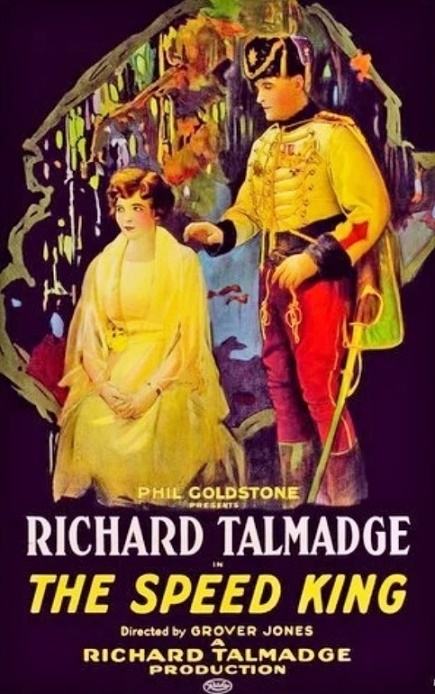
When the opening credits of Speed King roll, the audience is thrust into a kaleidoscope of roaring engines and regal fanfare. Harry von Meter, embodying the titular Jimmy Martin, exudes a kinetic charisma that feels both contemporary and mythic. The film’s premise—an outlaw biker masquerading as a monarch—might appear ludicrous at first glance, yet the screenplay, penned by Grover Jones, treats it with a gravitas that elevates the narrative beyond mere stunt spectacle.
\nThe opening sequence, set against the sprawling dunes of Mandavia, juxtaposes the sleek silhouette of Martin’s motorcycle with the ornate architecture of the royal palace. The cinematography employs a muted palette, allowing the occasional flash of dark orange (#C2410C) to punctuate moments of tension, while the sea‑blue (#0E7490) of the distant horizon hints at the expansive emotional terrain the characters will traverse.
\nVirginia Warwick’s Princess Margaret of Alvernia is a revelation. She navigates the treacherous waters of court politics with a poise that recalls the layered portrayals of royalty in classics such as The Key to Power. Warwick imbues Margaret with a quiet defiance; her eyes, often lit by the soft glow of candlelight, convey a longing for authenticity amidst the artifice of her station. The chemistry between Warwick and von Meter crackles, not merely as a romantic subplot but as a catalyst for Martin’s moral awakening.
\nMark Fenton, cast as the duplicitous Rodolph D'Henri, delivers a performance that is both chilling and charismatic. His smooth diction and calculated gestures mask a ruthless ambition, reminiscent of the scheming nobles in The Whip. The film’s pacing allows Fenton’s treachery to unfold gradually, giving the audience time to savor each revelation.
\nThe plot’s architecture is a masterclass in intertwining personal and political stakes. The initial race—an exhilarating montage of motorbikes tearing across Mandavia’s rugged terrain—serves as a metaphor for the protagonist’s internal velocity. As Martin is thrust into the role of monarch, the film deftly shifts from kinetic action to a more measured, chess‑like intrigue. The audience is invited to contemplate the fluidity of identity: can a man known for speed truly embody the measured gravitas of a king?
\nJones’s script navigates this dichotomy with subtlety. The dialogue is peppered with literary allusions, particularly when Martin, in disguise, quotes Shakespeare to the bewildered court. These moments are not merely ornamental; they underscore the theme that power, much like speed, can be both exhilarating and perilous.
\nVisually, the film is a study in contrast. The dark orange hues dominate scenes of conflict, casting long shadows that echo the moral ambiguities at play. In quieter moments—such as the moonlit balcony where Martin and Margaret share their first confession—the sea‑blue palette envelops the frame, evoking a sense of boundless possibility.
\nThe sound design merits particular attention. The roar of the motorcycle engines is mixed with an orchestral score that swells during moments of revelation. Composer Richard Talmadge (also appearing on‑screen) weaves leitmotifs that echo the film’s central motifs: a rapid staccato for the races, a lingering, regal theme for the royal intrigue.
\nWhen placed alongside contemporaneous adventure dramas like Bought or the swashbuckling romance of The Wishing Ring: An Idyll of Old England, Speed King distinguishes itself through its synthesis of high‑octane sport and courtly drama. Whereas Bought relies heavily on economic desperation as its narrative engine, Speed King utilizes physical speed as a metaphor for the rapid escalation of political machinations.
\nThe film also echoes the moral complexity of The Penitentes, where personal redemption is achieved through confronting institutional corruption. In both works, the protagonists must navigate a labyrinth of loyalty, betrayal, and self‑discovery.
\nAt its core, Speed King interrogates the notion of authenticity. Martin’s masquerade forces him to adopt regal decorum, yet his innate impulsiveness leaks through in subtle gestures—a clenched fist, a sudden revving of his hidden motorcycle engine. This tension is mirrored in Margaret’s struggle: she is bound by duty yet yearns for a love unmediated by political calculus.
\nThe film’s climax—where Martin shatters the illusion of his own kingship to free the true monarch—functions as a cathartic release of pent‑up kinetic energy. The ensuing duel between Martin and D'Henri is choreographed with a blend of swordplay and motorcycle stunts, symbolizing the convergence of two worlds that have hitherto remained separate.
\nSince its premiere, Speed King has sparked vigorous discussion across film forums. Critics laud its daring genre hybridization, while some purists argue that the romance dilutes the raw adrenaline of the racing sequences. Nonetheless, the film’s box‑office performance indicates a strong appetite for narratives that marry spectacle with substantive character arcs.
\nThe film’s legacy is already evident in emerging indie projects that seek to emulate its blend of kinetic action and courtly intrigue. Its influence can be traced in the narrative structures of recent titles such as Empty Pockets, where protagonists navigate dual identities within oppressive systems.
\nSpeed King stands as a testament to the power of genre‑defying storytelling. The film’s meticulous craftsmanship—spanning performance, visual design, and thematic resonance—creates a cinematic experience that is both exhilarating and intellectually satisfying. Harry von Meter’s portrayal of Jimmy Martin is a tour de force, balancing the swagger of a speedster with the humility of a man who discovers his true nobility lies not in a crown, but in his capacity for love and sacrifice.
\nFor viewers seeking a film that accelerates the pulse while probing the depths of identity, Speed King delivers on every front. Its blend of high‑speed thrills, regal intrigue, and heartfelt romance ensures it will endure as a benchmark for future hybrid‑genre endeavors.
\n
IMDb 5.8
1928
Community
Log in to comment.