DbcultAccessing Vault...
3.7/10
Senior Film Conservator

A definitive 3.7/10 rating for a film that redefined the boundaries of cult cinema. Every Mother's Son remains a cornerstone of transgressive art.
There are films that merely tell a story, and then there are those that etch themselves into the very fabric of our understanding of a particular era, capturing the zeitgeist with an almost uncanny precision. Raoul Walsh's Every Mother's Son, a cinematic artifact from the crucible of World War I, belongs squarely in the latter category. It's not just a narrative; it's a profound cultural document, reflecting the tumultuous shifts in public sentiment, the agonizing personal sacrifices, and the fierce ideological debates that defined America's entry into the Great War. Released at a time when the echoes of conflict still reverberated across the globe, this film offers a fascinating, often heartbreaking, glimpse into the domestic front, where the battle for hearts and minds was waged with as much intensity as the trench warfare overseas. It's a testament to the enduring power of silent cinema to convey complex human emotions and societal pressures without uttering a single spoken word, relying instead on the nuanced performances and the evocative visual storytelling that was the hallmark of the era.
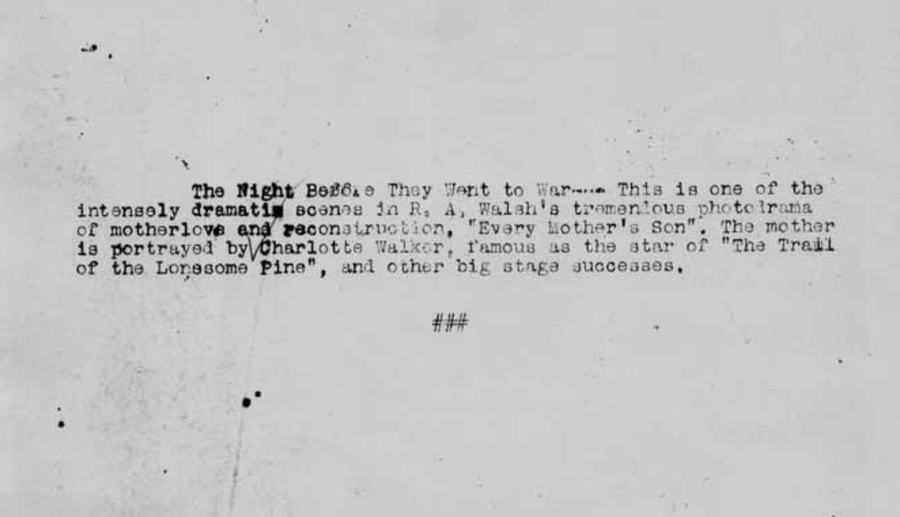
At the core of Every Mother's Son lies the agonizing dilemma of a mother, portrayed with breathtaking gravitas by Charlotte Walker. Her character embodies the universal anguish of sending children into harm's way, a sentiment that transcends time and conflict. The initial scenes, where she bids farewell to her two eldest sons, are a masterclass in understated emotional portrayal. Her smile, a fragile veneer over a heart already shattering, is a visual metaphor for the societal expectation of stoicism in the face of national duty. It's a performance that speaks volumes without dialogue, relying on subtle gestures, the flicker in her eyes, and the slight tremor in her posture to convey the immense personal cost of patriotism. This initial sacrifice sets the stage for the film's deeper exploration of the moral and emotional toll of war, not just on the soldiers themselves, but on the families left behind to grapple with an uncertain future. Walker’s depiction is not merely a caricature of maternal grief; it's a deeply empathetic portrayal of a woman caught between her love for her children and the overwhelming currents of national fervor. Her struggle resonates powerfully, making her the emotional anchor of the entire narrative. The initial optimism, however forced, gives way to a gnawing dread that becomes almost palpable to the viewer, pulling us into her perspective with compelling force.
The narrative takes a pivotal turn with the introduction of the youngest son, brought to life by Gareth Hughes, and his embrace of pacifist ideals. This aspect of the film is particularly fascinating, offering a window into the intellectual and moral debates that were raging concurrently with the physical conflict. The influence of "pacifist literature" on the young man is a clear nod to the burgeoning anti-war movement that, while often overshadowed by patriotic fervor, held significant sway in certain intellectual and social circles. Hughes portrays this nascent idealism with a youthful earnestness, not as cowardice, but as a principled stand. His willingness to accompany his mother to their secluded seaside retreat, a desperate attempt to shield him from the war's grasp, underscores the profound conviction behind his beliefs. This retreat is more than a physical escape; it's a symbolic attempt to create a sanctuary from the encroaching clamor for war, a quiet space for individual conscience to flourish. The film doesn't immediately condemn this stance, instead allowing it to develop as a legitimate, albeit unpopular, viewpoint. This nuanced approach is commendable, especially considering the prevailing jingoism of the era. It allows the audience to understand, if not always agree with, the motivations behind the youngest son's initial reluctance to enlist. The film, in this segment, becomes a compelling exploration of personal conviction versus societal expectation, a theme that remains perennially relevant.
Bernard Thornton, as the father, provides the crucial counterpoint to the mother's protective instincts and the youngest son's pacifism. His character embodies the societal pressures of the time, where military service was often equated with honor, manhood, and national pride. The shame he feels at his son being labeled a "slacker" is palpable, a reflection of the intense public scrutiny and condemnation faced by those who did not immediately flock to the colors. His pursuit of his wife and son to their secluded hideaway is driven not by malice, but by a deeply ingrained sense of duty and a desperate need to uphold the family's reputation in a community that valued patriotism above all else. The ensuing heated argument between the three family members is a microcosm of the larger national debate, a clash between individual conscience, maternal love, and societal expectation. Thornton's performance is stern yet nuanced; he isn't simply a villain, but a man burdened by the weight of cultural norms and the perceived dishonor of his family. This internal conflict, and the external confrontation it sparks, adds a layer of raw dramatic tension to the narrative, highlighting the profound divisions that the war created even within the most intimate of family units. His character serves as a stark reminder of how deeply ingrained the concept of national duty was in the public consciousness, making any deviation from it a source of profound personal and communal shame.

The film's most impactful sequence, and arguably its dramatic zenith, occurs when the war intrudes directly upon the family's sanctuary. The arrival of the pitiful, shell-shocked survivors from a ship destroyed offshore by a German U-boat is a moment of stark, visceral realism that shatters any remaining illusions of immunity or detachment. This isn't abstract news from a distant front; it's the raw, unvarnished horror of conflict washing up on their very doorstep. The sight of these broken individuals, shivering and traumatized, serves as an undeniable, irrefutable testament to the barbarity of the war. It's a scene that transcends mere plot device, becoming a profound emotional and ideological turning point. Both the mother and the youngest son, confronted with this immediate, tangible evidence of suffering and destruction, are forced to re-evaluate their positions. The theoretical arguments for pacifism and the protective instincts of a mother crumble in the face of such raw human cost. The "importance of the cause" is no longer an abstract concept but a stark reality demanding action. This sequence is masterfully executed by Walsh, demonstrating his keen understanding of how to leverage visual storytelling for maximum emotional impact. It’s a powerful cinematic moment that shifts the entire trajectory of the narrative, proving that some lessons can only be learned through direct, unavoidable encounter with tragedy. This scene echoes the stark realism found in other war dramas, demonstrating that even in a silent film era, the power of visual narrative to convey horror was immense.
Raoul Walsh, a director renowned for his versatility and ability to elicit powerful performances, truly shines in Every Mother's Son. His direction is both sensitive and unflinching, navigating the complex emotional landscape with a steady hand. He understands the power of visual metaphor, from the mother's forced smile to the stark imagery of the U-boat survivors. The pacing is deliberate, allowing the emotional arcs of the characters to unfold organically, rather than rushing to a predetermined conclusion. The ensemble cast, under Walsh's guidance, delivers performances that are remarkably nuanced for the silent era. Charlotte Walker, as previously noted, is the emotional linchpin, her portrayal of maternal anguish and resilience being truly captivating. Gareth Hughes captures the idealism and eventual awakening of the youngest son with compelling sincerity, making his transformation believable. Bernard Thornton’s stern but conflicted father adds necessary tension and a grounded sense of societal pressure. Even supporting roles, such as Ray Howard, Percy Standing, Edwin Stanley, and Corona Paynter, contribute to the rich tapestry of the film, adding depth to the small-town community grappling with the war's demands. Walsh's ability to orchestrate such a cohesive and emotionally resonant narrative, particularly given the constraints of silent film, is a testament to his directorial prowess. He doesn't shy away from the difficult questions, instead presenting them through the lens of human experience, making the film a powerful commentary on the personal sacrifices demanded by national conflict. This film, in its quiet intensity, shares a certain narrative drive with other Walsh projects, even if their themes diverge. One might draw a parallel to the psychological depth he could achieve, though The Wild Olive explored different facets of human drama, it showcased Walsh's emerging talent for compelling storytelling.

While Every Mother's Son is undeniably a product of its time, reflecting the pervasive patriotic sentiment and the eventual rallying cry for American involvement in WWI, it manages to transcend simple propaganda. It begins with a nuanced exploration of pacifism and personal choice, only to pivot, under the weight of tangible tragedy, towards a more conventional endorsement of the war effort. This evolution within the narrative itself offers a fascinating insight into the prevailing societal discourse. The film doesn't preach; instead, it presents a compelling case through emotional experience. The ultimate enlistment of the youngest son, galvanized by the U-boat attack, feels less like forced patriotism and more like an inevitable, deeply personal response to a threat that has become undeniably real. The film, therefore, acts as a historical document, illustrating how public opinion shifted from initial neutrality or dissent to a unified call for action. It’s a testament to the power of direct experience in shaping belief. This subtle shift from introspection to action is a hallmark of effective storytelling, allowing the audience to experience the transformation alongside the characters. Compared to other films that might have taken a more overtly jingoistic tone from the outset, Every Mother's Son stands out for its initial willingness to engage with dissenting viewpoints, even if only to ultimately argue against them through narrative rather than rhetoric. It’s a more sophisticated form of persuasion, one rooted in empathy and dramatic tension.
The film concludes with a Christmas reunion, a moment designed to offer solace and a sense of resolution amidst the lingering trauma of war. All three sons return home, a seemingly miraculous outcome for a family that had faced such profound uncertainty. The eldest son's return, accompanied by his new French bride, is a particularly poignant detail. It symbolizes not only survival but also the forging of new connections and the hope for a future beyond the immediate conflict. This union across national lines, born from the very crucible of war, suggests a broader theme of reconciliation and renewal. Yet, even in this joyous reunion, there's an underlying current of bittersweetness. The scars of war, though unseen, are implicitly carried by each returning soldier and by the family that waited. The film doesn't pretend that everything is perfectly restored; rather, it suggests a new normal, one shaped by the experiences of war but also by the enduring strength of familial bonds. It's a conclusion that offers a glimmer of hope without trivializing the immense sacrifices made. This ending is a classic cinematic trope, yet Walsh imbues it with a genuine emotional resonance, making it feel earned rather than saccharine. It leaves the audience with a sense of both relief and a quiet understanding of the indelible mark that such a global conflict leaves on individual lives and families. It brings to mind the domestic warmth, albeit with different narrative aims, of films like Little Women, where familial bonds are central, though the specter of war looms differently.
In retrospect, Every Mother's Son stands as a powerful and enduring piece of cinematic history. It's more than just a war film; it's a deeply human drama that explores the intricate interplay of personal conviction, societal pressure, and the raw, undeniable impact of global conflict on the individual and the family unit. Raoul Walsh, through his masterful direction and the compelling performances of Charlotte Walker, Gareth Hughes, and Bernard Thornton, crafts a narrative that remains relevant even a century later. The film's willingness to initially engage with pacifist ideas before ultimately endorsing the war effort through the catalyst of direct experience offers a nuanced perspective on the shifting tides of public opinion during wartime. It reminds us that the decisions to fight, or not to fight, are rarely simple, often born from a complex web of emotions, duties, and unforeseen circumstances. The harrowing sequence of the U-boat survivors is a stark reminder of the war's brutal reality, a moment that cuts through all ideological debates and demands a response. The final reunion, while offering a measure of peace, does not erase the journey, but rather celebrates the resilience of the human spirit and the unbreakable bonds of family. For anyone interested in the history of cinema, the social history of World War I, or simply a compelling human story, Every Mother's Son is an essential viewing experience. It's a film that speaks to the universal struggle of individuals and families caught in the maelstrom of historical events, a poignant testament to the sacrifices made and the hopes that endure. Its exploration of moral dilemmas and personal transformation, set against the backdrop of a world-altering conflict, grants it a timeless quality that continues to resonate with audiences today. It serves as a stark reminder that behind every grand historical event are countless personal stories of courage, fear, and profound change, illustrating how deeply interwoven the personal and the political truly are.
IMDb —
1917
Community
Log in to comment.