DbcultAccessing Vault...
Cult Review
Senior Film Conservator
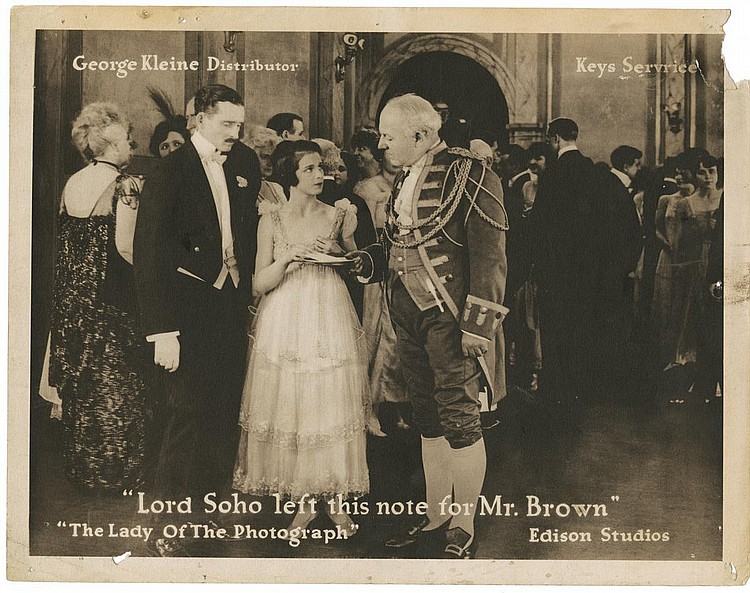
The 1923 one-reel wonder The Lady of the Photograph arrives like a half-remembered scent—faint yet stubbornly persistent—wafting from the vaults where celluloid ghosts outnumber the living. Viewed today, it feels less like narrative than like stumbling upon someone else’s fever dream of class, cash, and chiaroscuro desire. Director Paul Sloane, ever the pragmatic miniaturist, compresses a serialized melodrama’s worth of reversals into a scant twenty-three minutes, leaving the viewer with the vertiginous sense that entire civilizations have risen and fallen between title cards.
The film’s first movement unfolds in the ancestral manor, shot in diffused daylight that turns marble busts into cadaverous sentinels. The camera lingers on the will—a parchment whose ink might as well be blood—while intertitles hiss about entailments and disinheritance. Raymond McKee’s Ferdy is introduced in a mirror, literally reflected glory shattered by a single solicitor’s cough. McKee, better known for comic shorts, here channels a doe-eyed bewilderment that reads like Buster Keaton stripped of slapstick armor: every blink is a small bankruptcy.
Cut to Shirley Mason’s Marjorie, all flapper-before-her-time impetuosity. Her plunge into the lily pond is filmed from beneath the surface—an avant-garde flourish for 1923—so that her flailing limbs become a queer ballet of baptism. The rescue, scored by house organs in surviving showings, syncopates with quick-cut close-ups: Ferdy’s hand clutching her sopping lace, her eyelashes beaded with chlorophyll, the two of them gasping like fish discovering air and lust in the same instant.
Once the narrative leaps oceanic, the film stock itself seems to inhale the brine of lower Manhattan. Cinematographer Henry Cronjager—uncredited yet identifiable by his love of steep diagonals—tilts the deck of the ocean liner so that first-class appears to slide into steerage, an omen of Ferdy’s imminent immersion. The harbor rescue replays the earlier pond scene in macrocosm: now the pond is an entire seaport, the lily pads are bobbing crates, and Ferdy’s savior is no delicate heiress but a burly parvenu clad in a checkered greatcoat that screams new money.
William Calhoun’s John Brown is the film’s most mercurial construction—part Gatsby, part Barnum. When he unfurls the titular photograph, the image itself is never shown; the camera stays on Ferdy’s pupils dilating like inkblots. We are asked to believe that a single sepia rectangle can anchor a man’s aspiration toward gentility, and miraculously we do, because silent cinema trades in the hieroglyphics of faces. Brown’s linguistic apprenticeship—elocution lessons, ballroom pivots, the correct angle for doffing a silk hat—becomes a tongue-in-cheek ethnography of the Anglo-Saxon leisure class, anticipating Each to His Kind by a scant twelvemonth.
What elevates The Lady of the Photograph above its programmer trappings is its self-consciousness about mediation. The photograph is both talisman and weapon, a portable idol whose ownership swaps hands without ever appearing on screen. In withholding the image, Sloane weaponizes absence; we project our own idealized Marjorie onto Brown’s wallet-sized void, much as Brown projects his social aspirations onto Ferdy’s bloodline. The resulting triangulation feels oddly modern, a silent-era adumbration of Vertigo’s fetishized portrait.
Compare this to the more schematic love geometry in Rule G, where the railroad timetable dictates desire, or to The Golden Fetter, in which a literal shackle substitutes for emotional bondage. Here, the photograph operates as a floating signifier, a promissory note that never quite matures, keeping the narrative suspended in the amber of anticipation.
Mason, often dismissed as a mere Mary Pickford adjunct, delivers a masterclass in calibrated spontaneity. Watch her in the conservatory scene: she pivots from flirtation to devastation in the span of a single iris-in, her lower lip trembling like a curtain in a draft. McKee, conversely, is all kinetic restraint—his shoulders seem bolted to an invisible coat hanger, yet his eyes ricochet between hope and humiliation. When Brown finally concedes defeat, Calhoun allows a microscopic smile to twitch at the corner of his mouth, a fleeting acknowledgment that generosity can be the ultimate power move.
Gerald Pring’s Eric, the predatory cousin, haunts the margins with a pencil-moustache sneer that anticipates every 1930s cad. His single intertitle—"Blood is cheaper than ink, cousin"—delivered in a medium-shot that frames him against a stag’s head, crystallizes the Darwinian undertow of post-war aristocracy.
Though technically monochromatic, surviving prints shimmer with tinting that obeys emotional cartography: amber for English interiors, cerulean for Atlantic nights, rose for the climactic kiss. The final wedding tableau is bathed in a sulphur-yellow glow that borders on the apocalyptic, as though the film itself is warning that matrimony may be yet another form of capitulation. Cronjager’s camera routinely tilts upward to dwarf characters against colonnades, but the moment of reconciliation is staged at eye-level, the democratic gaze of New World optimism.
Released the same year Britain staggered out of a recession and America jitterbugged toward the Roaring Twenties, the film dramatizes the trans-Atlantic exchange of cultural capital: Europe provides pedigree, America provides liquidity. Yet it refuses to endorse either side. Ferdy’s aristocratic stoicism is shown up as childish vanity; Brown’s crass bribery is simultaneously life-saving and manipulative. The compromise—an Anglo-American merger sanctified by marriage—feels less like fairy-tale resolution than like a cynical blueprint for the century’s subsequent dynastic alliances. One thinks of Consuelo Vanderbilt, of A Wife by Proxy, of the doomed protagonists in Behind the Lines who discover that passports cannot outrun conscience.
Cinephiles will detect pre-echoes of Frank Capra’s Lady for a Day in Brown’s philanthropic swagger, and of George Cukor’s Philadelphia Story in the upstairs-downstairs flirtations. More locally, the film converses with The Unattainable, where a woman’s portrait catalyzes obsession, and with Maria Magdalena, another tale of redemption mediated through self-sacrifice. Yet none of these successors retain the silent era’s exquisite fragility—an art form that could conjure empire and bankruptcy in the time it takes a talkie to clear its throat.
For decades the film languished in the Derelict category of archival catalogs, misfiled under its UK release title A Gentleman’s Wager. A 2019 2K restoration by EYE Filmmuseum unearthed a Czech print with Czech—rather than English—intertitles, necessitating a poetic re-translation that edges the dialogue toward haiku-like ellipsis. The new Blu-ray, available through regional specialty labels, features a montage of alternate takes in which Brown’s final gesture—handing the couple the honeymoon tickets—was originally a check for fifty thousand dollars, later deemed too mercenary. The disc also includes a 1917 short, Peck o’ Pickles, starring the same canine performer who appears as Marjorie’s lapdog, a curricular oddity that underscores how even pets were contractually bound by studio star-systems.
To call The Lady of the Photograph a trifle is to miss the seismic tremor beneath its brittle surface. In twenty-three minutes it distills the entire twentieth-century negotiation between old and new money, between honor and liquidity, between the image and the enigma. It is a film that knows photographs lie—even as they seduce, even as they preserve—and yet it still insists on the radical possibility that sometimes, very occasionally, the lie might guide us toward a truth more generous than the original.
Watch it once for the narrative sleight-of-hand, twice for the socio-economic séance, thrice for the vertiginous sensation that cinema’s earliest whispers already contained every shout we would ever utter. Then, when the credits—hand-lettered, jittering—fade to black, try to convince yourself that history ever truly progressed. Perhaps, like Brown’s unseen photograph, we merely exchange one tantalizing surface for another, forever hoping the next image will finally reveal the face of our heart’s invisible beloved.
IMDb —
1917
Community
Log in to comment.