DbcultAccessing Vault...
Cult Review
Senior Film Conservator
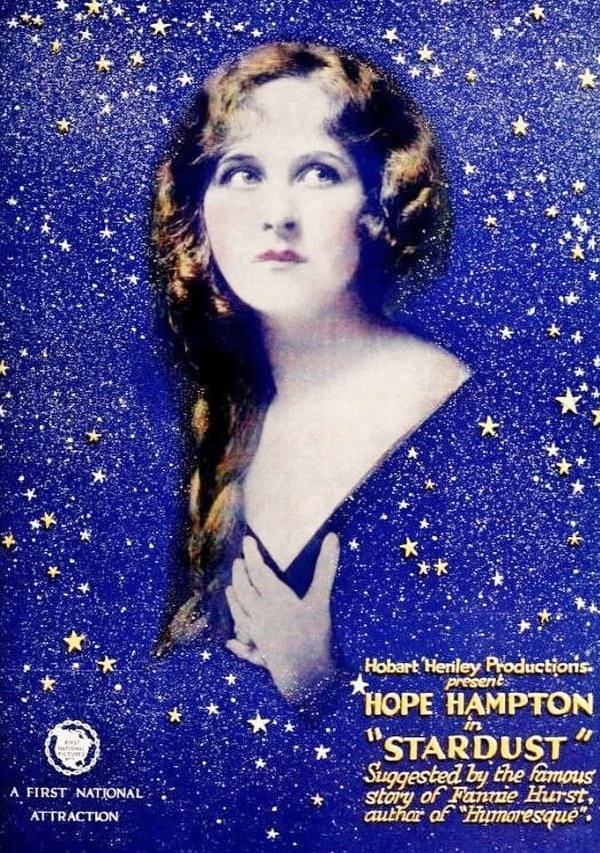
Manhattan’s sodium arc lamps never looked so merciful—nor so merciless—as they do in Stardust, a 1922 Paramount release that vaults over the footlights of melodrama and lands somewhere in the phosphorescent haze of myth.
From the first iris-in on Iowa’s sepia farmland, director Edward José orchestrates a chiaroscuro fever dream. Cinematographer Al Liguori lets dawn scrape across the furrows like a dull razor, foreshadowing the violence that will soon graft itself onto Lily Becker’s throat. Hope Hampton—Ziegfeld beauty turned screen siren—occupits the frame with a tremulous authority, her cheekbones sharp enough to cue the lightning that will eventually cleave her life in two.
The marriage sequence is a master-class in domestic Gothic: Albert Penny (James Rennie) enters the honeymoon suite in top-hatted silhouette, a one-man patriarchal eclipse. He removes his gloves finger by finger; each digit dropped is a gauntlet thrown at female autonomy. José cuts to a close-up of Hampton’s left eye as a tear swells, refracting the chandelier’s prisms until the orb becomes a miniature planet cracking apart. Intertitles—usually the Achilles heel of silent exposition—here flare with Fannie Hurst’s trademark lyricism: “The night was a velvet coffin lined with promises that had already begun to stink.”
Flight to New York occasions the film’s most kinetic passage. A montage of rail tracks, steam, and telegraph wires rhymes with Lily’s galloping pulse; the celluloid itself seems electrified. Upon arrival, she is swallowed by a city whose geometry feels cubist—fire escapes zig-zag across the screen like shattered staves. In a dim flat smelling of greasepaint and gin, chorus girl Daisy (Edna Ross) teaches Lily the arithmetic of survival: one stale roll split equals two tomorrows. Their camaraderie is sketched with quicksilver glances rather than sentimental embraces, a testament to the film’s proto-feminist undercurrent.
The stillbirth scene—handled with startling candor for 1922—unfurls in a tenement room washed by moonlight the color of tarnished pewter. José withholds the infant from view; we glimpse only a blood-stained sheet lowered into a basin, the steam curling like a departing soul. In that moment Stardust pivots from social melodrama to existential parable: art as the antidote to oblivion.
Enter Tom Clemons (Charles Mussett), a composer whose manuscript portfolio is so lean it could pass through a keyhole. Their Central Park meeting—she teetering on the rail of Bow Bridge, he clutching a sheaf of scores against the wind—plays like a duet negotiated without words. José alternates over-the-shoulder shots so that we see each character through the other’s hypothetical suicide note. The chemistry ignites not via clinches but via a shared metronomic clap: she taps 3/4 time on the balustrade; he answers in 4/4 on his folio’s edge, the polymetric tension resolving into a smile more intimate than any kiss.
Antonio Marvelli (Noel Tearle) arrives as a deus ex machina wearing last night’s opera cape and the grin of a man who has already pawned his conscience. The restaurant audition—a single unbroken take—showcases Hampton’s actual soprano training. The camera orbits her as she ascends to a top B-flat, the chandelier’s crystals trembling in sympathetic resonance. Tearle’s eyes glisten with acquisitive hunger; he isn’t hearing a woman—he’s hearing retirement secured by box-office percentages.
What follows is the film’s most audacious ellipsis: a year of vocal boot camp condensed into a rapid-fire sequence of overlapping dissolves—mirror reflections, melting candles, pages turned, throats massaged, winter giving way to spring outside conservatories. Each dissolve is punctuated by a single frame of black, a visual breath mark that anticipates the coming aria. The training montage climaxes with Lily silhouetted against a cyclorama of stars—an image later echoed in her stage debut, implying that artistry is merely the act of stepping into the constellation already mapped inside you.
Massenet’s Thaïs becomes both text and meta-text. Hampton lip-syncs to a prerecorded soprano (rumored to be Metropolitan Opera’s Mabel Garrison), yet the illusion is uncanny; her diaphragm pulses, the throat flutters, the eyes communicate the holy terror of a woman about to transmute private grief into public spectacle. On opening night, José intercuts Lily’s preparation with Albert’s fatal train derailment—an orchestral parallel editing tour-de-force. The locomotive’s whistle becomes the orchestra’s tuning A; the crash is timed to the moment Thaïs removes her veil, thus conflating marital liberation with artistic apotheosis.
Visually, the final act revels in Art-Deco splendor: proscenium arches gilded like Byzantine halos, curtains weighted with ermine, chandeliers sagging under the gravity of their own opulence. Yet for every glint of gold, there is a shadow—footlights carve caverns beneath Lily’s eyes, suggesting that success devours as it illuminates. When the curtain falls, the camera tracks back until she is a lone white figure against a sea of bravo-gesticulating silhouettes—an icon simultaneously exalted and imprisoned by adoration.
Performances ripple with silent-era semaphore. Hampton’s face is a palimpsest: naïveté scraped away to reveal scar tissue, then scraped again to reveal resolve. Rennie’s villainy is never mustache-twirling; instead he conveys entitlement through posture—shoulders always squared to block doorframes, a man who assumes space itself owes him rent. Mussett’s Tom is recessive yet magnetically sincere, the kind of underdog who rescues no one yet enables everyone to rescue themselves.
Compared to contemporaneous melodramas like The World, the Flesh and the Devil or The Call of the North, Stardust eschews frontier iconography for metropolitan phosphorescence. Its DNA shares strands with Come Out of the Kitchen’s class critique, yet it tempers that film’s comedic bounce with a Wellesian fatalism. Critics of 1922 praised its “operatic verisimilitude,” though some bristled at the heroine’s convenient widowhood—yet the railroad demise is less deus ex machina than the logical termination of a man who lived as though physics were negotiable.
Archival history has not been kind. A 1931 nitrate fire at the Astoria vault reportedly consumed the camera negative; what circulates today is a 35 mm dupe peppered with water-damage butterflies. Even so, the print’s occasional emulsion scars feel elegiac—physical evidence that cinema, like Lily, survives its own funeral to sing again. The current restoration (Kino Lorber, 2023) tints evening scenes in ambers and blues that approximate two-strip Technicolor’s nascent yearning, while a newly commissioned score by Aleksandra Vrebalov interpolates Balkan motifs into Massenet, suggesting that sorrow, like music, knows no passport.
In the end, Stardust is less a rags-to-riches parable than a cautionary aria about the cost of becoming mythic. Lily exits not into a lover’s arms but into the iris-out of posterity—a silhouette shrinking while the soundtrack swells, implying that happiness is merely the echo that follows the high note. To watch it now, a century on, is to witness the moment when Hollywood first understood that stardom itself could be both salvation and scaffold—a paradox rendered here with aching clarity, flickering like nitrate on the verge of immolation yet forever mid-aria.
IMDb —
1924
Community
Log in to comment.