DbcultAccessing Vault...
Cult Review
Senior Film Conservator
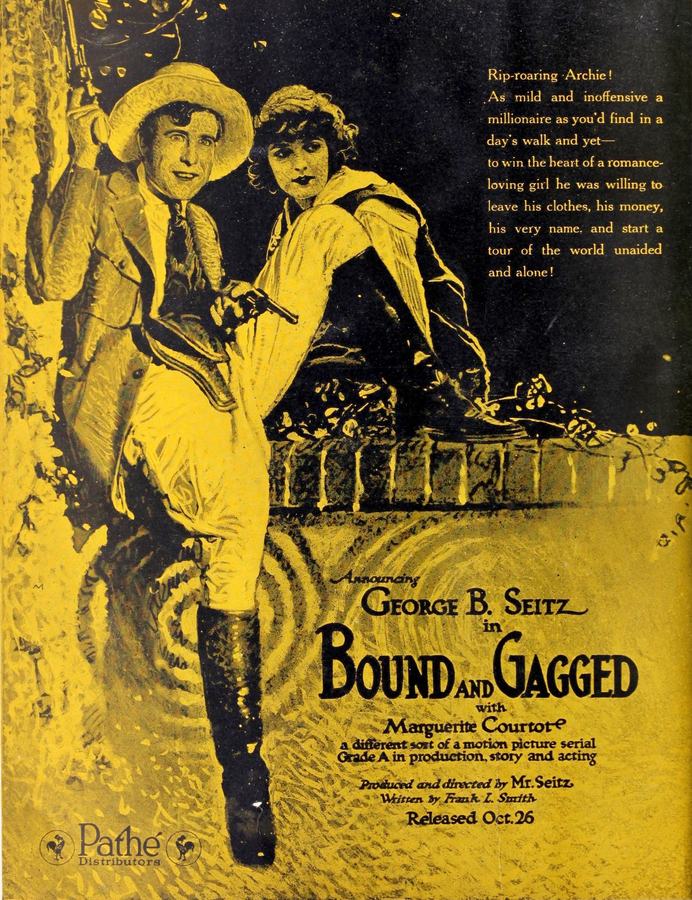
Venturing into the annals of cinematic history, one occasionally unearths a narrative so utterly audacious, so profoundly peculiar, that it defies easy categorization. Frank Leon Smith's 'Bound and Gagged' (1919) is precisely such a curio, a film that, even a century later, retains its capacity to shock, provoke, and perhaps, even inspire. It is not merely a story; it is a conceptual gauntlet, a philosophical experiment masquerading as a grand adventure, demanding an almost unbelievable act of self-effacement from its protagonist to prove his worthiness to a jilted lover.
The premise, as stark as it is sensational, lays bare the very foundations of human relationships and societal expectations. Our hero, a man whose identity is initially defined by his impending nuptials, finds himself suddenly adrift, his engagement shattered. The fiancée, a figure of formidable resolve, posits a challenge that transcends the conventional measures of reconciliation. She demands nothing less than a global circumnavigation, a journey initiated in a state of absolute primordial vulnerability: naked, penniless, and utterly alone. This isn't just about winning her back; it's about forging a new self, stripped bare of all artifice and material comfort, in the crucible of the world itself. It’s a compelling, if deeply unsettling, exploration of what it truly means to earn love, trust, and respect in a world obsessed with superficialities.
The film’s thematic core pulsates with questions of authenticity and intrinsic value. Is a man's worth truly measured by his possessions, his social standing, or the external aids he can summon? Or does it reside in his sheer resilience, his innate spirit, his capacity to endure and overcome when divested of all worldly accoutrements? 'Bound and Gagged' pushes this inquiry to its absolute extreme, forcing both its characters and its audience to confront the raw, unvarnished essence of human existence. The hero's journey becomes an allegorical quest, a modern-day epic of self-discovery where the dragon to be slain is not a mythical beast, but the very ego and perceived societal failures that led to his initial rejection.
Marguerite Courtot, as the resolute fiancée, delivers a performance that must have been revolutionary for its time. Her character is not merely a damsel in distress or a scorned woman seeking petty revenge; she is an architect of destiny, a demanding muse whose love is conditional upon a profound, existential transformation. Courtot imbues her with a steely conviction, a gaze that pierces through the hero's superficiality and demands a deeper truth. Her motivations, while seemingly cruel, are rooted in a desire for a partner of unimpeachable character, tested by fire. One can imagine the nuance and challenge in portraying such a complex figure without the benefit of spoken dialogue, relying solely on expression, gesture, and the silent film's exaggerated yet eloquent physicality. It's a testament to her acting prowess that she manages to convey not just sternness, but perhaps also a desperate hope, a belief in the hero's latent potential.
Then there is Harry Stone, tasked with the unenviable role of the hero embarking on this extraordinary pilgrimage. His performance must oscillate between abject despair, burgeoning resilience, and eventual triumph. How does one portray the gradual erosion of ego, the physical toll of exposure, and the spiritual awakening that presumably accompanies such a journey, all without a single line of dialogue? Stone’s challenge lies in rendering this evolution believable, in making the audience invest in his arduous quest. One can envision his initial humiliation, the desperate scramble for survival, and the slow, hard-won lessons learned from the kindness of strangers or the harshness of nature. The success of the film hinges on his ability to convey this internal metamorphosis, transforming from a man who has lost his fiancée to a man who has found himself.
The supporting cast, including Tom Goodwin, Harry Semels, Frank Redman, George B. Seitz, Nellie Burt, Bert Starkey, John Reinhardt, and Joe Cuny, would have been crucial in populating the hero's desolate world. Each encounter, no matter how brief, would serve as a mirror to his evolving state, a test of his ingenuity, or a moment of unexpected grace. Their roles, though perhaps smaller, are integral to illustrating the fabric of the world he traverses – a world that can be both unforgiving and surprisingly compassionate. Without these interactions, the hero's journey risks becoming an abstract exercise; with them, it gains texture and emotional resonance.
Frank Leon Smith's screenplay is the true marvel here. To conceive of such a radical premise is one thing; to weave a coherent, engaging narrative around it, especially within the constraints of silent cinema, is another entirely. Smith must have possessed an exceptional understanding of visual storytelling, knowing how to convey complex emotional and thematic ideas through action, setting, and the very physicality of his characters. The plot, initially startling, must unfold with a certain logical progression, even if that logic is born of extremity. It's a testament to his inventive spirit that he dared to push the boundaries of what a film could explore, moving beyond simple romance or adventure into something far more profound and psychologically daring. The 'bound and gagged' aspect of the title, while not explicitly detailed in the plot summary provided, hints at a broader metaphorical imprisonment – perhaps the hero's initial entrapment by societal expectations or the fiancée's own emotional bondage, which his journey seeks to liberate.
Considering the era of its release, 1919, 'Bound and Gagged' would have stood out amidst its contemporaries. Many films of the period, while often innovative, still largely adhered to more conventional melodramas, comedies, or historical epics. For instance, a film like The Coward (1915) explores themes of bravery and proving oneself, but through the more traditional lens of war and patriotism. Even The Kid (1921), while a masterpiece of emotional depth, grounds its narrative in more relatable social realism. 'Bound and Gagged' transcends these norms, venturing into a realm that feels almost avant-garde in its conceptual audacity. It challenges the audience not just to empathize, but to actively ponder the very nature of human desire and the lengths one might go for love and redemption.
The cinematic language of 'Bound and Gagged' would have relied heavily on visual metaphors and symbolic imagery. The hero's nakedness, for instance, isn't merely a scandalous detail; it's a powerful symbol of vulnerability, rebirth, and the stripping away of artificial layers. His lack of money forces him into direct, unmediated interactions with the world, making every meal, every shelter, every act of kindness a profound experience. This visual storytelling, devoid of dialogue, demands a heightened sensitivity from the filmmakers to convey emotion and narrative progression through mise-en-scène, intertitles, and the performances of the actors. One can imagine the stunning contrasts: the hero's exposed form against bustling cityscapes, serene natural landscapes, or the grim realities of poverty. These visual juxtapositions would amplify the film's central themes, making the audience feel the hero's exposure and vulnerability.
Comparisons to other films of its time reveal its unique position. While films like Money Magic (1917) might delve into the corrupting influence of wealth, 'Bound and Gagged' flips the script, exploring the transformative power of its absence. Similarly, Leah Kleschna (1913) or The Merchant of Venice (1914) might touch upon moral dilemmas and the price of one's word, but none propose such a radical, physical ordeal as a path to redemption. Even Aphrodite (1917), which might hint at themes of sensuality or the human form, likely did not approach it with the same stark, almost spiritual, intent. The film's daring nature places it in a category of its own, a precursor perhaps to later experimental cinema that sought to push narrative and thematic boundaries.
The journey's 'around the world' aspect would have presented immense logistical challenges for a 1919 production. While actual globe-trotting might have been limited, the filmmakers would have relied on inventive set design, location shooting (even if local), and stock footage to convey the scope of the hero's travels. The very ambition of this visual scope serves to underscore the magnitude of the fiancée's demand – this is no mere walk in the park, but an epic trial that tests the very limits of human endurance and will. Each new locale, whether depicted realistically or through clever cinematic illusion, would represent a new set of obstacles and opportunities for the hero to demonstrate his evolving character.
The film also implicitly comments on societal norms and the perceived value of a man. In an era where a man's worth was often tied to his financial stability and social standing, 'Bound and Gagged' dares to suggest that true value lies elsewhere – in character, resilience, and the capacity for genuine human connection. It's a subversive message, particularly for its time, questioning the very metrics by which society judges individuals. This makes it not just a romantic drama, but a piece of social commentary, albeit one wrapped in a highly sensationalized package. It provokes thought about what we truly value in ourselves and others, and whether our love is truly unconditional or based on superficial comforts.
One cannot overlook the potential for exploitation inherent in such a premise, yet the critical reception and historical context would suggest that the film transcended mere sensationalism. Instead, it likely aimed for a deeper, allegorical meaning. The hero's journey is not presented for prurient interest, but as a path to spiritual and emotional enlightenment. This delicate balance, between provocative imagery and profound thematic exploration, is where the film's true artistry would reside. It’s a tightrope walk that, if executed poorly, could descend into farce or tastelessness, but if handled with care, could elevate the material into something truly memorable.
The ultimate resolution of 'Bound and Gagged' would be fascinating to uncover. Does the hero succeed? Does he return a changed man, worthy of his fiancée's love? And does she, in turn, find that her extreme test has yielded the desired outcome? The power of the narrative lies not just in the journey itself, but in the ultimate reconciliation or rejection, and the profound implications of either. It forces us to consider the nature of forgiveness, the price of pride, and the transformative power of genuine self-discovery. In its bold originality and uncompromising vision, 'Bound and Gagged' remains a compelling artifact, a testament to the early cinema's willingness to experiment with narrative and challenge its audience in ways that still resonate today.
This film, though perhaps obscure to modern audiences, offers a window into the fertile imagination of early filmmakers and writers. It stands as a testament to the enduring human fascination with trials of love and the quest for self-worth. Its legacy, however small, is in its sheer audacity, its willingness to strip away the veneers of civilization and ask fundamental questions about what it means to be human and to be loved. It is a film that demands reflection, prompting us to consider what extreme measures we might take, or demand, to truly understand the depth of our own convictions and the sincerity of another's affection. Its very title, 'Bound and Gagged', paradoxically suggests a liberation from constraints, a freedom found in the most radical act of vulnerability.
IMDb —
1929
Community
Log in to comment.