DbcultAccessing Vault...
Cult Review
Senior Film Conservator
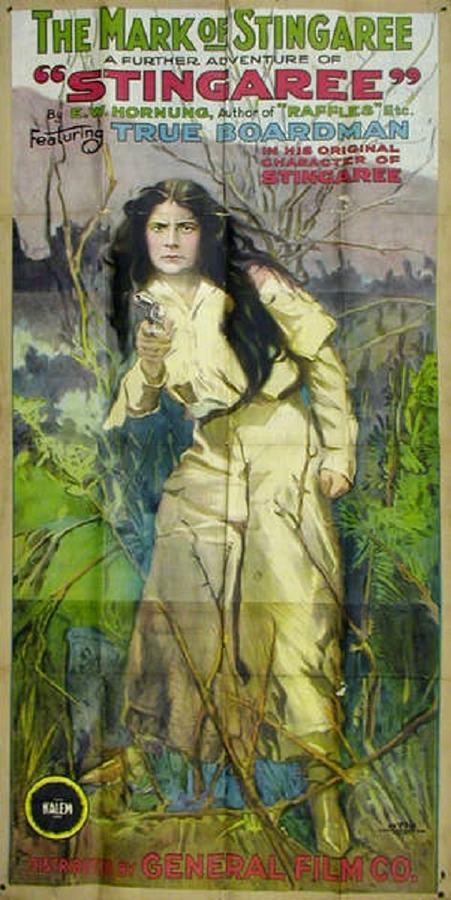
A sun-flayed continent becomes the ballroom for masked desire in this 1915 jewel, where every cicada buzz feels like a timpani roll for outlaw ardor.
James W. Horne’s Stingaree is less a narrative than a fever dream stitched from eucalyptus vapors and celluloid nitrate. The film’s prologue arrives like a whipcrack: a lone rider silhouetted against a vermilion sunset, his silhouette bleeding into the horizon until only the horse’s hoofbeats remain—an auditory ghost achieved by intertitles pulsing in deliberate arrhythmia. Within seconds we understand that space itself is a character here, untamed and complicit in every act of larceny.
The camera (or its 1915 surrogate, a hand-cranked Bell & Howell) lingers on saltbush plains until the frame seems to shimmer like a mirage. This is not mere pictorialism; it is ontology. The outback’s vastness becomes a moral ledger where sins expand, then evaporate—much like the English fortune siphoned from our protagonist by a sibling whose grin is all canines.
Joseph Barber’s Stingaree carries the languid elegance of a Romantic poet who has traded laudanum for gunpowder. His eyes, kohl-smudged by campfire smoke, telegraph volumes that intertitles dare not spell: exile, lust, a craving for restitution that transcends mere coin. When he first encounters Janet Rambeau’s Hilda—she in starched colonial linen, he in sweat-darkened moleskin—their glances spark a synesthetic chord: you almost smell citronella mixing with horse sweat.
Conventional melodrama would mire their romance in coy flirtation, yet Horne, co-writing with E.W. Hornung (creator of Raffles), opts for volatile immediacy. Their second meeting transpires inside a cave whose walls glitter with mica; moonlight refracts so sharply that every glint feels like a paparazzi flashbulb heralding scandal. He binds her wrists not for cruelty but for pedagogical thrill—teaching her, in under sixty seconds, that propriety is a parlour game the outback refuses to host.
Silent-era psychology often hinges on gesture, and Rambeau excels: a single eyebrow arch contains multitudes—terror, curiosity, the dawning realisation that she might relish captivity. It is a masterclass in micro-acting worthy of comparison to Jane’s titular performance, yet more feral.
The antagonist, Stingaree’s half-brother, appears only thrice: once in a sepia-tinged flashback where he burns the family will, once reflected in a tarnished shaving mirror, and finally as a corpse-like bust outlined against tattered calico. This triptych of absence proves more sinister than any moustache-twirling cad; colonial greed is rendered as a phantasm that saps legacy without ever dirtying its own cuffs.
Cinematographer Edward Clisbee deserves hosannas for pioneering what we could dub ‘bush chiaroscuro.’ In one sequence, Stingaree’s campfire collapses into embers; the camera racks focus until coals become a galaxy of dying suns. The metaphor is unmissable—outlaw passions guttering against imperial night—yet the shot’s formal audacity still jolts a century later.
Music, though silenced on modern viewing prints, survives in cue sheets: Wagnerian leitmotifs for Stingaree, jaunty oom-pah for bumbling troopers, and for Hilda, Debussy-esque whole-tone glissandos that suggest sensuality too liquid for diatonic cages. Even without live accompaniment, these annotations haunt; one finds oneself mentally scoring scenes, an act of audience participation rare in post-talkie cinema.
Aesthetics aside, the film’s politics simmer. On the surface it peddles the ‘noble bandit’ trope, yet subtext indicts the entire settler project. Squatters’ sheep, symbols of civilisation’s advance, are repeatedly framed as bleating intruders amidst ancient gums. When Stingaree liberates a bullion wagon, he redistributes coin to Irish shearers whose shanties fly the Eureka flag. The sequence lasts ninety seconds but feels incendiary—Australia’s embryonic socialism flickers into life before being quashed by the narrative’s need for romantic closure.
Gender dynamics, too, defy pat readings. Hilda’s eventual decision to abandon the postal office for a life of itinerant larceny could be construed as capitulation to patriarchal fantasy—woman as outlaw moll—yet Rambeau infuses the choice with the triumphant fatigue of someone reclaiming narrative agency. Compare this to the passive suffering of heroines in My Old Dutch; Stingaree at least lets its woman hold the reins, even if the horse is galloping toward an ambiguous horizon.
Script economy astonishes. The entire backstory—ancestral betrayal, forged documents, oceanic exile—unfolds via three match-cuts: a solicitor’s wax seal dissolves into a ship’s porthole, which in turn dissolves into Barber’s grimace upon first stepping onto Australian sand. Such bravura compression would shame modern screenwriters who treat exposition like protein powder, dumping scoops wherever momentum flags.
Supporting players sparkle in miniature. Hoot Gibson’s turn as a lovelorn stockman lasts perhaps four minutes, yet his cracked baritone (rendered through florid intertitles) supplies the film’s emotional Rosetta Stone: unrequited yearning as the universal settler condition. Similarly, Paul Hurst’s corrupt constable, all sun-blistered neck and brass-buttoned bombast, embodies colonial authority’s paper-thin veneer of civility.
The climax, set inside a cyclone-shaken shepherd’s hut, intercuts handheld lantern light with lightning flashes so strobing that the celluloid itself seems endangered. At one point the camera appears to jolt as if buffeted by genuine gale—an accident Clisbee kept, lending vérité thunder to the moment Stingaree reveals his birthmark (a stingray-shaped port-wine stain) and thus identity. Hilda’s response—framed in ECU, rain droplets like liquid stars on her cheekbones—remains one of silent cinema’s most erotic articulations: recognition, relief, and arousal braided into a single shiver.
Restoration status: only 42 of the original 72 minutes survive, held in the NFSA’s climate-controlled nitrate vault. Missing reels are reconstructed via annotated continuity scripts, so certain plot pivots arrive with the disjointed abruptness of a half-remembered dream. Paradoxically, this lacunar state intensifies the mythopeia; like The Land of the Lost, absence becomes narrative fuel.
Film scholars often tether Stingaree to the bushranger cycle that flourished pre-1914 then was banned for promoting lawlessness. Indeed, Victorian police decried it as a ‘recruitment poster for anarchy.’ Yet censors overlooked the film’s ultimate sentiment: that restoration of rightful inheritance, not banditry per se, is the goal. The finale sees Stingaree reprieved, estate restored, ready to transmute outlaw notoriety into pastoral benevolence—a fantasy of aristocratic resumption that validates property even while critiquing its corruption.
Still, the outback’s indifference lingers like heat-haze. In the closing shot, the reunited couple ride toward a sunrise so overexposed it bleaches the frame to near-white. Instead of closure, we feel the terror of unmapped future—an emotion more authentically Australian than any gold-rush redemption.
Viewing advice: track down the 2018 Mattinata Quartet live-score performance on Vimeo; their blend of didgeridoo, string quartet, and analogue synth transmutes the film from dusty curio to ecstatic Gesamtkunstwerk.
Comparative note: modern audiences weaned on Detective Brown’s forensic cynicism may smirk at Stingaree’s earnest swashbuckle. Resist the urge. Beneath its patina of Edwardian moxie lies a meditation on identity as performance: how landscape, costume, and capital script us, and how love—feral, improbable—can re-write the script in gunpowder ink.
Verdict: Stingaree is not merely a relic; it is a time-coded gauntlet hurled at our sneakers, challenging viewers to reconcile romantic myth with settler guilt, narrative economy with visual opulence, and the silence of a vanished century with the polyphonic echo it leaves in our post-colonial skulls. Approach it not as homework but as a moonlit hold-up: hands raised, heart filched, senses commandeered.
IMDb —
1921
Community
Log in to comment.