DbcultAccessing Vault...
Cult Review
Senior Film Conservator
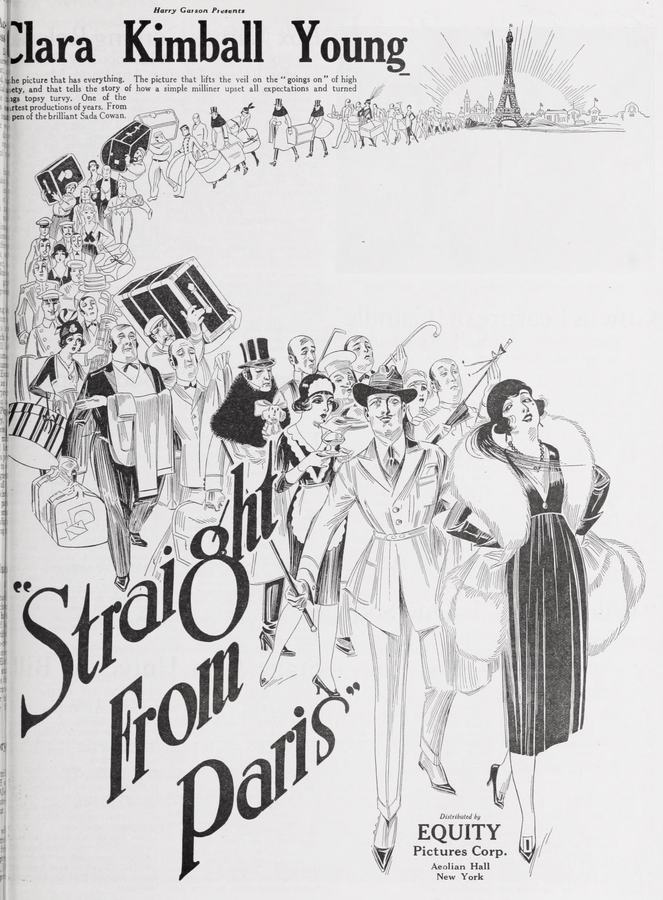
In the burgeoning landscape of early 1920s cinema, few films captured the anxieties of the American nouveau riche with as much surgical precision as Straight from Paris. Directed by Harry Garson and penned by the formidable Sada Cowan, this silent feature serves as a fascinating artifact of a time when 'European' was synonymous with 'elevated.' The film operates on a foundational irony: the very sophistication that the American aristocracy craves is often a mask for the very labor-class origins they despise. Clara Kimball Young, portraying the enigmatic Lucette, delivers a performance that is both luminous and deeply grounded, navigating the treacherous waters of social performance with a grace that suggests the character is more 'authentic' than the elites who judge her.
The plot, while seemingly straightforward, is a labyrinth of psychological posturing. When the young protagonist returns from his grand tour with Lucette, he isn't just bringing home a wife; he is bringing home a trophy of cultural acquisition. However, the revelation of her background—a shoe store clerk—acts as a catalyst for a visceral reaction from the matriarch, played with chilling rigidity by Clarissa Selwynne. This isn't merely a disagreement over a wedding; it is a defensive maneuver to protect the sanctity of the family's social capital. It reminds one of the economic struggles depicted in The Ten Dollar Raise, where the disparity between perceived worth and financial reality creates a constant state of friction.
The domestic space in Straight from Paris is treated as a battlefield. The mother’s refusal to sanction the engagement is presented not as a maternal whim, but as a structural necessity. In her eyes, a woman from a 'good' family is a pillar; a shoe clerk is a crack in the foundation. This rigid adherence to pedigree mirrors the social stratification seen in Worlds Apart, where the boundaries of class are treated as immutable laws of nature. The film excels at showcasing the micro-aggressions of the upper class—the way a glance can diminish a person, or how a silence can be used as a weapon of ostracization.
Sada Cowan’s writing shines in these moments of high-tension etiquette. She understands that the real drama isn't in the shouting, but in the subtle shifts of power during a dinner service or a formal introduction. The dialogue intertitles are sharp, avoiding the florid sentimentality of many contemporary silents. Instead, they pierce the veil of politeness to reveal the cold, calculating heart of the social climber. The film’s pacing allows these moments of social horror to breathe, forcing the audience to sit with the discomfort of Lucette’s predicament.
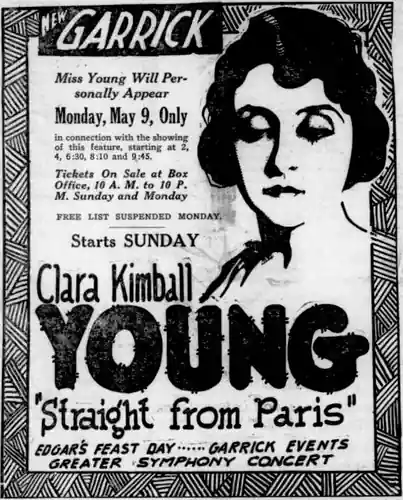
Perhaps the most compelling element of the narrative is the character of the uncle, played by Thomas Jefferson. Initially introduced as the voice of reason and a potential bridge between the warring factions, his arc takes a turn that is both unexpected and deeply human. As he attempts to convince the mother of Lucette’s inherent worth, he finds himself falling under the very spell he was meant to analyze. This development shifts the film from a social satire into a more complex exploration of desire and the fluidity of affection. It echoes the intense emotional entanglements found in Playthings of Passion, where the heart’s impulses frequently collide with societal expectations.
Jefferson’s performance is nuanced, capturing the transition from paternalistic protector to a man haunted by a late-blooming infatuation. This subplot adds a layer of 'forbidden' tension to the film. Is his desire for Lucette a genuine connection, or is it another form of the same 'Parisian' fetishization that brought her to America in the first place? The film doesn't provide easy answers, which is a testament to its narrative maturity. It acknowledges that even the most well-meaning 'allies' in a class struggle can have their own self-serving motivations.
Visually, Straight from Paris utilizes light and shadow to demarcate the different spheres of Lucette’s existence. The scenes set in the family mansion are characterized by a stagnant, heavy opulence—the camera lingers on the ornate furniture and the stiff costumes, emphasizing the suffocating nature of this environment. In contrast, the flashbacks or mentions of her life in Paris (and even the shoe store) possess a kinetic energy that feels far more vital. This visual dichotomy reinforces the film’s central theme: that the 'high' life is often a tomb, while the 'low' life is where actual living occurs.
The cinematography during the uncle’s realization of his feelings is particularly striking. The framing becomes tighter, more intimate, isolating him from the grand rooms he inhabits. This visual isolation mirrors his internal state, as he becomes a stranger to his own family’s values. It is a technique often employed in more suspenseful fare, such as The Phantom Foe, to indicate a character’s psychological descent. Here, it serves to humanize a man caught between his duty to his class and his burgeoning love for an 'outsider.'
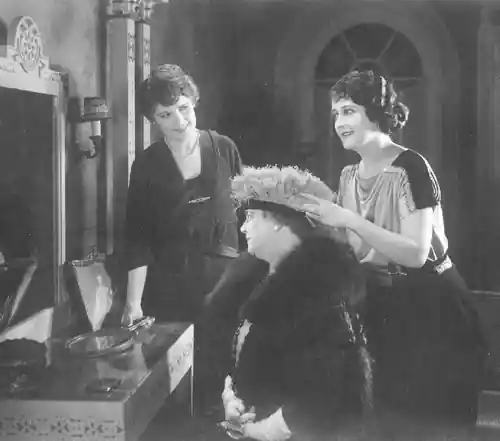
When comparing Straight from Paris to other films of the era, such as Big Jim Garrity or Crack Your Heels, one notices a distinct lack of melodrama in Garson’s work. While many films of 1921 relied on external threats—villains, accidents, or physical peril—this film finds its stakes in the internal and the interpersonal. The 'villain' is not a person, but a system of belief. The mother isn't evil; she is simply a zealous adherent to a code that no longer serves the world around her.
Sada Cowan was a writer who understood the power of the subtext. In Straight from Paris, she avoids the trap of making Lucette a victim. Instead, Lucette is a woman of agency who navigates her situation with a quiet intelligence. She doesn't beg for acceptance; she simply is. Her presence in the household acts as a mirror, reflecting the insecurities and prejudices of the 'better' people around her. This level of character depth is rare for the period and points toward the more complex female protagonists of the later 20s and 30s.
The resolution of the film is equally sophisticated. It avoids a clean, saccharine ending in favor of something more ambiguous. The uncle’s feelings are not dismissed as a mere plot device but are allowed to linger, casting a shadow over the eventual union of the young couple. This complexity ensures that the film remains relevant to modern audiences, who are all too familiar with the ways in which class and desire continue to intersect in messy, unpredictable ways. It lacks the simplistic moralizing found in films like Jewel, opting instead for a gritty, albeit polished, realism.
Ultimately, Straight from Paris is more than just a romantic comedy; it is a document of a society in transition. It captures the moment when the old world of hereditary titles and 'good' families began to crumble under the pressure of a new, more meritocratic (or at least more fluid) social order. Clara Kimball Young’s performance remains a highlight of the silent era, providing a masterclass in how to convey complex internal states through subtle physicality and expressive eyes.
For those interested in the evolution of the social drama, this film is essential viewing. It stands alongside works like Blindfolded or The Wolf of the Tetons as a testament to the diversity of storytelling in the early 1920s. Whether it’s the biting satire of the mother’s snobbery, the tragicomic plight of the uncle, or the quiet strength of the 'Parisian' clerk, the film offers a rich tapestry of human experience that transcends its silent origins. It is a reminder that while fashions change and the world moves on, the fundamental conflicts of the human heart—and the human ego—remain remarkably consistent.
IMDb 5.2
1936
Community
Log in to comment.