DbcultAccessing Vault...
Cult Review
Senior Film Conservator
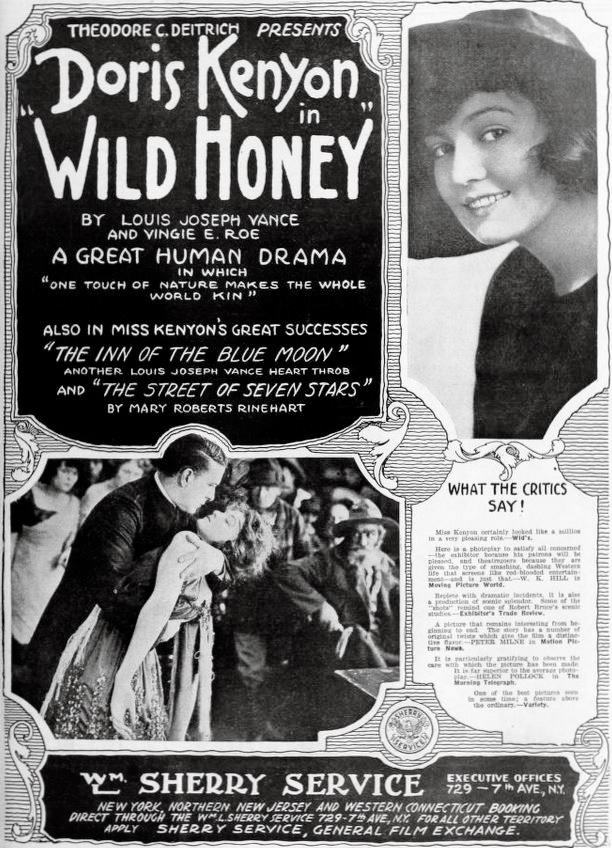
Wild Honey is not merely a film—it is an incantation, a silent but seismic shift in the landscape of early American cinema. Directed with a deft touch by Vingie E. Roe and Louis Joseph Vance, it marries the austere moral frameworks of 19th-century parables with the visceral urgency of modernist storytelling. The film’s central tension—a minister’s struggle to reconcile his vocation with a forbidden love—resonates with the same tautness as Legion of Honor, yet its emotional cadence is uniquely its own, a lullaby of contradictions.
The film’s structure is a Russian doll of narratives, each layer peeling back to reveal the next in a sequence of escalating stakes. Letty Noon’s introductory sequence—her hesitation to wed Rev. David Warwick—serves as a prologue to the parable of Jim Brown and Wild Honey. This meta-narrative device, reminiscent of Her Own People, elevates the film from mere melodrama to a meditation on the cyclical nature of moral dilemmas. The Holbrooks’ parlor, with its heavy wood paneling and dim lighting, becomes a stage for both retrospection and prophecy, the past and present converging in a chiaroscuro of emotions.
Doris Kenyon, as Wild Honey, embodies a paradox: a woman of the streets whose soul is rendered with the delicacy of a Renaissance Madonna. Her every movement is a language of defiance and yearning, a contrast to Nellie King’s more restrained portrayal of Letty Noon. Frank Mills, as Rev. Jim Brown, navigates the tightrope between sanctity and vulnerability with a grace that recalls the performances in Kärleken segrar. His physicality—tense shoulders, averted gaze—conveys the spiritual conflict that words could not articulate.
At its core, Wild Honey interrogates the boundaries between piety and passion. The town of miners, a microcosm of societal decay, is juxtaposed against the sanctified halls of the Holbrooks’ home. This spatial opposition mirrors the internal battles of its characters, particularly Jim Brown, whose sermons on redemption are rendered hollow by his own human failings. The film’s climax—a bullet-deflecting act of love—transcends the didacticism of early cinema, offering instead a visceral, almost pagan celebration of life’s tenacity.
The film’s visual grammar is a masterclass in economy. Long takes linger on the texture of Wild Honey’s dress, the flicker of a candle in the parlor, the sweat on a miner’s brow—each detail a cipher for deeper emotions. The use of negative space in scenes between the reverend and the dance hall girl is particularly striking, their silences speaking volumes in a way that would later echo in the works of In the Python’s Den. The score, though absent in the silent tradition, is evoked through the interplay of light and shadow, a chiaroscuro that guides the viewer’s emotional pulse.
Wild Honey’s enduring relevance lies in its unflinching exploration of moral ambiguity. It is a film that refuses to sanitize its characters, allowing both Jim Brown and Wild Honey to exist in the gray areas of human behavior. This complexity distinguishes it from contemporaries like A Mother’s Sin, which often sought clear-cut moral resolutions. The film’s final tableau—the reverend and Wild Honey growing old in a new town—suggests not a conclusion but a continuation, an acknowledgment that love and duty are not finite but evolving forces.
Wild Honey shares thematic DNA with Der Bär von Baskerville, though its focus on personal redemption over external mystery sets it apart. Similarly, its emotional intensity rivals that of The Martyrdom of Philip Strong, yet its resolution is far less didactic. The film’s exploration of societal judgment through the lens of a frontier town also finds parallels in Sloth, though Wild Honey’s tone is more lyrical in its despair.
Wild Honey is a film that demands to be revisited, its layers of meaning unfurling with each viewing. It is a testament to the power of silent cinema to convey the full spectrum of human emotion without the crutch of dialogue. In an age where modern films often prioritize spectacle over substance, Wild Honey stands as a quiet rebellion, a reminder that the most profound stories are those that dwell in the spaces between light and shadow, between duty and desire. For those who seek not just to watch but to feel, this film is an invitation to step into a world where every glance, every pause, is a universe of its own.
IMDb —
1924
Community
Log in to comment.