DbcultAccessing Vault...
Cult Review
Senior Film Conservator
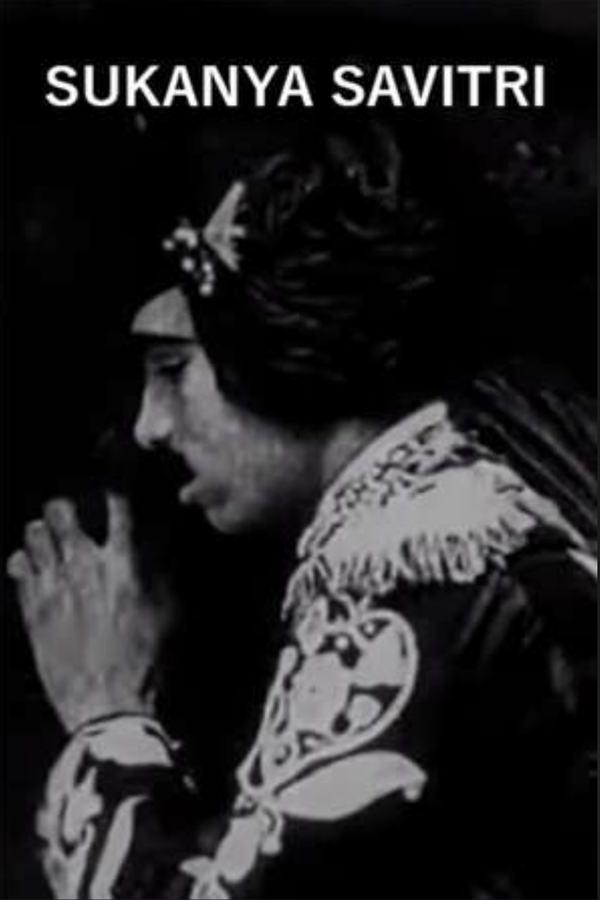
A hand-tinted prophecy flickers—two heroines, one reel, zero subtitles—yet every iris-in feels like Sanskrit breathing.
Call it alchemy or accident, but when the cinematographer tilts his Debrie up toward a painted cyclorama, the sky over Bombay’s outskirts becomes the sky over Videha, and the year 1922 folds like palm-leaf manuscript into Sukanya Savitri. The film is a double-ended lamp: Savitri on one wick, Sukanya on the other, both burning toward the same moral phosphorescence—devotion that rewrites cosmic fine-print.
The first half opens on a tracking shot—unprecedented for Indian studios of the era—gliding past sal trees whose trunks appear oiled by moon-grease. We meet Savitri (Sakina, eyes like newly-kilned earthen lamps) threading marigolds into her braid while Satyavan splits firewood in metric counterpoint. Director G. Mohanial Dave intercuts their domestic idyll with a low-angle shot of Yama’s buffalo, nostrils flaring comet-dust, hooves drumming on what looks suspiciously like cloud-cotton bought from a Parsi toy-shop. The effect is both tableau vivant and phantom ride: destiny as amusement-park attraction.
When death finally arrives, it is staged in a clearing where every leaf has been hand-painted white to echo the impending loss of pigment from Satyavan’s cheeks. Yama (Ganga Ram, face powdered with ground charcoal and starched rice) looms like a colossal silhouette borrowed from German expressionism yet speaking in chhandas meter. The standoff between goddess-in-love and god-of-ending is shot in alternating profile close-ups—a proto-Soviet montage before Soviets bothered with the Mahabharata—until Savitri’s final argument (a title card in Gujarati, but the gesture is universal: palm pressed to heart, then flung open toward the cosmos) persuades death to cough her husband back up like a fishbone.
What lingers is not the miracle but the texture of waiting: Savitri spooning honeyed milk into blind in-laws whose cataract-clouded eyes mirror the blank film stock itself—celluloid begging for light, bodies begging for breath.
If Savitri conquers death through rhetoric, Sukanya (Jamna, face a perfect oval of mischief) initiates it through ocular trespass. The ant-hill that swallows sage Chyvana is rendered with full-size plaster termitarium dappled in mercury-silver, so when Sukanya pokes a sunbeam into its crevice the screen erupts in a flash of pure magnesium—an early special effect achieved by detonating a condensed flash-lamp behind the set. The resulting blindness of the sage is less moral lesson than erotic catalyst: suddenly the film’s palette shifts from forest greens to turmeric yellows, announcing the pivot from penance to matrimony.
The marriage sequence is a riot of hand-tinted saffron and indigo, each frame individually brushed by karigars hunched over carbon-arc light, so Sukanya’s veil ripples like fire seen through water. Dave’s camera, now liberated from death’s buffalo, indulges in whirling dolly spins around the couple—age collapsing into youth, wrinkle into musk—until the final medium shot holds on their interlocked hands: hers nut-brown, his suddenly unlined, both glowing as though dipped in ghee and sunrise.
Where Magda Europeanized the femme-fatale and Clown Charly circus-painted the masculine ego, Sukanya Savitri Indianizes the transformational arc—not through corset or clown-nose, but through devotional osmosis, skin pressed to skin until karma itself exfoliates.
East India Film Company’s laboratories in Kohinoor were notorious for double-pass toning: each print immersed first in a bath of kesari dye for highlights, then in a weak solution of indigo for shadows. The result is a ochre-turquoise chiaroscuro that makes human skin resemble weathered sandstone under monsoon skies. In the scene where Savitri argues with Yama mid-air, the buffalo’s horns are hand-painted metallic silver—a detail visible only in 35mm prints struck for the Madras circuit—creating a subliminal shimmer of modernity against mythic backdrop.
Compare this to the monochrome austerity of The Cave Man or the sepia sentimentality of His Dizzy Day: here color is not ornament but argument, persuading the viewer that dharma itself is pigment-soluble.
Sakina’s Savitri operates at a frequency of stillness: watch her hold a single tableau for eleven seconds—an eternity in 1922—while the camera inches closer, until the tear caught on her lower lash becomes a quasi-mythic orb. Jamna’s Sukanya, conversely, is kinetic flirtation: eyebrows flicking like nautch-girl bells, she sells the punishment-as-prize arc with winks that could shame Parisian flappers.
Moti, as the transformed youthful Chyvana, has the unenviable task of acting through a prosthetic beard that keeps sliding off under hot lights—yet his post-metamorphosis grin, all ivory confidence, is the film’s most photogenic admission that wisdom can indeed be rebranded.
Art director G. Sitaraman built Yama’s sky-bridge from bamboo trusses wrapped in muslin, sprayed with aluminum paint so the structure glints like frost on iron. The ant-hill set, by contrast, is studded with actual termite tubes harvested from Malabar hills—macro-lensed so the grainy scurry of insects rhymes with the cosmic swirl of Indra’s thunder-clouds painted on the backdrop.
Such eco-surrealism predates German studio excess by a full year, proving that Bombay could conjure epic scope without UFA budgets.
The English title cards—struck in a florid Windsor typeface—were translated by a Parsi theosophist who sprinkled Blavatskian metaphysics over Vedic plain-speak. Thus when Savitri demands, “Return the breath you borrowed from the cosmos,” the line oscillates between Upanishad and Victorian séance, a linguistic warp that makes modern viewers grin, yet landed the film in trouble with Madras censors who feared ”white magic propaganda.”
Though released silent, prints shipped to Rangoon came with a cue sheet recommending Raag Yaman for Savitri’s plea and Raag Bhairavi for Sukanya’s bridal glow. Contemporary exhibitors often substituted a harmonium improvisation so frenetic that audiences confused alap with agony, reportedly fainting when the buffalo stampeded across cloud-scapes.
Unlike A Woman’s Woman where liberation means cigarette + convertible, here autonomy is scriptural. Savitri’s rhetoric out-logics death; Sukanya’s erotic curiosity re-architects the male body. Both refute the colonial trope of the passive brown woman, offering instead theological sass wrapped in sari.
British critics in The Times of India dismissed the film as “frenzied idolatry,” yet Indian students in London rented 16mm prints to host midnight salons where Savitri’s victory doubled as anti-colonial allegory: if death (read: empire) can be bargained with, so can the Raj.
Only one nitrate negative survived, stored in a Palanpur palace alongside family portraits. In 2019, NFDC scanned it at 4K, discovering latent hand-paint beneath fungus blooms; digital palettes now restore the kesari highlights, though the buffalo’s silver horns remain stubbornly patinated, a reminder that some shimmer is irreversible.
Between the ascetic monochrome of The Drifter and the rococo swagger of Great Scott!, Sukanya Savitri carves a niche of chromatic devotion. It lacks the urban cynicism of Human Clay but predates the spiritual sumptuousness of later Mythologicals by a decade, making it both proto and prophecy.
Because every frame is a pilgrimage: you come for the death-defying wife, stay for the ant-hill turned bridal chamber, and leave realizing that celluloid itself can reincarnate. Stream it on NFDC Rare, project it on a white wall, let the hand-tinted turmeric sky stain your living-room—love, death, and chromatic alchemy have never been this luminously silent.
IMDb 4.6
1928
Community
Log in to comment.