DbcultAccessing Vault...
Cult Review
Senior Film Conservator
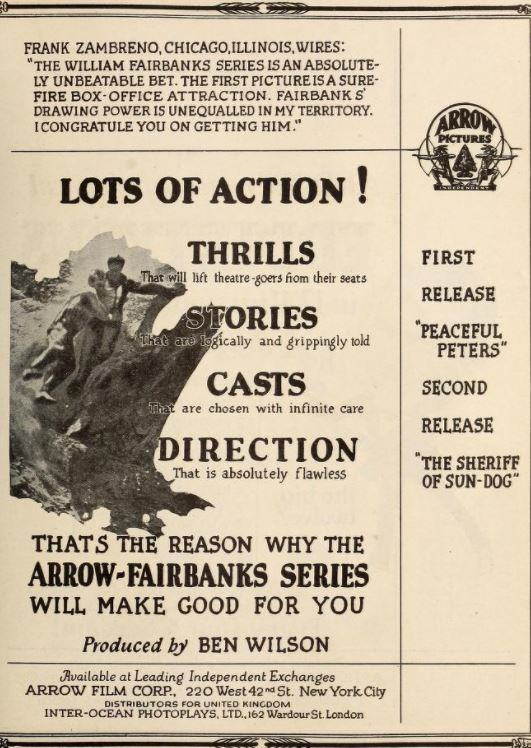
Sun Dog Trails, a 1926 Western starring William Fairbanks and Florence Gilbert, unfolds like a slow-burning fuse in a tinderbox of moral ambiguity. Directed by W.C. Tuttle, the film masterfully balances genre conventions with psychological nuance, creating a narrative that lingers long after the credits roll. At its core lies Dave Richards, a man whose every action is steeped in the duality of heroism and self-preservation.
The film’s opening scene—a stagecoach held up in the desolate town of Sun-Dog—sets the tone with a visual economy that speaks volumes. The empty coach, a silent witness to impending chaos, foreshadows the entanglement of fate that binds Richards to Scott Martin, the estranged father of his beloved Jean. This setup is both classic and inventive, leveraging the Western genre’s love of lone riders and redemptive arcs while subverting expectations through its layered character dynamics.
The relationship between Richards and Silent Slade, played with steely intensity by Ashton Dearholt, is a masterclass in unspoken tension. Their camaraderie is laced with an undercurrent of rivalry, each man measuring the other’s loyalty to the code of the frontier. The film’s greatest strength lies in its ability to humanize its characters without sacrificing the raw, unfiltered grit of the Old West. Jean Martin, portrayed by Florence Gilbert, is not merely a damsel in distress but a figure of quiet resilience, her interactions with Richards revealing a depth that transcends the era’s typical gendered tropes.
Director Tuttle’s use of landscape is nothing short of revelatory. The vast, sun-bleached plains and jagged hills serve as both backdrop and character, their harsh beauty mirroring the internal struggles of the protagonists. The cinematography, though constrained by the technology of the time, employs high contrast lighting to dramatic effect, casting characters in pools of shadow and light that symbolize their moral complexities.
Sun Dog Trails sits comfortably alongside other early Westerns like Pawn Ticket 210 and Straight Is the Way, yet distinguishes itself through its focus on interpersonal conflict rather than mere action set pieces. The script by W.C. Tuttle and Daniel F. Whitcomb avoids the melodrama that plagues many films of the period, opting instead for a taut, dialogue-driven narrative that prioritizes character over spectacle. This approach is particularly evident in the scenes between Richards and Jean, where unspoken emotions and glances convey as much as the spoken word.
The film’s exploration of justice is particularly prescient. The sheriff’s complicity in the gang’s schemes and Richards’ decision to withhold the incriminating note raise questions about the legitimacy of authority in a lawless land. This theme resonates with modern audiences, echoing contemporary debates about institutional corruption and individual accountability. The resolution—where Richards and Slade capture the gang not through brute force but through strategic cunning—underscores the film’s progressive leanings, a rarity in the hypermasculine tropes of 1920s cinema.
William Fairbanks, known for his roles in films like Guilty of Love, delivers a nuanced performance as Richards, balancing stoicism with moments of vulnerability. His chemistry with Florence Gilbert is palpable, their on-screen connection providing the emotional throughline that ties the film together. Gilbert’s portrayal of Jean is a standout, her quiet strength a counterpoint to the more bombastic performances of her male co-stars.
Ashton Dearholt’s Silent Slade is a fascinating character study in restraint. His minimal dialogue—delivered with a clipped, deliberate cadence—speaks volumes about his role as Richards’ foil. The supporting cast, including Jim Welsh as the conflicted Zell Mohr, adds depth to the narrative without overshadowing the leads. Welch’s performance is particularly noteworthy; his gradual descent into paranoia and desperation is portrayed with a subtlety that elevates the film’s central conflict.
Tuttle’s direction is marked by a keen understanding of pacing. The film’s second act, which sees Richards fleeing into the hills, is a masterclass in tension-building. The use of wide shots to emphasize Richards’ isolation is juxtaposed with tight close-ups during moments of decision-making, creating a visual rhythm that mirrors the protagonist’s internal state.
The editing, though rudimentary by today’s standards, is effective in its simplicity. Cross-cutting between Richards’ escape and the sheriff’s investigation maintains a sense of urgency without overwhelming the viewer. The sound design—limited as it is to the era’s capabilities—uses ambient noise (the creak of wagons, the whistle of the wind) to enhance the film’s immersive quality.
Sun Dog Trails also benefits from its historical context. The 1920s saw a shift in Westerns from silent era romanticism to a more grounded realism, a trend this film exemplifies. Its themes of individual justice versus institutional corruption prefigure later works like Dead Eye Jeff, yet it stands on its own as a product of its time. The film’s influence can be seen in the morally complex protagonists of mid-century Westerns, a testament to its enduring relevance.
The film’s final act—a daylight showdown that avoids the clichés of blood-soaked gunfights—chooses resolution over catharsis. Richards’ embrace of Jean is not a triumphant conclusion but a quiet acknowledgment of the cost of their choices. The sheriff’s removal of the gang from the town is a pragmatic solution, not a moral victory, leaving the audience to ponder the true nature of justice in a world where right and wrong are rarely clear-cut.
For modern viewers, Sun Dog Trails serves as both a window into early cinema and a timeless meditation on human resilience. Its exploration of loyalty, betrayal, and moral ambiguity remains strikingly resonant, a testament to the skill of its creators. While it may lack the visual flair of later Westerns, its narrative depth and character-driven storytelling ensure its place among the genre’s more thoughtful entries.
For enthusiasts of classic cinema, Sun Dog Trails is a must-watch. Its blend of historical authenticity and psychological depth offers a refreshing contrast to the often-over-the-top melodrama of its contemporaries. Whether you’re a fan of the Western genre or simply appreciate the artistry of early film, this is a work that rewards careful attention and repeated viewings.
IMDb —
1914
Community
Log in to comment.