DbcultAccessing Vault...
Cult Review
Senior Film Conservator
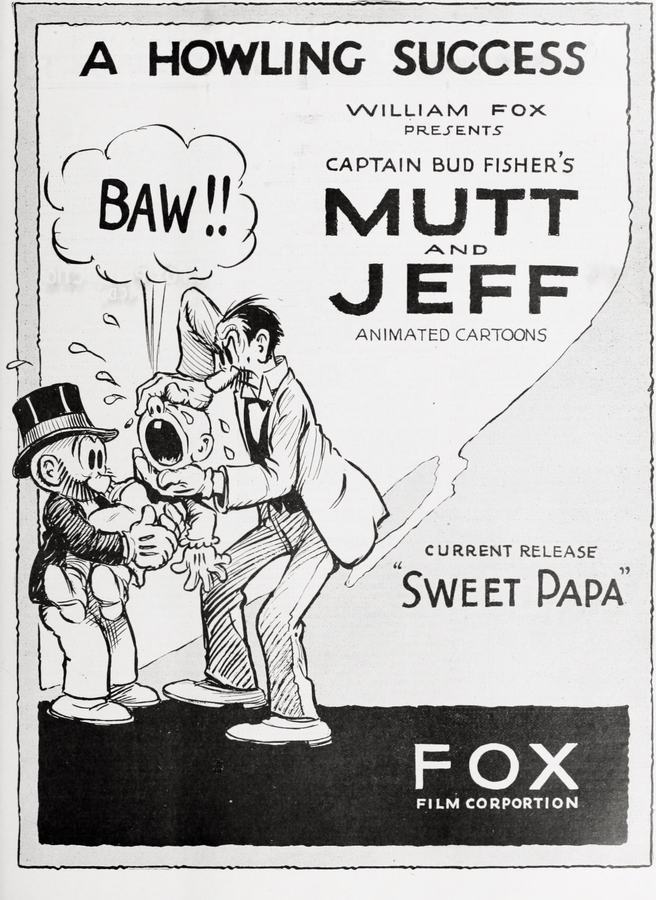
Bud Fisher’s one-reel curio Sweet Papa lands like a cat tossed through a stained-glass skylight: all shards, shine, and yowling surprise.
Filmed in the same year the 19th Amendment was ratified and the American patent office was choking on applications for every imaginable mechanical cradle, the short feels—at first glance—like a throwaway doodle. Yet beneath its jittery, under-cranked surface lies a sardonic X-ray of a culture trying to litigate its way out of entropy. Fisher, syndicate cartoonist turned celluloid prankster, translates his two-panel-strip timing into a kinetic haiku: gag, counter-gag, blackout. The result is a miniature masterpiece that lampoons the infantilization of the consumer age while simultaneously indulging in the most infantile humor possible.
The set is a claustrophobic box of scuffed wainscot, a single window admitting a rectangle of overexposed daylight that makes every fleck of dust a tiny meteor. Into this aquarium struts the unnamed widow—played with proto-screwball verve by an uncredited actress whose kohl-rimmed eyes could launch a thousand affidavits. She brandishes blueprints that resemble a cross between a baby’s mitten and a coal furnace. Her pitch: strap the squall stopper to any bawling brat and presto, serenity via “scientific suction and harmonic vibration.” The phrase itself is Fisher’s send-up of the era’s pseudoscientific advertising cant, the same lexicon that sold vibratory belts to flappers and radioactive water to anxious husbands.
Matt—towering, all elbows—snatches the parchment, eyes dollar signs; Jeff—pudgy, perpetually behind the eight-ball—attempts to read the fine print and smacks his forehead on the edge of the roll-top desk. The collision is so precisely timed it feels like a metronome set to the heartbeat of Fate. From here the film becomes a fugue of escalation: every attempt to formalize the invention sends the office into deeper disarray. Inkwells upend over starched collars; law books become stepping stones across an imaginary stream; the secretary’s typewriter ribbon tangles around Jeff’s neck like a silk noose. The gags are elementary, yet Fisher’s framing—often diagonal, so the chaos spills toward the viewer—makes each pratfall feel like a breach of the fourth wall.
Mid-reel arrives the set-piece: the “demonstration.” A neighbor’s colicky infant is hauled in, red-faced, lungs primed. The widow produces the squall stopper—essentially a rubberized muzzle with a rubber bulb that, when squeezed, creates a vacuum seal. What follows is a ballet of escalation worthy of Keaton. Mutt squeezes, the bulb implodes, the baby’s howl drops an octave, then rebounds with operatic fury. Jeff, attempting to adjust the fit, accidentally yanks the bulb free; it ricochets off the ceiling fan, boomerangs, and smacks Mutt in the eye. The camera ling—not on the violence, but on the instant of silence that follows, a beat so pure it feels almost sacrilegious. In that hush, the film exposes its real subject: not a gadget but the terror of adult impotence before a child’s ungovernable emotion.
The widow, undeterred, produces a second model—this one with a built-in phonograph intended to distract the child with lullabies. Fisher cranks the handle; instead of Brahms we get a blistering ragtime riff. The baby’s wails syncopate with the piano, creating an accidental jazz duet that anticipates the coming sound era. It’s a moment so anarchic it loops back around to genius: the first documented instance, perhaps, of a soundtrack being born inside the diegesis of a silent film.
Having failed to silence the child, the attorneys pivot to the only language they trust: paperwork. Mutt dictates a patent claim so florid it borders on incantation: “…an apparatus for the attenuation of infantile acoustic emissions via pneumatic resonance modulation…” Jeff, transcribing, misspells every third word, crosses out, overwrites, until the page resembles a demented ransom note. The visual gag is old as vaudeville, yet Fisher layers in a sly critique: the law, meant to codify human ingenuity, buckles under the weight of its own verbiage. The more precise the language, the more comically useless the document becomes.
They summon a notary—played by Fisher himself in a Hitchcockian cameo—who arrives wearing pince-nez and a toupee that seems to possess its own agency. The notary insists on reading the entire application aloud; each mispronunciation triggers a new round of spasmodic interruptions from the still-howling infant. Finally, Mutt stuffs the squall stopper into the notary’s mouth instead of the baby’s. Silence. Then a cut to the widow’s face: a rictus of triumph that curdles into horror as she realizes the device works only when misapplied. It’s a punch-line that skewers the cult of technocratic parenting: the remedy is worse than the malady, and the malady is us.
Fisher shot the entire film in two days on a shoestring leased from the remnants of Balboa Amusement. The camera never moves; depth is conjured via staggered blocking and the stark chiaroscuro of overhead Cooper-Hewitt mercury lamps. Yet within these constraints he engineers visual puns worthy of Eisenstein: the widow’s silhouette, framed against the window, morphs into a gallows when Mutt lifts the blueprint overhead; the shadow of the ceiling fan slices the frame into comic-strip panels, anticipating the split-screen gags of Stripped for a Million by a full decade.
The print quality on contemporary restorations is speckled like a starling’s egg, but the blemishes enhance the texture; each scratch feels like a fingerprint from a vanished era. The intertitles—hand-lettered by Fisher—use a jittery baseline that mirrors the characters’ nervous energy. When the final intertitle reads “Patent Pending—Morals Optional,” the letters wobble as if laughing at their own impudence.
Buried beneath the custard-pie chassis is a sly commentary on post-suffrage gender politics. The widow is no hapless supplicant; she commands the narrative, weaponizing maternal anxiety as entrepreneurial leverage. Her costume—a drop-waist dress with a daring knee-length hem—signals modernity, yet her cloche hat hides curlers, hinting at domestic labor still unpaid. The attorneys, emasculated by their inability to pacify one small human, resort to bureaucratic theater. The film’s truest invention is not the squall stopper but the widow’s smirk when she pockets their retainer: a moment of economic transgression as sharp as any pickpocket’s lift.
Compare her to the suffering maternal icons in The Mother Instinct or the sacrificial martyr of The Woman Thou Gavest Me; Fisher’s heroine neither dies nor repents. She exits the frame humming, patent in purse, leaving two men dazed under a confetti of legal briefs. It’s a feminist coup disguised as slapstick, so subtle it almost slips past unnoticed.
Because the film is silent, the baby’s cry exists only in the viewer’s mind—a phantom soundtrack more piercing than any audible wail. Fisher exploits this absence brilliantly. Each time the widow brandishes the squall stopper, he cuts to a close-up of the rubber bulb throbbing like a dying heart. The viewer fills the gap with remembered infant shrieks, a synesthetic jolt that makes the contraption’s failure feel personal. When the final silence arrives, it lands not as relief but as uncanny void, the same hollow sensation left by the abrupt end of a lullaby.
In tone, Sweet Papa dovetails with the domestic anarchy of The Grocery Clerk, yet its legal milieu nods toward the contractual obsessions of The Promise. Where Out of the Shadow moralizes over urban poverty, Fisher refuses pity; where Don Quixote romanticizes delusion, he satirizes solutions. The result is a cinematic pocket-watch whose gears squeak yet keep perfect comic time.
Modern viewers, weaned on CGI and adrenalized pacing, may initially dismiss the film as quaint. Persist. The rhythm of Fisher’s gags—set-up, inversion, exponential catastrophe—prefigures the mathematics of Looney Tunes. One can trace a straight, if kinked, line from Mutt’s eye-roll to Daffy Duck’s beak-spin. Moreover, the film’s skepticism toward technocratic parenting anticipates the anxious blogs of today: the same yearning for gizmos to soothe the existential ache of child-rearing, the same commercial vultures circling.
Archival sightings remain scarce; most prints circulate among private collectors and the occasionally enterprising cinematheque. If you snag a ticket, expect to share the auditorium with avant-garde musicians eager to supply live accompaniment—usually toy pianos and kazoos, a choice Fisher would have applauded for its impertinence.
Great comedy distills dread into delight; Sweet Papa distills the dread of modernity into a rubber bulb that squeaks. It won’t stop a baby from crying, but it might stop you from taking your own contraptions so seriously. And if, after the lights rise, you find yourself humming a ragtime lullaby to an imaginary infant, congratulations—you’ve just been fitted with the one patent that actually works: the cinema’s timeless squall stopper.
IMDb —
1926
Community
Log in to comment.