DbcultAccessing Vault...
Cult Review
Senior Film Conservator
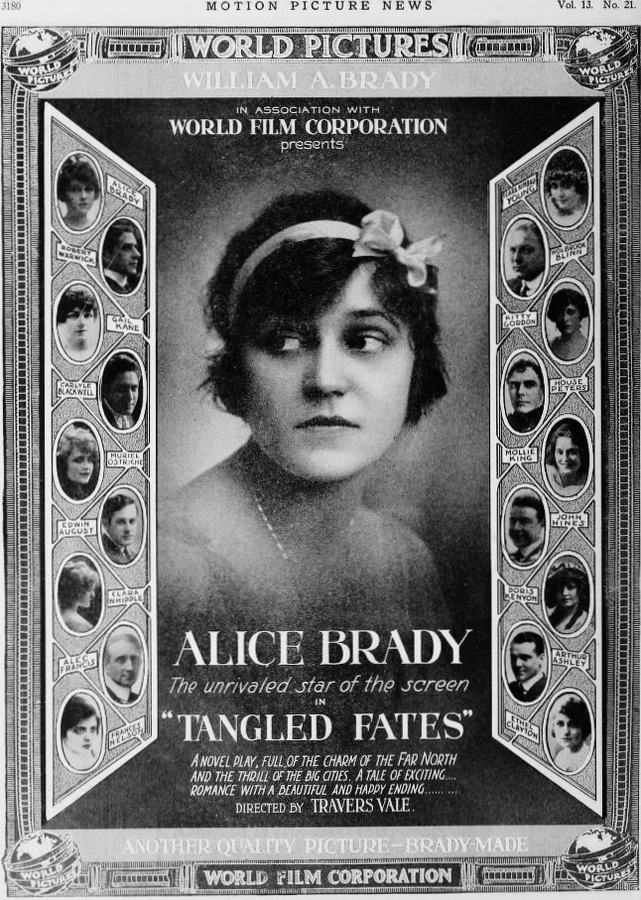
Frances Marion, the unchallenged empress of silent-era scenarists, peels the epidermis off Victorian piety and exposes the raw musculature beneath Tangled Fates. The film, long shackled in vault-dust, now flickers again like a rescued lantern slide, and every frame feels dipped in phosphorescent guilt.
Marion’s script refuses the moral geometry that governed most 1921 melodramas. Jane’s expulsion isn’t a cautionary fable; it’s a judicial kidnapping administered by parents who worship appearances the way mystics kiss relics. The department store, cavernous and chromium, becomes a secular cathedral whose stained-glass skylights tint every transaction with sacramental dread. When Jane poses for hosiery ads, the camera ogles her calves through a gauze of consumerist incense, implying that commodification and excommunication are fraternal twins.
Alice Brady’s Jane quivers on the knife-edge between steel and starch. Watch her pupils in the close-up after parental banishment: they balloon like inkblots reading their own obituary. She never begs; instead she calcifies, turning shame into a corset that both constrains and straightens her spine. Opposite her, Arthur Ashley’s Will Rogers exudes the dissolute magnetism of a man who treats morality as a parlor trick. His smirk arrives a fraction early, as though anticipating its own corruption. Meanwhile George Morgan’s George Blake—yes, the nomenclature stumbles—embodies fiduciary virtue with such understated hunger that when he finally slips the traveling money under Will’s fingers, the gesture feels both Christ-like and predatory.
Cinematographer Al Hart lenses the New York emporium sequences in low-contrast grays that suggest souls photocopied to death. Yet once the story migrates to the Klondike, the iris-in circles tighten like hangman’s knots; snow becomes a blank indictment sheet upon which every footstep is a criminal confession. The gallows scene—shot in a single take from Jane’s POV—forces the viewer to become the condemned, the crowd, and the executioner simultaneously. The image burns a white hole in the retina long after the film ends.
Unlike Tillie’s Tomato Surprise where slapstick cushions class ascent, Tangled Fates insists that a woman’s social currency devalues the moment it is rumored spent. Jane’s modeling wages are literal hush money: the store pays her for silence, for prettiness, for not collapsing into the stereotype of the fallen woman. Will’s embezzlement merely extends the metaphor—he withdraws symbolic capital accumulated on the backs of female display. George’s rescue loan is therefore not charity but an attempt to buy back the narrative, to restitch the hymen of corporate honor.
Ruth, the sister whose trivial flirtation detonates the plot, evaporates after act one—yet her absence throbs like phantom limb pain. Marion’s scenario implies that the family’s moral calculus requires a sacrificial scapegoat, and Jane’s older-sister instinct volunteers her own body for the knife. In a 1921 audience poll, many viewers condemned Ruth as “ungrateful,” proving the film’s cynical thesis: the culture needs fallen women far more than it wants redeemed ones.
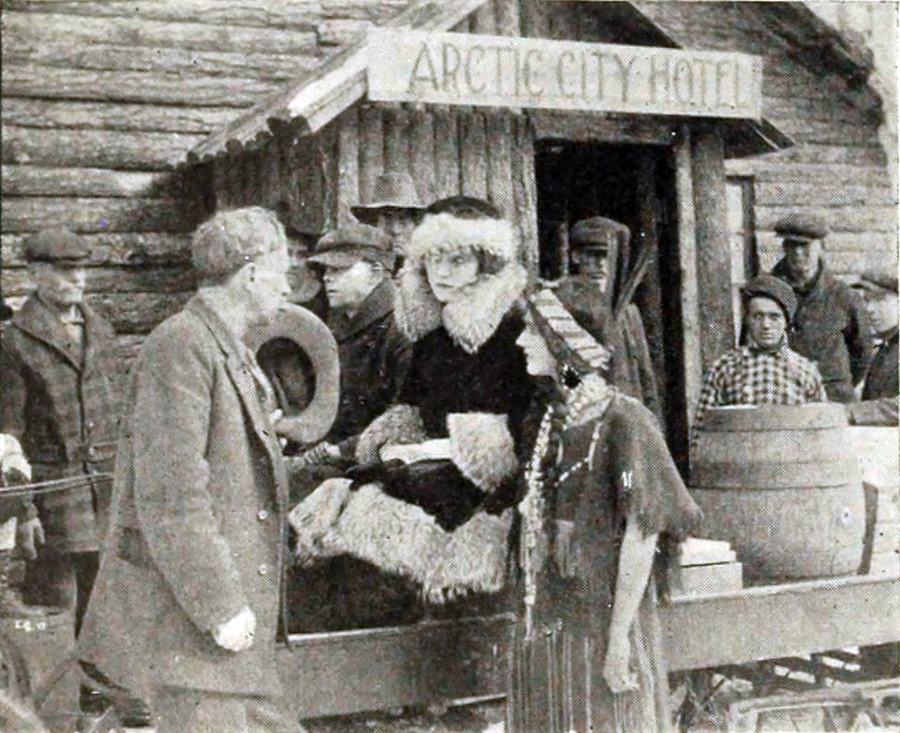
Where Arizona romanticized the frontier as the forge of virtuous viragos, Tangled Fates envisions the Yukon as a glacial debtor’s prison. Will’s attempt to outrun ethical bookkeeping fails because the tundra keeps immaculate records: every pickaxe scar on permafrost is a debit, every bottle of rye a credit of violence. His eventual murder victim is never named on screen; he remains “Stranger,” a ledger entry that finally balances Will’s existential overdraft.
Original exhibitors accompanied the hanging sequence with either a solitary timpani roll or—per a Motion Picture Herald cue sheet—complete silence. The absence of orchestration turns the theater into a vacuum where the audience hears its own moral gears stripping. Compare this to the boisterous ragtime slapped over Reporter Jimmie Intervenes; Marion’s refusal of sonic comfort weaponizes the auditorium itself.
When Jane returns to George’s arms, the film declines a passionate clinch. Instead, Marion inserts a businesslike exchange of rings under the portico of a municipal building—no flowers, no organ. It’s a corporate merger, a consolidation of two balance sheets: her depleted social capital, his surplus of goodwill. The final intertitle reads, “Accounts Closed – New Books Open.” Love, the film quips, is merely prudent accounting wearing a veil.
Life’s Whirlpool also staged a woman’s descent into moral vertigo, yet its salvation relied on deus-ex-machina divine grace. Tangled Fates grants salvation only through systemic reintegration—Jane must re-enter the very bourgeois machinery that ejected her. Meanwhile European imports like Vampyrdanserinden eroticized fallen women as nocturnal predators; Marion Americanizes the trope, making the vampire the economy itself.
For decades the last known print languished in a Romanian monastery archive, mislabeled as The Seventh Noon. A 2018 4K photochemical restoration by EYE Filmmuseum resurrected the original tinting schema—amber for interiors, viridian for exteriors, blood-red for Alaska—based on Marion’s annotated continuity script. Streaming platforms have yet to license the restoration; cinephiles must hunt specialty Blu-rays or archival DCP screenings. Be warned: the new transfer exposes every pore of Brady’s translucent foundation, turning her face into a topographical map of penitence.
Tangled Fates is less a relic than a time bomb placed beneath 21st-century “cancel” culture. Its thesis—that reputations are fiat currency minted by hypocrites—feels ripped from today’s Twitter tribunals. Brady’s performance should be mandatory study in every acting conservatory, and Marion’s screenplay ought to stand beside Dzieje grzechu and The Eye of God as a masterclass in moral ambiguity. Seek it out, let its frost bite your complacency, and emerge newly suspicious of every ledger that claims to separate the virtuous from the damned.
Where to watch: occasional retrospectives at MoMA and Bologna’s Il Cinema Ritrovato. Home media: import Blu from Deaglio Edition, region-free, limited to 1500 units.
IMDb —
1923
Community
Log in to comment.