DbcultAccessing Vault...
Cult Review
Senior Film Conservator
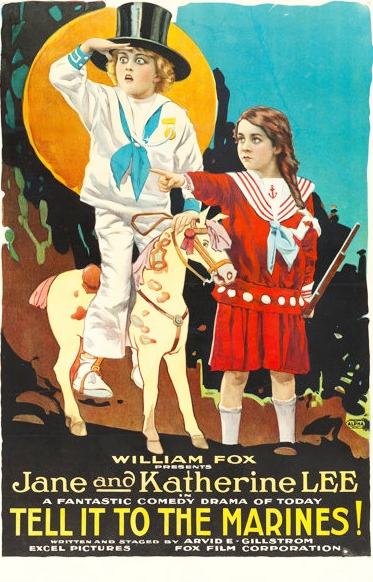
Stepping back into the nascent years of cinematic storytelling, one encounters films that, despite their often rudimentary technical execution by today's standards, offered profound glimpses into the contemporary psyche. Among these, 'Tell It to the Marines' (1918), a work attributed to the writing duo Adrian Johnson and Arvid E. Gillstrom, stands as a fascinating, if sometimes perplexing, artifact. It’s a film that eschews grand battlefields and heroic deeds for a more intimate, yet equally potent, exploration of conflict, filtered through the lens of childhood innocence. The narrative, deceptively simple, unfurls a complex tapestry of allegorical meaning, inviting viewers to ponder the nature of war, perception, and the subconscious mind.
The film commences not with the roar of cannons, but with the playful pandemonium of two young girls, Jane (Jane Lee) and Katherine (Katherine Lee), daughters of Harry Williams. Their day, a whirlwind of harmless pranks inflicted upon their father's unsuspecting servants and guests, paints a vivid picture of unbridled youth, a world defined by whimsy and immediate gratification. This initial sequence, though seemingly a lighthearted preamble, serves a crucial purpose: it establishes a baseline of innocence and domestic tranquility against which the subsequent dream sequence will starkly contrast. The performances by Katherine and Jane Lee, though undoubtedly constrained by the conventions of silent film acting, convey a genuine sisterly bond and the boundless energy of childhood. Edward Bagley and Charles Slattery, in their supporting roles, anchor the adult world, providing the stable, if sometimes exasperated, counterpoint to the children's antics.
It is in the quiet aftermath of this playful chaos, as the girls tumble into bed, that the film truly begins to unfurl its thematic core. Little Jane, her imagination still alight from a recent viewing of a World War I film, drifts into a dream that becomes the central conceit of 'Tell It to the Marines.' This is where the film transcends mere domestic drama and ventures into the realm of allegorical fantasy, a bold narrative choice for its era. The dream is a phantasmagoria, a surreal battlefield populated not by men, but by mechanical dolls. This particular creative decision is nothing short of inspired, transforming the brutal realities of war into a stylized, almost sterile, spectacle, yet one that retains its inherent horror through symbolic representation.
The mechanical dolls are not mere playthings; they are avatars of nations, embodying the warring factions with stark, almost propagandistic, clarity. Trik, leading the German contingent, is depicted as a harbinger of atrocities, a mechanical embodiment of malevolence. His army's actions are presented without ambiguity, aligning with the prevailing sentiment of the time regarding German culpability in the Great War. Conversely, Trak commands the Allied forces, portrayed as the righteous defenders, destined for ultimate victory. This binary opposition, while perhaps simplistic to a modern, nuanced understanding of historical conflict, was undeniably potent for contemporary audiences. It distilled the complex geopolitical landscape into a digestible moral fable, reflecting the urgent need for clarity and conviction during wartime.
The choice of mechanical dolls is particularly telling. It strips the combatants of their humanity, reducing them to cogs in a larger, impersonal machine of destruction. This dehumanization, while serving the practical purpose of allowing a child's dream to depict war without explicit gore, also subtly comments on the industrial nature of modern warfare itself. Soldiers, in the trenches of WWI, were often treated as expendable units, components in a vast, grinding mechanism. The dolls, therefore, become a powerful metaphor for the individual's diminished agency in the face of mechanized slaughter. The dream sequence, with its stark contrasts and symbolic figures, might even draw a parallel to other allegorical narratives of the era, though perhaps less overtly fantastical than the moralistic tales found in works like The Power of Evil, which often explored abstract concepts through human drama.
The film's impact, particularly during its initial release, must have been considerable. Released in 1918, a pivotal year in the Great War, it tapped directly into the collective consciousness, reflecting anxieties, hopes, and the pervasive influence of war news on even the youngest minds. The dream serves as a safe space for Jane to process the overwhelming information she has absorbed from the adult world, translating the incomprehensible horror of distant battles into a framework her child's mind can grasp. This psychological realism, embedded within a fantastical premise, gives 'Tell It to the Marines' a surprising depth. It’s not just a war film; it’s a film about how war permeates every aspect of society, even the innocent dreams of children.
From a cinematic perspective, 'Tell It to the Marines' is a fascinating study in early visual storytelling. While precise details on its technical specifications (like camera work, editing techniques, or specific sets) are elusive without direct access to the film itself, one can infer certain stylistic choices common to the era. Silent films relied heavily on exaggerated expressions, title cards for dialogue and exposition, and often symbolic imagery to convey complex ideas. The depiction of mechanical dolls, for instance, would have required inventive practical effects or stop-motion techniques, pushing the boundaries of what was achievable on screen at the time. The visual language would have been crucial in differentiating Trik's forces from Trak's, likely employing distinct costumes, movements, or even facial expressions for the dolls, if they were anthropomorphic enough.
The writers, Adrian Johnson and Arvid E. Gillstrom, crafted a narrative that, while ostensibly simple, carried significant thematic weight. Gillstrom, known for his prolific output in the silent era, often contributed to comedies and dramas, and his involvement here suggests a conscious effort to blend entertainment with a timely message. Johnson's contribution would have helped shape the allegorical structure, ensuring the dream sequence resonated with the public's understanding of the war. Their collaboration resulted in a film that, rather than directly documenting the conflict, chose to explore its psychological footprint on the home front, particularly on children. This approach, focusing on internal experience rather than external event, sets it apart from more straightforward war dramas of the period.
One could argue that 'Tell It to the Marines' functions as a subtle piece of wartime propaganda, albeit one delivered with a child-like innocence. By portraying the German side as unequivocally evil ('guilty of committing a score of atrocities') and the Allied side as ultimately victorious and righteous, the film reinforces a clear moral directive. This wasn't uncommon for films made during wartime, which often sought to bolster morale and solidify public opinion. However, the dream framework provides a layer of artistic distance, transforming overt propaganda into a more palatable, almost fable-like, narrative. It’s less about exhorting men to enlist and more about reassuring a nation that justice will prevail, even in the most terrifying of circumstances.
The film's ending, with Jane awakening to the realization that it was 'all a dream,' is both a trope and a profound emotional release. It allows the audience, like Jane, to escape the horrors depicted, reaffirming the safety and innocence of her reality. Yet, the dream's impact lingers. The memory of Trik's malevolence and Trak's triumph, however fantastical, has indelibly touched Jane's subconscious. This ending doesn't negate the dream's significance; rather, it highlights the enduring power of imagination and the indelible marks left by external events, even when filtered through a child's mind. It's a poignant reminder that even fabricated realities can shape our understanding of the world.
Comparing 'Tell It to the Marines' to other films of its time reveals its unique position. While films like The Romance of Tarzan offered escapist adventure, and others like A Wife on Trial delved into domestic dramas, 'Tell It to the Marines' dared to blend the mundane with the fantastical, the personal with the political. It doesn't quite fit the mold of a social commentary piece like Society for Sale, nor is it a pure mystery like The Mystery of the Black Pearl. Instead, it occupies a fascinating middle ground, using the innocent prism of a child's dream to reflect the monumental anxieties of a world at war. This makes it a compelling subject for study, offering insights into the creative ways filmmakers navigated sensitive topics during a transformative period in history.
The enduring legacy of 'Tell It to the Marines' may not be as prominent as some of its more celebrated contemporaries, but its boldness in tackling such a weighty subject through such an unconventional narrative device is commendable. It serves as a testament to the ingenuity of early filmmakers who, with limited technology, sought to engage audiences on emotional and intellectual levels. The film, through Jane's innocent eyes and her mechanical dream, offers a microcosm of a world grappling with unprecedented conflict, reminding us that even the most abstract and brutal realities can find a voice in the most unexpected of places.
Ultimately, 'Tell It to the Marines' is more than just a historical curiosity; it is a thoughtful exploration of how societal anxieties seep into personal consciousness, particularly in the formative years of childhood. The mechanical dolls, Trik and Trak, become indelible symbols of a global struggle, rendered intelligible and cathartic through the imaginative faculty of a dreaming child. It’s a powerful reminder of cinema’s capacity to interpret the world, not just reflect it, and to do so with a blend of simplicity and profound insight that resonates even today. The film’s ability to take the grandest, most devastating event of its time and distill it into a child’s dream speaks volumes about its artistic ambition and the enduring power of allegorical storytelling.
The film's strength lies in its ability to humanize, paradoxically, through dehumanization. By presenting the warring parties as dolls, it allows for a detachment that makes the underlying message of good versus evil, and the ultimate triumph of the latter, more palatable and universally understood, especially for younger audiences who might have been exposed to its themes. The stark visual contrast between the playful domestic scenes and the dream’s stark battlefield reinforces the jarring intrusion of global conflict into personal lives, a theme that remains tragically relevant. The creative team’s decision to frame such a serious subject within the innocent confines of a child's mind was a stroke of genius, offering a unique perspective that avoids didacticism while still delivering a potent message. This subtle yet impactful approach is a hallmark of early cinematic artistry, where narrative innovation often compensated for technological limitations.
The performances, particularly by the young actresses, deserve further commendation. Jane Lee, as the dreamer, carries the weight of the film's central conceit. Her awakening at the end, a sudden jolt back to reality, is not just a narrative device but an emotional reset for the audience. It allows for a moment of collective relief, a shared sigh that the horrors depicted were, indeed, just a dream. Yet, the memory of those mechanical armies, their stylized movements, and their clear moral alignment, would undoubtedly have imprinted itself on the minds of viewers, much as it did on Jane's. The film cleverly uses this dream framework to explore the psychological impact of war news on the civilian population, particularly on those most vulnerable to its abstract terrors.
In conclusion, 'Tell It to the Marines' is a film that, while perhaps overlooked in the grand tapestry of cinema history, offers a compelling and insightful glimpse into early 20th-century filmmaking and societal anxieties. Its use of allegory, its focus on childhood perception, and its subtle yet effective commentary on the Great War make it a rich text for analysis. It reminds us that even in the nascent stages of an art form, profound stories could be told, touching upon the deepest human experiences with remarkable ingenuity and emotional resonance. It stands as a testament to the power of imagination, both within the narrative and in the minds of its creators, to transform the brutal realities of the world into a narrative that could be understood, processed, and ultimately, overcome.
IMDb —
1921
Community
Log in to comment.