DbcultAccessing Vault...
Cult Review
Senior Film Conservator
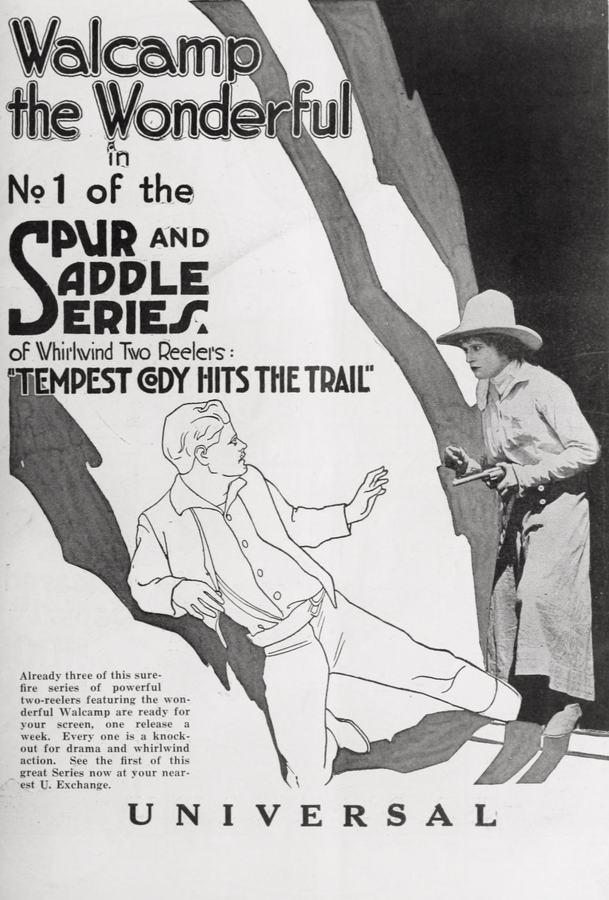
The celluloid flicker of 1919 serves as a portal to an era where the American West was not just a setting, but a psychological frontier. Tempest Cody Hits the Trail stands as a testament to this epoch, a film that avoids the saccharine trappings of early melodrama in favor of a rugged, almost atavistic realism. At the center of this whirlwind is Marie Walcamp, an actress whose physicality and screen presence challenged the prevailing notions of femininity in early Hollywood. Unlike the protagonists in The Desire of the Moth, who often found themselves entangled in the intricate webs of domesticity and social expectation, Walcamp’s Cody is a creature of the open air, a figure defined by action rather than reaction.
The direction by Jacques Jaccard is remarkably sophisticated for its time. Jaccard, who also co-wrote the script with George Hively, understands the visual language of the landscape. He utilizes long shots to emphasize the isolation of the trail, making the characters appear as mere specks against the vast, indifferent majesty of the mountains. This sense of scale provides a gravity to the narrative, suggesting that the struggles of these individuals are part of a larger, more elemental conflict. When compared to the more contained, almost theatrical staging of The Pretenders, Jaccard’s work feels revolutionary, embracing the inherent mobility of the camera to capture the kinetic energy of a horse chase or the tension of a standoff.
The supporting cast, featuring stalwarts like Robert Anderson and Leonard Trainor, provides a sturdy framework for Walcamp’s performance. Anderson, in particular, brings a grounded intensity that balances the more flamboyant aspects of the plot. There is a palpable sense of history in these faces—lines etched by the sun and the wind, reflecting a life lived on the edge of the map. This authenticity is something that modern Westerns often struggle to replicate, yet here it feels effortless. Even in the smaller roles, such as those played by Archie Ricks and Charles Brinley, there is a commitment to the reality of the setting that elevates the film above its serial origins.
Interestingly, the film’s pacing mirrors the rhythmic trot of a horse on a long journey. It is not always hurried; it allows for moments of quiet contemplation. This is a far cry from the frenetic energy seen in The Kid Is Clever, where the narrative seems to leap from one gag to the next with little regard for atmosphere. In Tempest Cody Hits the Trail, the atmosphere is the narrative. The dust that kicks up from the hooves, the way the light hits the sagebrush, the stark shadows cast by a midday sun—these are the elements that tell the story as much as the intertitles do.
One cannot discuss this film without addressing the radical nature of Tempest Cody herself. In an era where the 'damsel in distress' was a ubiquitous trope, Walcamp’s character is a revelation. She is the one who 'hits the trail,' she is the one who confronts the outlaws, and she is the one who ultimately dictates the terms of her own survival. This subversion of gender roles is perhaps more pronounced here than in contemporary works like This Hero Stuff, which, while playful with its archetypes, often returns to a more traditional status quo. Cody remains an outlier, a woman who has mastered the masculine landscape without losing her own distinct identity.
The cinematography, though limited by the technology of 1919, manages to achieve a certain poetic quality. There is a raw, high-contrast look to the film that suits its subject matter perfectly. The whites are blinding, the blacks are deep and cavernous, and the grays are filled with the texture of the desert. This visual palette creates a sense of moral clarity that is characteristic of the early Western, yet the script introduces enough ambiguity to keep the audience engaged. The conflicts are not always black and white; they are often born of necessity, desperation, and the harsh realities of frontier life.
The writing by Hively and Jaccard avoids the pitfalls of excessive exposition. They trust the audience to follow the visual cues, a skill that seems to have been more prevalent in the silent era than in the talkies that followed. The narrative structure is lean, focusing on the essential movements of the characters. This economy of storytelling is what makes the film so effective. It doesn't waste time on subplots that don't serve the central journey of Tempest Cody. In this regard, it shares a certain structural purity with The Life Line, another 1919 release that prioritized visual momentum over narrative clutter.
Furthermore, the film’s exploration of justice is nuanced. It isn't just about the law of the land, but the law of the trail. There is a code of conduct that the characters adhere to, a set of unwritten rules that govern their interactions. When these rules are broken, the consequences are swift and often violent. This thematic depth elevates the film beyond mere entertainment, turning it into a meditation on the nature of order in a lawless world. It’s a theme explored through a different lens in The Black Chancellor, but in the Western setting, it takes on a more visceral, immediate quality.
Marie Walcamp was often referred to as the 'Serial Queen,' and Tempest Cody Hits the Trail illustrates why. Her ability to perform her own stunts and her fearless approach to the role gave her an aura of authenticity that few of her peers could match. She wasn't just playing a part; she was inhabiting a world. This level of immersion is what draws the viewer in, even a century later. While films like Vampire or Dämon und Mensch explored the darker, more supernatural aspects of the human psyche, Walcamp’s work remained firmly rooted in the physical world, celebrating the resilience of the human spirit in the face of natural and man-made obstacles.
The technical aspects of the film, from the editing to the set design, reflect the high standards of the Universal Film Manufacturing Company during this period. The sets feel lived-in, the costumes are appropriately weathered, and the editing creates a seamless flow of action. It is a reminder that even in its infancy, cinema was a highly collaborative art form, requiring the synchronized efforts of writers, directors, actors, and technicians. The precision seen here is comparable to the meticulous craft of Sanz y el secreto de su arte, despite the vastly different subject matter.
In the grand tapestry of film history, Tempest Cody Hits the Trail might be viewed by some as a minor thread, but to the discerning eye, it is a crucial one. It represents a moment of transition, a bridge between the simplistic morality plays of the earliest films and the complex, character-driven narratives of the 1920s. It showcases a female lead who is as capable and compelling as any male counterpart, and it does so without fanfare or apology. It is a film that demands to be seen not just as a curiosity, but as a vibrant piece of storytelling that still resonates today.
The film’s ability to conjure a sense of time and place is its greatest strength. When we watch Tempest Cody ride across the screen, we aren't just watching a performance; we are witnessing the birth of a myth. The Western, as a genre, would go on to define American cinema for decades, and the seeds of its enduring popularity are all present here. From the rugged individualism to the sweeping vistas, Tempest Cody Hits the Trail is a foundational text that deserves its place in the pantheon of silent cinema. It lacks the whimsical charm of Angel Child or the instructional novelty of How Animated Cartoons Are Made, but it possesses a gravity and a raw power that those films do not seek to achieve.
Ultimately, the film is a celebration of movement. Every frame is imbued with a sense of purpose, every gesture is calculated for maximum impact. It is a reminder that cinema, at its heart, is the art of the moving image. Whether it’s the subtle shift in Walcamp’s expression or the thunderous charge of a posse, the film never stops moving, never stops searching for the next horizon. It is this restless energy that makes Tempest Cody Hits the Trail such an exhilarating experience, even after all these years. It remains a stark, beautiful, and unapologetic slice of Western history, a celluloid dream of a world that was as harsh as it was magnificent.
As we look back at the diverse output of 1919, from the comedic antics of The Janitor to the dramatic weight of The Other Half, Tempest Cody carves out its own unique space. It doesn't rely on the sentimentality of An Alabaster Box or the social satire of Das große Los. Instead, it relies on the strength of its lead, the vision of its director, and the timeless allure of the trail. It is a film that hits the trail and never looks back, leaving a trail of dust and inspiration in its wake for all who follow.
IMDb 5.9
1925
Community
Log in to comment.