DbcultAccessing Vault...
Cult Review
Senior Film Conservator
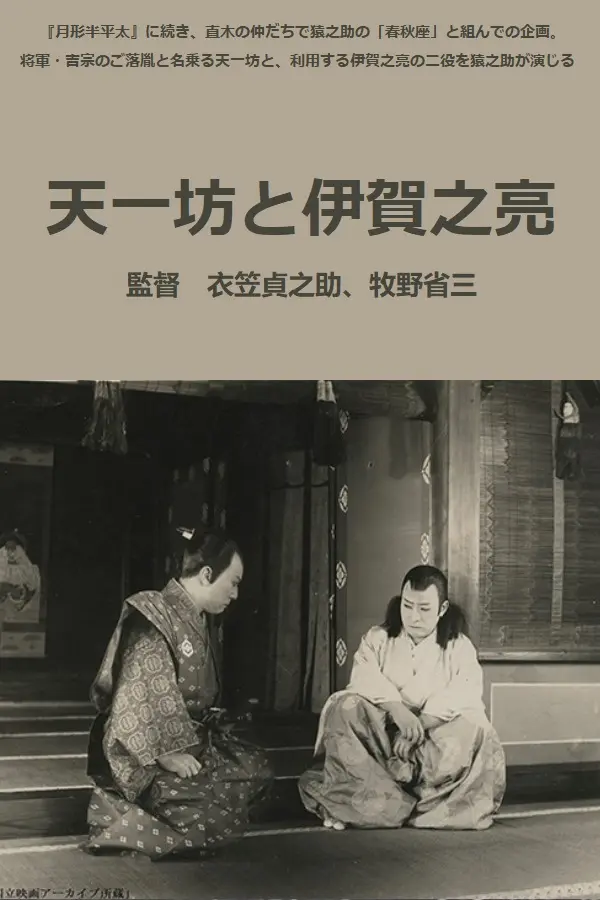
Is 'Tenichibo to Iganosuke' a film that warrants your attention today? Short answer: absolutely, but with significant caveats that demand a certain kind of viewer. This is not a film for the impatient, nor for those seeking modern narrative conventions; it is, however, an essential viewing experience for aficionados of classic Japanese cinema, particularly those drawn to period dramas that prioritize meticulous detail and thematic depth over rapid-fire plot progression.
It's a challenging, often somber piece, best suited for an audience willing to immerse themselves in a historical world that feels both distant and eerily relevant. If you cherish the slow burn, the nuanced performance, and a film that asks you to meet it halfway, then prepare for a rewarding journey. If your tastes lean towards contemporary pacing or clear-cut moralities, you might find its deliberate rhythm a test of endurance.
At first glance, 'Tenichibo to Iganosuke' might appear to be just another historical drama from a bygone era, perhaps even a relic. Yet, beneath its traditional exterior lies a narrative that speaks to universal themes of duty, betrayal, and the struggle for personal agency within rigid societal structures. It’s a film that refuses easy answers, instead opting for a portrayal of human nature that is as complex as it is compelling.
The film’s power lies not just in its story, but in its profound commitment to atmosphere and character. Every frame feels imbued with purpose, every silence heavy with unspoken meaning. It’s a masterclass in how to build a world, not just tell a story within one.
This film works because: it commits unflinchingly to its historical setting and thematic explorations, anchored by performances of profound gravitas.
This film fails because: its deliberate pacing and reliance on theatrical conventions can create an emotional distance for modern audiences.
You should watch it if: you appreciate historical Japanese cinema, nuanced character studies, and films that demand intellectual and emotional investment.
The performances in 'Tenichibo to Iganosuke' are, without question, the bedrock upon which its emotional weight rests. Genjûrô Sawamura, in particular, delivers a portrayal of Tenichibo that is both stoic and deeply vulnerable. His ability to convey internal turmoil through subtle shifts in expression, a lowered gaze, or a carefully measured posture is remarkable. There’s a scene, early in the film, where Tenichibo is confronted with an impossible choice; Sawamura’s silent agony, framed in a stark, almost theatrical close-up, speaks volumes about the character’s moral burden.
Dan'en Ichikawa, as Iganosuke, provides a striking counterpoint. His character is often more outwardly passionate, his ambition and frustrations simmering closer to the surface. Ichikawa's physicality, a hallmark of many actors trained in traditional Japanese theater, brings a dynamic energy that prevents the film from becoming overly static. The interplay between Sawamura's restraint and Ichikawa's intensity creates a compelling dramatic tension that drives much of the narrative.
The supporting cast, including Shôen Ichikawa and Tomoshirô Otani, also contribute significantly, each carving out memorable, if smaller, roles. Their collective commitment to the period’s mannerisms and emotional register helps to fully flesh out the world, making the historical setting feel lived-in rather than merely staged. One could draw parallels to the ensemble work in other period pieces, though the particular nuances here feel uniquely Japanese, a blend of kabuki’s grandeur and cinematic realism.
Roppuku Nukada's direction, while perhaps not as overtly flashy as some of his contemporaries, is nonetheless masterful in its restraint and precision. Nukada understands the power of the long take, allowing scenes to breathe and emotions to unfold organically. He frequently employs wide shots that emphasize the grandeur and often the desolation of the Japanese landscape, placing the human characters within a much larger, often indifferent, world. This visual style is reminiscent of the spatial awareness found in films like The Girl and the Game, though applied to a dramatically different cultural context.
Consider the scene depicting a clandestine meeting in a moonlit garden. Nukada doesn’t rush the conversation; instead, he holds the shot, allowing the rustling of leaves and the distant sounds of the night to become as much a part of the dialogue as the spoken words. This deliberate pacing builds an almost unbearable tension, drawing the audience deeper into the characters' precarious situation. It's a directorial choice that prioritizes atmosphere and psychological depth over rapid plot advancement, a decision that will either captivate or frustrate, depending on your cinematic sensibilities.
The cinematography in 'Tenichibo to Iganosuke' is a testament to the era's visual storytelling. Shot in stark black and white, the film utilizes light and shadow not just for aesthetic beauty, but as narrative tools. Shadows often engulf characters, symbolizing their moral quandaries or impending doom, while shafts of light pierce through darkness, hinting at moments of clarity or hope, however fleeting. The composition is often painterly, with each frame meticulously arranged to convey mood and meaning.
There's a particular sequence involving a journey through a snow-covered mountain pass that stands out. The bleak, unforgiving landscape is captured with breathtaking majesty, the stark white contrasting sharply with the dark figures trudging through it. This visual serves as a powerful metaphor for the arduous and often solitary paths the characters must traverse. It’s a moment of pure visual poetry, echoing the stark realism sometimes found in early American Westerns like Cameo Kirby, albeit with a distinctly Eastern sensibility.
The pacing of 'Tenichibo to Iganosuke' is undeniably deliberate, even by the standards of classic cinema. This is a film that takes its time, allowing events to unfold at a natural, almost unhurried rhythm. For some, this will be its greatest strength, fostering a sense of immersion and allowing for a deeper contemplation of the film's themes. For others, it may feel ponderous, a relic of a time when audiences were perhaps more accustomed to slower narrative builds.
I argue that the slow pace is integral to the film's emotional impact. It forces the viewer to sit with the characters, to feel the weight of their decisions and the inexorability of their fate. The gradual accumulation of tension, rather than sudden bursts, creates a sustained sense of dread and anticipation that is ultimately more potent. The narrative, penned by Sanjûgo Naoki and Roppuku Nukada, is dense with historical context and character nuance, and the pacing allows this richness to be fully absorbed.
The tone of 'Tenichibo to Iganosuke' is predominantly somber and reflective, occasionally punctuated by moments of intense drama or quiet beauty. There's a pervasive sense of fatalism, a feeling that characters are often swept along by forces beyond their control, whether it be societal expectations, political machinations, or the dictates of honor. This fatalism isn't presented as nihilistic, but rather as a profound observation on the human condition within a specific historical context.
The film delves deep into themes of loyalty versus self-preservation, the corrupting influence of power, and the often-blurred lines between justice and revenge. It asks difficult questions about what it means to be honorable when all choices lead to suffering. The moral landscape is rarely black and white, forcing the audience to grapple with the complexities of each character's motivations.
One particularly surprising observation is how the film, despite its historical setting, subtly critiques the very foundations of the feudal system it depicts. Through the tragic arcs of its protagonists, it suggests that the rigid adherence to codes of honor, while seemingly noble, can lead to immense personal and communal destruction. It's a less overt critique than some contemporary films might offer, but its power lies in its subtlety, allowing the audience to draw their own conclusions from the unfolding tragedy.
The film’s refusal to provide a clear moral compass for its characters isn't a flaw, but arguably its greatest strength, forcing viewers to confront their own biases and understand the motivations behind actions that might otherwise seem reprehensible. This ambiguity is what makes 'Tenichibo to Iganosuke' so enduringly thought-provoking, standing apart from more simplistic narratives found in films like A Perfect 36.
Yes, 'Tenichibo to Iganosuke' is absolutely worth watching today, especially for those with an appreciation for classic Japanese cinema and a willingness to engage with a film on its own terms. It offers a rich, immersive experience that transports you to a different time and place, challenging you with its deliberate pacing and complex moral questions.
However, it is crucial to approach it with the right expectations. This is not a popcorn flick. It demands patience and attention. If you are open to a film that prioritizes atmosphere, character depth, and thematic resonance over rapid plot twists, you will find it profoundly rewarding. It works. But it’s flawed. Its deliberate pace might test the limits of modern attention spans, but its rewards are immense for those who persevere.
'Tenichibo to Iganosuke' is a monument of classic Japanese cinema, a film that, despite its age and challenging rhythm, retains a potent emotional and intellectual resonance. It is a demanding watch, certainly, but one that rewards patience with a deeply immersive experience and a nuanced exploration of timeless human struggles. It stands as a testament to the power of committed performances, thoughtful direction, and a narrative that trusts its audience to engage with its complexities.
While it may not appeal to everyone, for those willing to step into its world, 'Tenichibo to Iganosuke' offers a profound and unforgettable journey into the heart of feudal Japan, and into the enduring questions of what it means to live and die with honor. It's a film that stays with you, long after the final frame fades to black. A strong 8.5/10.
IMDb 7.2
1928
Community
Log in to comment.