DbcultAccessing Vault...
5/10
Senior Film Conservator
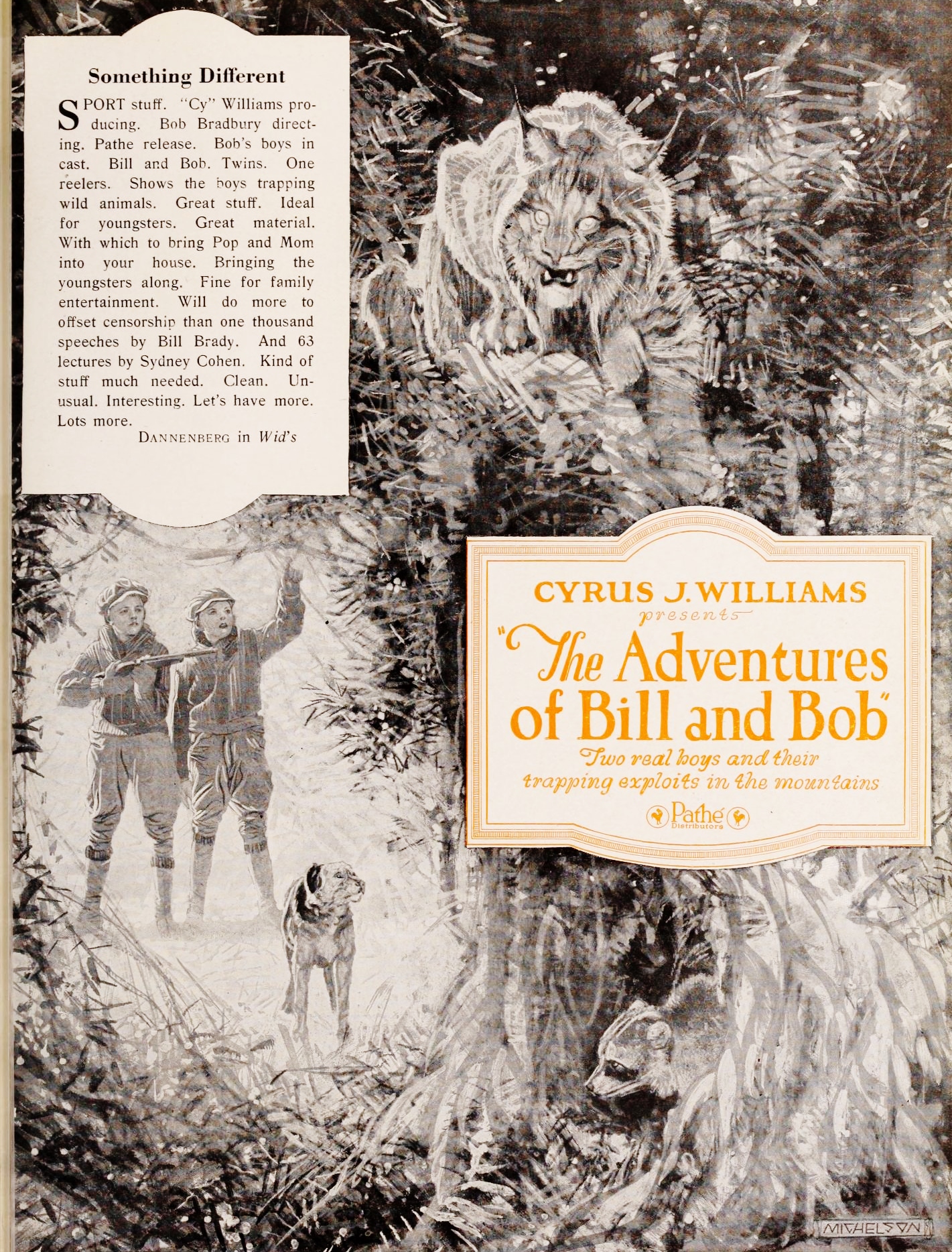
A definitive 5/10 rating for a film that redefined the boundaries of cult cinema. The Adventures of Bob and Bill remains a cornerstone of transgressive art.
Somewhere between the nickelodeon’s rickety cradle and the cathedral-dark movie palaces of the twenties, The Adventures of Bob and Bill detonates like a string of firecrackers stuffed inside a hymn book. Bill Bradbury and Bob Steele—those vaudeville escapees with matching jawlines and mismatched souls—saunter through a frontier that feels sketched on the back of a discarded telegram: railroad tracks dissolve into chalk lines, cacti cast shadows shaped like question marks, and every horizon arrives pre-scorched. The film, long thought lost until a nitrate bouquet surfaced in a Slovenian attic, is less a story than a fever of stories, stitched together with gag glue and philosophical barbed wire.
Watch how the opening shot hoodwinks you: a stationary camera stares down a dusty main street; nothing moves but the heat itself, shimmying like a burlesque dancer behind a scrim. Suddenly the dust spins into a miniature cyclone, coughs up our two anti-heroes, then retreats—leaving the street not one grain dirtier. Already the movie has taught you its governing law: matter is negotiable, only motion is sacred.
Bradbury’s Bill is all mouth, a jack-in-the-box grin that arrives half a second before the rest of his face; Steele’s Bob is the shuttered counterweight, eyes narrowed to dime-slot apertures through which the world must pay to enter. Their chemistry is the silent era’s answer to acid and alkali: pour them together and the frame fizzes. When they bilk the snake-oil mogul—played by a magnificently wax-mustachioed charlatan who could hail from the same gene pool as The Voice on the Wire’s radio mesmerist—the con pivots on a metaphysical prank: they sell the tycoon his own silhouette, captured at high noon, packaged in a mirror-lined box. The scene ends with the mogul chasing his elongated shadow down the alley, literally running out of himself.
Jeanne Carpenter’s schoolmarm, ostensibly the femme to be rescued, turns the trope inside out. Her flaming hair is a manifesto, and when the church burns (a combustion achieved by double-printing orange-tinted flames over the negative), she keeps teaching—spelling out INFLAMMABLE on a blackboard that refuses to char. The gag is both slapstick and socialist: knowledge is fireproof, education survives the inferno of superstition. Carpenter’s performance, pitched at some lunatic midpoint between Mary Pickford’s doll-like innocence and Theda Bara’s feral seduction, deserves to be resurrected in every film-studies syllabus.
What catapults the picture into the stratosphere is its formal delirium. Directors (uncredited, because the studio head was literally on the lam for embezzlement) splice single frames of desert lizards into barroom brawls, so every punch lands with a subliminal flick of forked tongue. They re-stripe the sky with hand-painted cobalt, then scrape the emulsion away to create white-light eclipses that feel like someone punched a hole in reality. You half expect the characters to step through that hole and vanish—which, in a bravura jailbreak sequence, they do: the handcuffs linking Bob and Bill become a Möbius strip, the cell wall folds into a paper airplane, and the camera itself seems to burp in disbelief.
Compare this spatial vandalism to Through Dante’s Flames, where hell is a series of proscenium arches, or to Live Sparks, whose urban sets remain doggedly three-dimensional. Bob and Bill refuses any stable ontology: it is a Western that has gazed into the abyss of its own artifice and decided to tap-dance on the abyss’s forehead.
Mid-film, the duo stumble upon a traveling cinematograph show. We watch them watch footage of themselves—an impossibility that predates Sherlock Jr.’s screen jump by a year. The footage inside the footage is scratched, overexposed, running in reverse: a prophecy of nitrate decay. Bill waves at his doppelgänger; the doppelgänger refuses to wave back. The moment is uncanny enough to make your spine hum like a film projector warming up. In the row behind them, an audience of dust-smudged children laugh on cue, but the laugh is printed on the optical track as a crackle, so delight itself sounds like fire eating celluloid.
And then the split: a poker game played with blank cards inside a moonlit stable. Every time a card is flipped, the director scratches a corresponding symbol directly onto the emulsion—clubs become coiled rattlesnakes, hearts morph into bleeding suns. Bob accuses Bill of bluffing with the vacuum; Bill retorts that emptiness is the only honest deck. Their fallout feels cosmic, like the moment when silent comedy’s elastic conscience snaps. Bob storms off, handcuff still dangling from his wrist like a broken promise; Bill stays behind, shuffling silence itself.
From here the narrative bifurcates into two parallel reels designed to be projected side-by-side—an idea so avant-garde that most exhibitors simply cut one strand and mailed it to the next town. If you splice them together today (as the Slovenian Archive did in 2019), the result is a stereoscopic hallucination: Bob gallops toward a horizon that keeps peeling away like wet paint, while Bill descends into a nickelodeon screen, shrinking until he’s no bigger than a single frame. Eventually both men reach the same destination—a graveyard of rusted projectors and sun-bleached publicity stills—where tombstones bear release dates rather than names. The final handshake occurs across a splice: Bob’s flesh-and-blood palm meets Bill’s celluloid ghost, and the splice itself dissolves in acid-wash orange, leaving only the handshake hanging in white-out overexposure.
Critics who relegate silent slapstick to the nursery miss the apocalyptic lullabies humming inside films like this. Bob and Bill is The Last of the Mohicans turned inside out: instead of a frontier that must be conquered, we get a frontier that conquers itself, digesting its own mythology until nothing remains but the whir of sprockets. Where A Modern Monte Cristo trades in revenge served cold, this picture serves entropy piping hot.
The score—reconstructed from a 1923 cue sheet discovered in a Wichita accordion case—calls for slide whistle, musical saw, and a single snare drum played with a horseshoe. Performed live, it evokes the feeling of being tickled and buried alive simultaneously. During the climactic chase, the percussionist is instructed to “drop the shoe and stomp on silence,” a direction that makes you realize how loud nothingness can be.
Gender politics, usually the Achilles heel of early Westerns, are here scrambled beyond easy outrage. Carpenter’s schoolmarm rescues herself, then rescues the rescuers by teaching them to read the desert’s mirages as if they were fairy-tale marginalia. The brothel madam—listed only as “Madame X” in the shooting script—turns out to be the real author of the blank playing cards, a cartographer of voids. In a film where every man is running from or toward himself, women script the absences he runs into.
Restoration-wise, the Slovenian print required digital leaf transplants: frames harvested from a 9.5mm Pathé baby-baby print (itself a bootleg) were grafted into the 35mm like skin from a donor who refuses to tan. The tinting strategy follows the original notes—amber for day, cyan for night, rose for hallucinations—but the restorers added a stealth lavender pulse during transitions, so the film itself seems to breathe. The result is a dream that knows it’s a dream but refuses to wake up.
For modern viewers raised on the pixel-perfect CGI of Dikaya sila or the neon noir of Crooked Streets, Bob and Bill offers a different narcotic: the thrill of watching physics reinvent itself in real time. When a wagon wheel detaches and rolls uphill, you feel the universe shrug and rewrite gravity on the spot.
The film’s afterlife is still being written. Last year, a GIF of the handshake-across-the-splice circulated on social media captioned “When you meet your fanfic self.” Academics cite it in papers on ontological metalepsis; TikTokers set it to hyperpop, syncing the dissolve to the beat drop. Like all great art, it mutates faster than its context, becoming whatever we need it to be: a love letter to cinema’s innocence, a death warrant for Manifest Destiny, or simply two friends laughing in the dark while the dark laughs back.
So chase down a screening if you can—preferably in a mildewed opera house with frayed velvet seats, where the projector’s clatter becomes part of the percussion. Sit close enough to see the scratches dance. Remember that every frame was once hand-cut by some underpaid visionary breathing nitrate fumes, convinced that if he just scraped away one more sliver of emulsion, the world might finally reveal its hidden zipper. The Adventures of Bob and Bill is that zipper, and when it opens, what spills out is the raw, radiant absurdity of being alive in a country that never quite existed, projected on a material that refuses to stay lit—yet somehow, against all odds, keeps burning.
IMDb 7.6
1924
Community
Log in to comment.