DbcultAccessing Vault...
Cult Review
Senior Film Conservator
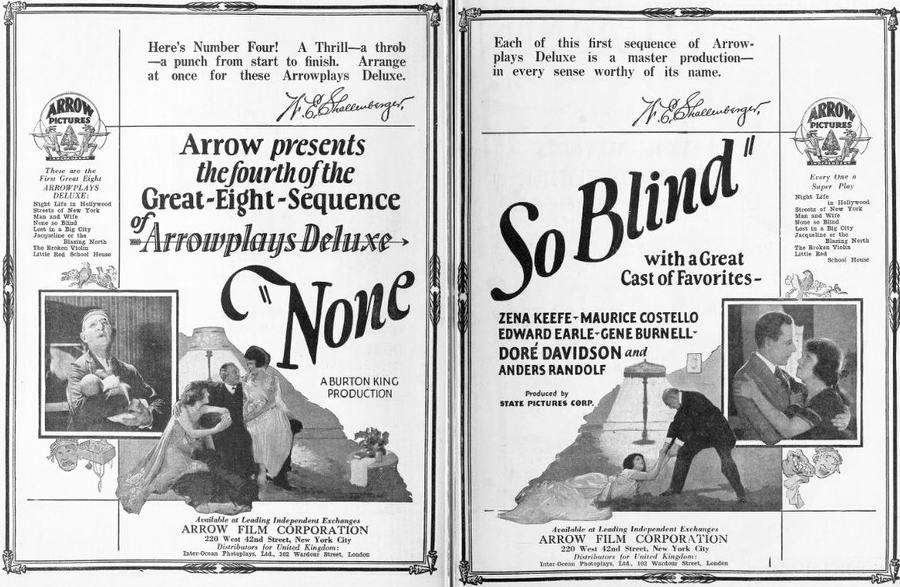
None So Blind occupies a peculiar niche in pre-Code cinema—an elegantly wrought yet unsentimental study of how financial desperation and romantic idealism collide. This 1920 silent drama, directed with a painterly eye for chiaroscuro by an uncredited hand, transcends its era through its unflinching portrayal of human foibles. The film’s narrative structure, while indebted to classic melodrama tropes, avoids melodramatic excess in favor of psychological nuance, particularly in its portrayal of Ruth Abrams (Sonia Nodell) as both avenger and victim.
Where many films of this period resort to simplistic moral binaries, None So Blind thrives in ambiguity. The opening act—a veritable masterstroke of visual storytelling—establishes Aaron Abrams (Edward Earle) as a man whose pride exceeds his means. His pawnshop, rendered in cold sepia tones, becomes a metaphor for his own life: a place where value is extracted rather than created. Rachel’s elopement with Russell Mortimer (Bernard Siegel) isn’t framed as a romantic triumph but as a collision of star-crossed fates, with the $10,000 divorce settlement feeling less like a transaction and more like a death knell.
"The money is not for you. It is for the revenge you refuse to name," Aaron tells his daughter in a pivotal scene, his voice trembling with a father’s anguish that’s been calcified into rage.
The film’s second act shifts focus to Ruth (Dore Davidson), whose childhood is steeped in the acrid scent of her father’s resentment. Her relationship with Sheldon Sherman (Robert Bentley) becomes the narrative’s emotional fulcrum. Their romance isn’t depicted with the usual romantic flourishes but as a quiet rebellion against the Mortimer legacy. The cinematography here is particularly noteworthy—their stolen glances are framed through Venetian blinds, casting slivers of light that mirror the precariousness of their love. This sequence has echoes of Die Kreutzersonate’s intimate tension but with a distinctly American grit.
What elevates None So Blind beyond its contemporaries is its treatment of financial themes. The transformation of Aaron from pawnbroker to Wall Street shark isn’t portrayed as a rags-to-riches triumph but as a descent into moral bankruptcy. His manipulation of Ruth’s marriage prospects mirrors the predatory lending practices he once railed against. This duality is rendered with remarkable subtlety in Edward Earle’s performance, which oscillates between paternal tenderness and calculating cruelty.
The climax—where Ruth is banished for her "impure" affections—unfolds with the weight of Greek tragedy. Yet the film resists easy resolutions. The final reconciliation feels less like a narrative contrivance and more like a weary acknowledgment of human limitations. This thematic complexity is rare in films from this period, which often prioritized moral clarity over psychological authenticity.
For modern audiences, None So Blind’s greatest strength lies in its unflinching examination of class mobility and its discontents. The film’s unromantic portrayal of financial ambition—where wealth is portrayed as both a means of survival and a corrosive force—resonates with startling immediacy. Consider the parallels to The Game's Up’s treatment of economic desperation, though here the stakes feel more personal and less allegorical.
The supporting characters—particularly Russell Mortimer’s daughter Hazel (Sonia Nodell) and her romance with Saul Cohen (Gene Burnell)—add necessary texture to the narrative. Their subplot, though secondary, explores the generational cost of holding onto grudges. Hazel’s relationship with Saul isn’t played for pathos but as a quiet testament to the possibility of healing across divides. The chemistry between Nodell and Burnell, while understated, carries the weight of unspoken generational trauma.
Technically, the film is a marvel of early 20th-century filmmaking. The use of shadows in Wall Street scenes—where Aaron’s financial empire is depicted as a maze of darkened office corridors and shadowy figures—echoes the chiaroscuro techniques later perfected in film noir. These visual motifs are particularly effective in contrast to the more naturalistic interiors of the Abrams home, where light floods in through dusty windows, symbolizing the fragile hope that sustains the family.
For cinephiles interested in comparative analysis, None So Blind shares thematic DNA with The Face in the Fog’s exploration of familial secrets and Who Shall Take My Life?‘s examination of moral compromise. Yet it distinguishes itself through its focus on financial systems as both enablers and oppressors. The film’s treatment of banking and pawnbroking as interconnected institutions is particularly prescient, anticipating later critiques of capitalism in films like Elmo, the Mighty.
The final act’s resolution may challenge modern viewers accustomed to more definitive conclusions. The reconciliation between Aaron and Ruth is portrayed not as a triumph of love but as an exhausted surrender to life’s complexities. This ambiguity is perhaps the film’s most modern element, suggesting that the filmmakers understood that real-life resolutions are rarely as clean as those depicted in fiction.
In an era of algorithm-driven storytelling, None So Blind remains a testament to the power of character-driven narratives. Its exploration of how financial systems shape personal relationships feels both timeless and urgently relevant. The film’s enduring power lies not in its plot mechanics but in its emotional authenticity—the unvarnished portrayal of love as both a weapon and a balm.
For those seeking similar cinematic experiences, consider exploring Ducks and Drakes for its exploration of familial ambition or Louisiana for its treatment of class tensions. None So Blind, however, stands apart in its singular focus on the intersection of finance and family, rendered with a level of psychological complexity rarely seen in pre-Code cinema.
Ultimately, None So Blind is more than a period piece. It’s an incisive study of human nature that remains disturbingly relevant in our age of economic uncertainty. The film’s greatest triumph lies in its ability to make us question, even as it moves us, whether the bonds of family can truly transcend the corrosive influence of wealth and ambition.
IMDb 5.1
1928
Community
Log in to comment.