DbcultAccessing Vault...
6/10
Senior Film Conservator
A definitive 6/10 rating for a film that redefined the boundaries of cult cinema. The Adventures of Felix remains a cornerstone of transgressive art.
In the grand tapestry of early cinematic innovation, where the moving image was still finding its voice and defining its grammar, certain figures emerged with an undeniable magnetism, etching themselves into the collective consciousness. Among these pioneers, few possess the enduring charm and historical significance of Felix the Cat. “The Adventures of Felix” stands as a fascinating artifact, a vibrant, if brief, testament to the character’s nascent appeal and the burgeoning artistry of animation in the silent era. It is more than a mere cartoon; it is a cultural touchstone, a window into a period when imagination, rendered through ink and celluloid, began to truly captivate audiences worldwide. The film, a product of its time, showcases the rudimentary yet profoundly effective techniques that laid the groundwork for the animated spectacles we enjoy today, offering a narrative that, despite its simplicity, resonates with timeless themes of friendship, peril, and ingenuity.
The short opens with a delightful scene of bucolic tranquility, a stark contrast to the impending excitement. Felix, already an established icon by this point, known for his mischievous grin and adaptable tail, embarks on what appears to be a quintessential childhood adventure: a fishing trip. He is not alone, but accompanied by two human children, their presence lending a poignant sense of innocence and vulnerability to the proceedings. Their journey to the lake is depicted with an unhurried grace, allowing the audience to absorb the serene atmosphere before the narrative’s inevitable shift. The animators, under the visionary guidance of Otto Messmer, masterfully use visual shorthand to establish the setting and the characters’ convivial relationship, a hallmark of silent storytelling. The idyllic scenery, though rendered in monochrome, evokes a sense of vibrant natural beauty, setting the stage for an encounter that will test the mettle of our feline protagonist.
As the trio settles by the shimmering waters, the initial promise of a peaceful afternoon begins to fray. The very act of fishing, a serene pastime, inherently involves a delicate dance with nature, a venture into the unknown depths. It is from these depths that a primordial threat emerges: a hungry crocodile. The sudden appearance of this reptilian antagonist immediately injects a jolt of suspense into the narrative, transforming the lighthearted expedition into a struggle for survival. The crocodile is not merely a plot device; it embodies the wild, unpredictable forces that often lurk beneath the surface of seemingly calm environments. Its hunger is palpable, its presence menacing, effectively escalating the stakes for Felix and his young companions. This shift from playful adventure to genuine peril is executed with a surprising degree of tension, a testament to the animators’ ability to convey emotion and urgency through movement and expression alone, without the benefit of spoken dialogue.
Felix, ever the resourceful hero, rises to the occasion. His character, conceived by Otto Messmer, was always defined by an uncanny ability to adapt, to turn adversity into advantage, and to outsmart his foes with a blend of quick thinking and cartoon physics. In this encounter, these traits are put to the ultimate test. The ensuing confrontation is a delightful display of animated ingenuity, a ballet of chase and evasion where Felix’s iconic elasticity and problem-solving skills shine. He doesn’t merely react; he strategizes, manipulating his environment and even his own physical form to outwit the formidable predator. This sequence is a masterclass in visual comedy and suspense, demonstrating how early animation could weave compelling narratives without relying on complex plots or extensive character development. The humor is derived from the absurd situations Felix finds himself in and his equally absurd, yet effective, solutions.
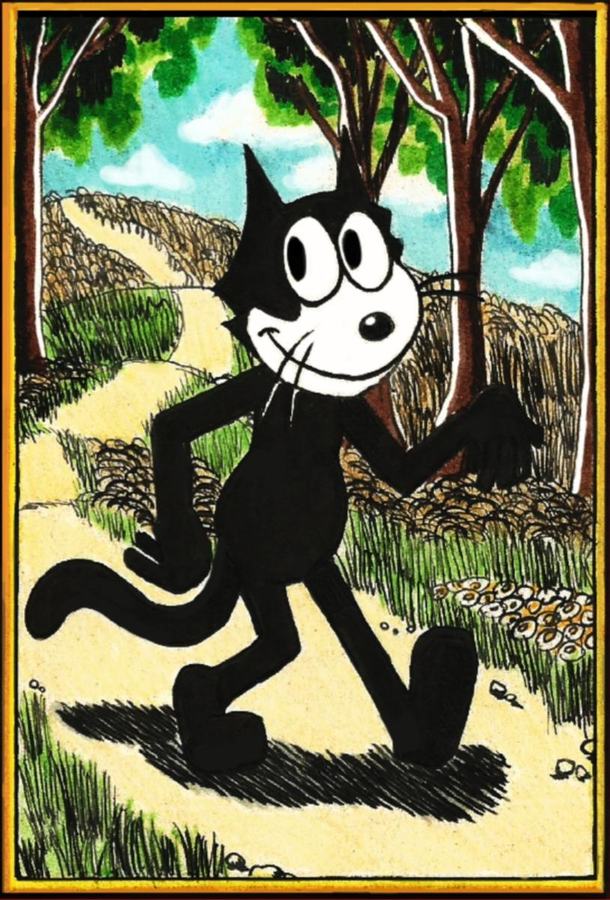
The genius of Otto Messmer, often uncredited in an era where studio brands overshadowed individual artists, lies in his ability to imbue Felix with a distinct personality that transcended the limitations of the medium. Felix is not just a drawing; he is a character with agency, emotions, and a discernible moral compass. His protection of the children is not merely a plot point, but a reflection of his inherent good nature, solidifying his role as a benevolent, albeit mischievous, guardian. This empathetic connection between character and audience was crucial for Felix’s widespread popularity, making him one of the first true animated superstars. His design, simple yet expressive, allowed for a vast range of emotions and actions, a testament to the power of minimalist artistry. The iconic black body, white eyes, and wide grin became instantly recognizable, a symbol of the burgeoning art form.
From a technical perspective, “The Adventures of Felix” exemplifies the state-of-the-art animation of its period. The fluidity of Felix’s movements, particularly his iconic walk and the expressive use of his tail, was groundbreaking. Messmer’s innovations in character animation, such as the “rubber hose” style, where characters could stretch and distort without breaking their form, offered unparalleled freedom of movement and comedic potential. This short film, like many Felix cartoons, served as a laboratory for these techniques, pushing the boundaries of what was thought possible in animated storytelling. The visual gags are often clever and well-timed, relying on the audience’s understanding of physical comedy and the inherent absurdity of the animated world. The film’s pacing is brisk, maintaining engagement without overwhelming the viewer, a delicate balance for a silent film that had to convey its entire narrative visually.
While the film’s narrative is straightforward, its thematic undercurrents are surprisingly rich. It touches upon the universal fear of the unknown, the primal struggle for survival against nature’s might, and the enduring power of friendship. Felix’s protective instincts towards the children elevate the cartoon beyond mere slapstick, imbuing it with a genuine sense of warmth and heroism. The children, though not central to the action, serve as anchors for the audience’s empathy, making Felix’s victory all the more satisfying. The resolution, while fitting for a children’s animated short, reinforces the idea that quick thinking and courage can overcome even the most daunting obstacles. It’s a classic underdog story, albeit one starring a remarkably clever cat.
Comparing “The Adventures of Felix” to other films of its era, particularly those outside the animation sphere, reveals interesting parallels in storytelling approaches. While a dramatic feature like The Man of Shame might delve into complex human psychology and societal pressures through its narrative, “The Adventures of Felix” achieves its impact through exaggerated visual comedy and a clear, morally unambiguous conflict. Both, however, rely heavily on visual cues and physical performance to convey emotion and plot, a commonality in the silent film era. The simplicity of Felix’s motivations – to protect his friends – contrasts with the intricate web of deceit and passion found in a melodrama like Il mistero dei Montfleury, yet both aim to evoke strong reactions from their respective audiences. The immediate, physical danger presented by the crocodile in Felix’s adventure, though cartoonish, mirrors the more grounded, yet equally perilous, threats faced by protagonists in thrillers of the time, such as those implied by the title The Gray Wolf's Ghost, demonstrating a universal appeal of conflict and resolution, regardless of genre or medium.
The legacy of Felix the Cat, and by extension, films like “The Adventures of Felix,” cannot be overstated. Felix was, for a time, the most popular animated character in the world, influencing subsequent generations of animators and setting precedents for character design and narrative structure. His character predates Mickey Mouse by nearly a decade, establishing many of the tropes and conventions that would become standard in cartooning. The film, in its modest scope, contributes to this grand narrative, showcasing Felix in a characteristic situation that highlights his enduring appeal. It’s a reminder of a time when animation was a fresh, exciting frontier, unburdened by the sophisticated technologies and complex narratives of later eras, yet brimming with raw creative energy.
The absence of specific writer credits, typical for animated shorts of this period, underscores the collaborative and often anonymous nature of early animation production. While Otto Messmer is widely recognized as the primary creative force behind Felix, the development of these early shorts was often a fluid process, with ideas emerging from various animators and story artists. This collective authorship, while obscuring individual contributions, also speaks to the vibrant, experimental atmosphere of early animation studios, where innovation was often a shared endeavor. The focus was on the visual spectacle and the character’s appeal, rather than a meticulously crafted screenplay in the modern sense. This approach allowed for a spontaneous, improvisational quality that is often palpable in these early works, giving them a unique charm.
The visual aesthetic of “The Adventures of Felix” is a study in contrasts and bold lines. The stark black and white palette, a limitation of the era, is used to great effect, creating dramatic shadows and highlights that emphasize the characters’ forms and movements. The backgrounds, while simple, effectively convey depth and environment without distracting from the central action. Felix’s design, with his large, expressive eyes and malleable body, allows for a wide range of emotions and physical comedy. The crocodile, too, is rendered with a menacing simplicity, its jagged teeth and powerful tail instantly communicating its threat. The use of clear, strong lines ensures that even with the quick movements and limited frames of early animation, the action remains legible and impactful. This visual clarity was paramount for silent films, where every gesture and expression carried significant narrative weight.
In an era where cinema was still finding its commercial footing, the ability of a character like Felix to draw audiences was invaluable. “The Adventures of Felix” is not just entertainment; it’s a piece of cultural history, demonstrating how popular characters could transcend their initial medium and become global phenomena. The film, despite its brevity, captures the essence of Felix: his boundless energy, his unwavering optimism, and his capacity for both mischief and heroism. It’s a reminder that even the simplest stories, when told with creativity and heart, can leave an indelible mark. The enduring appeal of Felix is a testament to the power of well-crafted animation and the universal resonance of a character who, despite being a silent, ink-drawn cat, speaks volumes about resilience and the joy of adventure.
Ultimately, “The Adventures of Felix” serves as a delightful encapsulation of early animated artistry. It is a film that, while perhaps overlooked by modern audiences accustomed to more sophisticated narratives and visual effects, holds immense value for its historical context and its pure, unadulterated charm. It invites us to appreciate the foundational work of pioneers like Otto Messmer, whose inventive spirit brought Felix to life and paved the way for the animation industry as we know it. The fishing trip, the unexpected peril, and Felix’s triumphant ingenuity all combine to create a short, sweet, and profoundly significant cinematic experience. It’s a vibrant splash of yellow in the black-and-white canvas of early cinema, a beacon of creative exploration that continues to inspire and entertain. The sea blue depths of the lake hold not just a hungry crocodile, but also the boundless potential of a new art form, while Felix, with his dark orange determination, navigates its challenges with characteristic flair. This film is a crucial chapter in the ongoing story of animation, a joyful ode to the power of imagination.

IMDb 6.9
1926
Community
Log in to comment.