DbcultAccessing Vault...
Cult Review
Senior Film Conservator
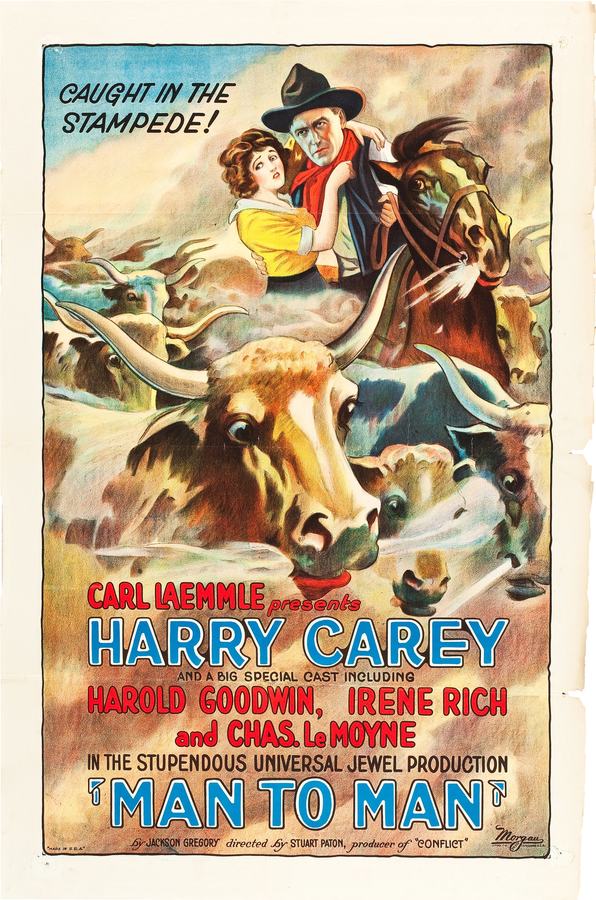
A century after its premiere, Man to Man rides again—hoof-beats echoing across the digital ether like distant thunder on sandstone.
The first thing that strikes you is the heat. Not the metaphorical heat of conflict, but the granular, frame-baked heat that seems to rise from every 35-mm grain of George C. Hull and Jackson Gregory’s blistering 1922 Western. Even in monochrome, the Arizona badlands glare with such ferocity you half-expect the aperture itself to blister. This is not the postcard West of John Ford’s later hymns; it is a land of cracked caliche and merciless horizons, a place where inheritance arrives like a bullet—fast, hot, and rarely welcome.
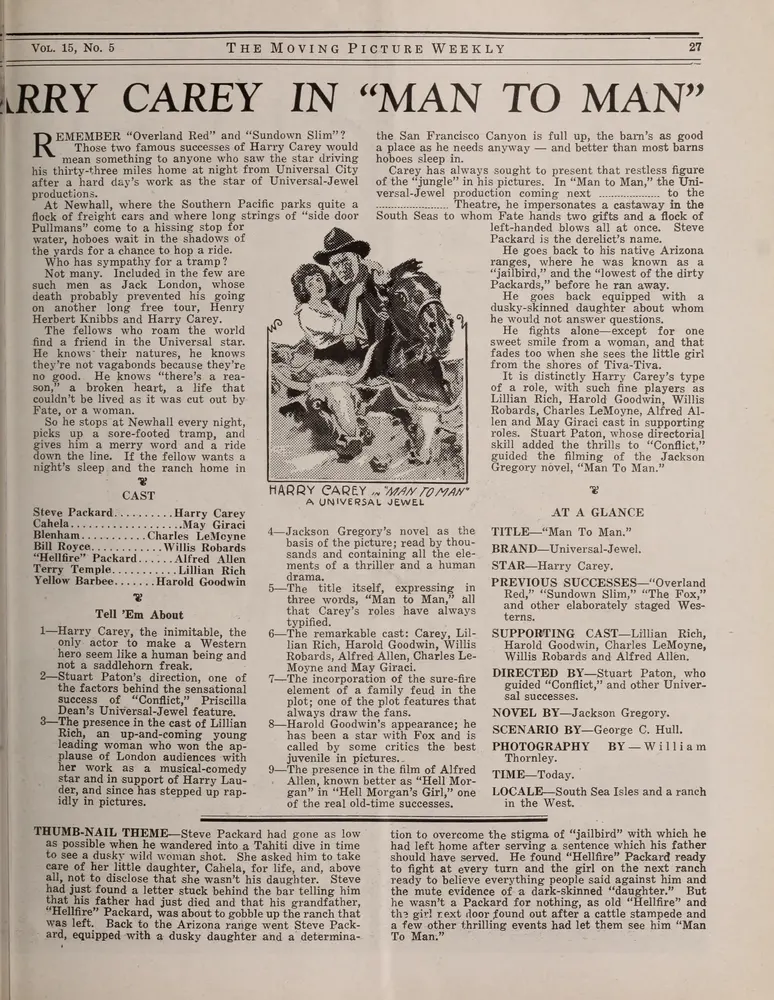
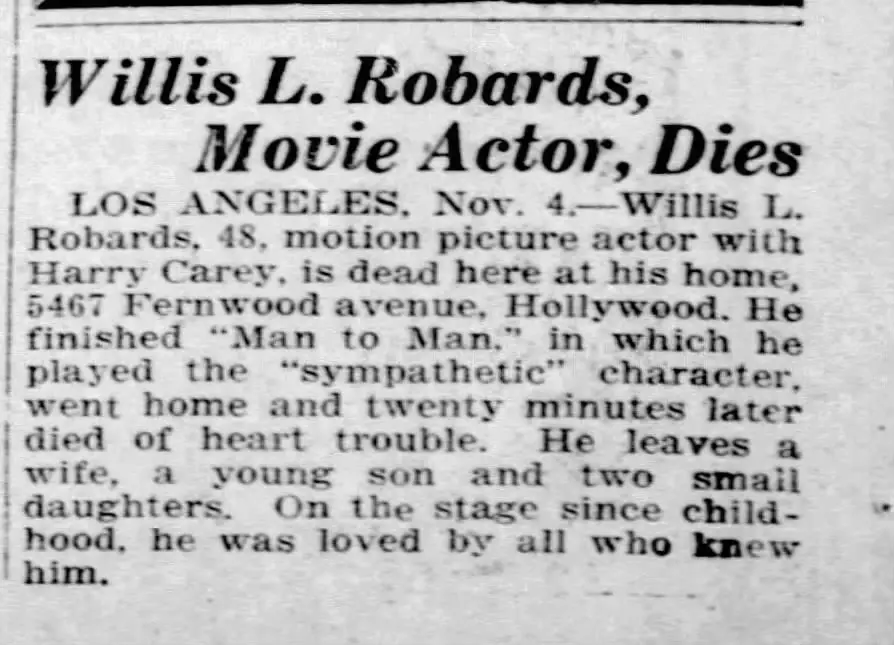
Willis Robards’ Steve Packard surfaces from the narrative surf like a man crawling onto shore after a shipwreck, except the ocean he left behind was a turquoise playground and the shore is a graveyard of cattle skulls. Robards—an actor whose career never quite crested the tidal wave it deserved—brings a sunburned languor to the role, a sense that every gesture costs him something. Watch the way he removes his gloves in close-up: not with the crisp efficiency of the righteous, but with the slow deliberation of a man who suspects the leather might be stitched with his own sins. It’s silent-film acting at its most microscopically eloquent, a semaphore of regret conveyed through knuckle tension.
Charles Le Moyne’s grandfather is granite given gaiters, a living gargoyle of settler capitalism. The screenplay refuses him the balm of redemption; instead it lets his eyes glint like mica under the brim of a sweat-stained Stetson, calculating water rights the way card sharps tally dead men’s aces. When he utters the intertitle, “Blood may own the brand, but brands can be rebranded,” the subtitle card itself seems to curl at the edges, as though even the film stock recoils from the moral corrosion.
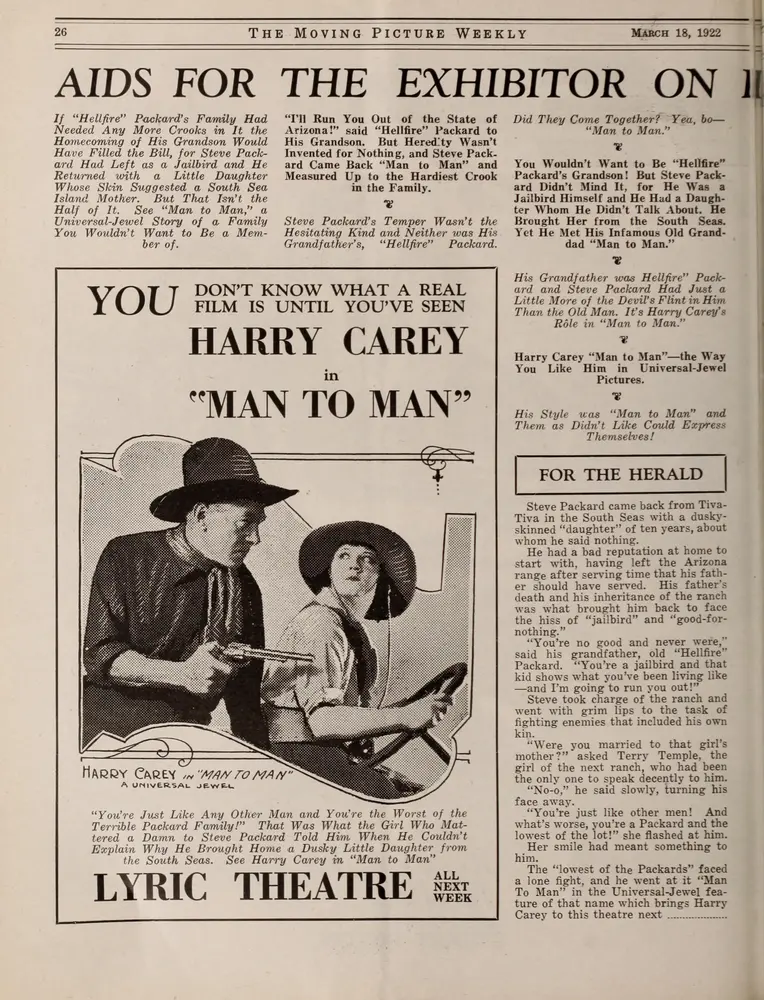
Between these two poles of DNA—beach bum and baron—courses Lillian Rich as Ellen Marlowe, the ranch’s unofficial engineer and the movie’s stealth radical. She strides through corrals in split-skirts, wielding surveying instruments like a cavalry sabre, her very presence an argument that the West was built not by lone gunmen but by cartographers and bookkeepers. Rich, luminous even under orthochromatic stock that tends to devour female faces, projects a cerebral swagger that makes the eventual flicker of romance feel less like narrative obligation and more like geopolitical treaty: two tectonic plates of trauma deciding collaboration beats subduction.
Enter Duke R. Lee’s Joe Blenham—foreman, usurper, collector of other men’s shadows. Lee, who could grin like a coyote tasting carrion, gives the silent era one of its most underappreciated sociopaths. His body language is all elbow and implication; when he leans against a fence rail, the rail seems to confess. The film’s most chilling sequence involves no gunfire at all: Blenham quietly redirects the ranch’s irrigation trench under cover of dusk, a bureaucratic act of violence more devastating than any shootout because it starves the future, not merely the present.
Director Charles R. Seeling shoots this sabotage with proto-noir expressionism: the trench becomes a black gash across the screen, water glinting like liquid obsidian while the windmill creaks in counter-rhythm to the audience’s pulse. You can almost taste the alkali on your tongue, a synesthetic triumph that makes The Stainless Barrier feel antiseptic by comparison.
What elevates Man to Man above the 1922 Western glut is its temporal vertigo. Flashbacks to Steve’s island idyll are double-exposed over the desert footage—palm fronds superimposed on saguaro, ukuleles echoing through canyons—creating a ghost-memory of humidity inside the xerophytic now. The device anticipates the layered timelines of Upstairs by nearly a decade, yet here the past is not exposition but contamination: every grain of South Pacific sand Steve carried home abrades the ranch’s mythology of Manifest Destiny.
Notice how costume designer Mae Giraci (billed as Tyra Duncan) strips Steve’s wardrobe as the film progresses: linen whites surrender to denim, ukulele to six-gun, until in the final reel he appears in a coal-dark shirt that drinks light the way parched soil gulps rain. It’s sartorial alchemy, a color-less color commentary on the price of assimilation.
The restoration currently circulating via Kino’s 4K Blu-ray (struck from a Dutch print discovered in a Haarlem attic) features a commissioned score by Guus van der Steen that avoids the usual Copland-esque pastiche. Instead, he amplifies the atonal groan of windmill gears and overlays sparse Hawaiian slack-key motifs, so when gunfire finally erupts it arrives like a broken chord—both musical and moral dissonance. Turn up the volume during the midnight raid sequence and you’ll hear faint conch-shell resonance beneath the hoof-beats, a subconscious reminder that every colonized landscape carries prior oceans.
Curiously, Man to Man shares DNA with Vengeance Is Mine!—both pivot on contested patrimony and the fungibility of legal documents in territories where ink competes with lead. Yet where Vengeance externalizes guilt through biblical tempests, Man to Man internalizes it, letting the desert itself become both tribunal and co-conspirator. The film also converses with Woman (1923) in its refusal to cast female intellect as mere foil; Ellen’s surveying compass is as phallic as any Colt, and twice as precise.
Modern viewers will flinch at the shorthand used for Indigenous and Mexican laborers—intertitles that brand them “squatters” or “banditos.” Yet the film’s visual grammar complicates the racism: when Blenham’s posse torches a vaquero camp, Seeling frames the arson in long shot, letting the fire become a miniature sunset that dwarfs the riders. The spectacle indicts the perpetrators more than the victims, a rare instance where silent cinema’s grammar of scale subverts its own bigotry. Compare this to the regressive caricatures in The Border Wireless and Man to Man feels almost progressive—an uncomfortable reminder that even poisoned wells can reflect starlight.
The climactic standoff ditches the familiar Main-Street showdown. Instead, antagonists meet in a half-built irrigation tunnel, shadows writhing on wet concrete like cave paintings. Cinematographer Reginald Lyons lights the scene with a single carbide lamp, placing it between the fighters so their silhouettes merge into a two-headed hydra—suggesting that inheritance warps both claimants into the same monstrous lineage. When the gunsmoke clears, the victor staggers not into celebratory daylight but deeper into the tunnel, a blunt metaphor for the hereditary curse that no bullet can sunder.
Trace the genealogy and you’ll find Man to Man’s fingerprints on The Gunfighter (1950) and even No Country for Old Men: the unease of prodigal return, the suspicion that land ownership is merely licensed burial. Yet unlike those talky descendants, this silent progenitor trusts geography to do the expository heavy lifting. Every mesquite shadow, every cicada-click of the sprocket holes, whispers: you can inherit dirt, but dirt also inherits you.
For decades the picture languished on the Library of Congress’s “7-shelf,” a polite bureaucratic euphemism for “we think it exists but we’re not sure where.” Then in 2019 a mislabeled canister marked “Educational Short: Soil Erosion” turned out to contain reels 3 and 5. The Dutch Eye Filmmuseum print supplied the remainder, minus one intertitle card that had to be reconstructed from censorship records—turns out the Chicago board demanded the excision of the word “hellhound” in 1923. The restored card now reads “hounds of perdition,” a euphemism so baroque it feels like victory.
Watch it at midnight with desert-white noise looping on your speakers; let the film’s alkali silence mingle with the hum of your own HVAC—suddenly your living room becomes an annex of the Packard ranch. Better yet, project it onto a bedsheet strung between two ladders in your backyard; let moths rewrite the intertitles in wing-dust Morse. However you ingest it, Man to Man leaves you with the taste of copper and the vertigo of genealogy—an artifact that reminds us every frontier, even the ones inside our blood, demands a toll taller than any mesa.
Verdict: a sun-scorched parable that redefines the Western not as conquest but as inheritance’s open wound—essential viewing for anyone who suspects the past is never past; it’s just waiting by the windmill with a deed in one hand and a six-gun in the other.
IMDb —
1924
Community
Log in to comment.