DbcultAccessing Vault...
Cult Review
Senior Film Conservator
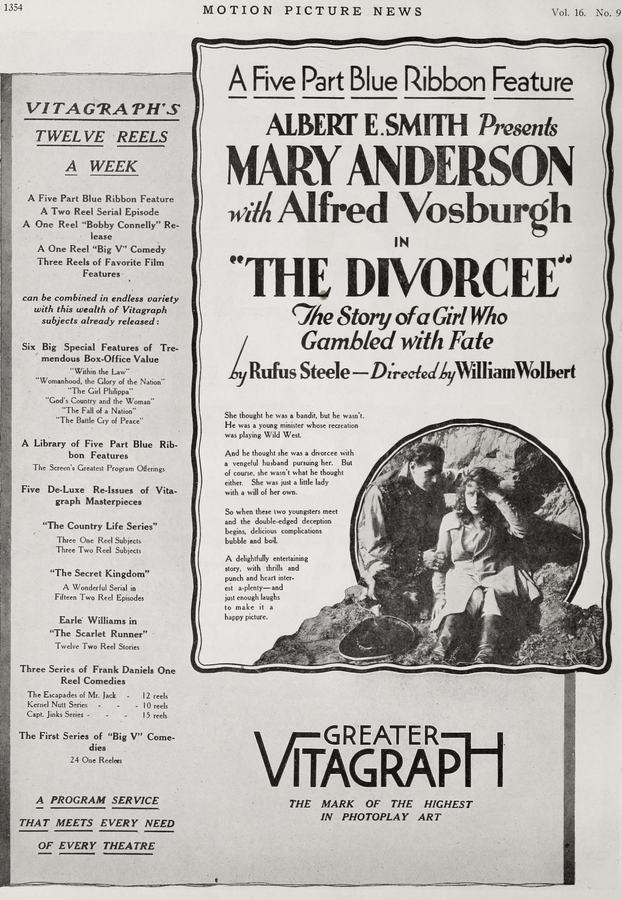
The 1917 iteration of The Divorcee is a peculiar artifact of American silent cinema, a narrative that dances precariously on the edge of social satire and earnest melodrama. Directed with a certain kinetic energy that belies its age, the film serves as a window into the burgeoning 'divorce colony' of Reno, Nevada—a place that, in the early 20th century, represented both a scandalous moral vacuum and a beacon of liberation for the constrained woman. Mary Anderson, as Wanda Carson, delivers a performance that is both mercurial and deeply empathetic, navigating the transition from a naive visitor to a calculated socialite with a dexterity that rivals the era's most celebrated ingenues.
Wanda’s journey begins not with a quest for romance, but with a search for familial connection. Finding her brother Sam absent, she is thrust into the vibrant, almost carnivalesque atmosphere of the divorce colony. It is here that the film’s writer, Rufus Steele, exhibits a sharp wit, as Wanda chooses to inhabit the role of a divorcee. This masquerade is not merely a plot device; it is a commentary on the performative nature of social status. By exhibiting her companion's baby as her own, Wanda taps into a maternal archetype that grants her instant legitimacy and sympathy within the colony. This deception creates a fascinating tension, one that echoes the thematic weight of Tangled Lives, where identity is a fluid and often dangerous currency.
Enter Reverend Jerry Ferguson, portrayed with a stoic intensity by Gayne Whitman. Ferguson is the antithesis of the Reno spirit—a Bostonian moralist who views divorce as a plague upon the American soul. The irony of their meeting is thick enough to cut with a bowie knife. When Jerry rescues Wanda after her horse bolts, the film shifts from social satire to a pastoral romance. Under the aliases of 'Prince Cactus Pete' and 'The Sagebrush Queen,' the pair engages in a courtship that is untainted by the labels of their urban identities. This retreat into the 'hills' serves as a sanctuary where their true selves can interact, free from the didacticism of the pulpit or the gossip of the colony.
The brilliance of The Divorcee lies in its dual-track narrative. While Pete and the Queen fall in love in the wilderness, Wanda and Jerry engage in a fierce intellectual battle in the local newspaper. This anonymous exchange of ideas regarding the morality of divorce adds a layer of intellectual rigor often missing from contemporary rom-coms. It reminds one of the ethical debates found in A Question of Right, where the conflict is as much about ideology as it is about human emotion. The fact that neither realizes they are debating their own lover adds a delicious layer of dramatic irony that keeps the audience tethered to the screen.
Visually, the film utilizes the stark Nevada landscape to mirror the internal states of its characters. The wide, sweeping shots of the hills represent the freedom of their assumed identities, while the cluttered, busy interiors of the Reno townsite reflect the constraints of social expectation. One can see the early influences of European lighting techniques, perhaps reminiscent of the atmospheric work in Det gamle fyrtaarn, in the way shadows are used during the film’s more suspenseful sequences. The holdup scene, in particular, is a masterclass in silent film pacing, using rapid editing and high-contrast lighting to convey Wanda’s mounting panic.
The misunderstanding that drives the final act—Wanda believing Jerry is a bandit—is a classic trope of the era, yet it is handled with a sincerity that prevents it from feeling farcical. This sense of impending doom and the frantic ride to warn the 'outlaw' Jerry captures the same adventurous spirit found in The Three Musketeers, albeit on a more intimate, domestic scale. The pursuit by the sheriff’s posse serves as the catalyst for the ultimate revelation, stripping away the aliases of Cactus Pete and the Sagebrush Queen to reveal the fallible humans beneath.
When comparing The Divorcee to other films of the period, its unique blend of humor and social commentary becomes even more apparent. Unlike the heavy-handed moralizing of The Mortal Sin, Steele’s screenplay allows for a certain level of ambiguity. Jerry is not just a judgmental preacher; he is a man whose convictions are challenged by his heart. Similarly, Wanda is not just a deceiver; she is a woman seeking a space where she can exist without the stifling expectations of her class. The film’s exploration of the 'fallen woman' trope is far more nuanced than in The Devil, where the archetypes are more rigidly defined.
Furthermore, the mystery of the identities and the climactic reveal possess a structural integrity that brings to mind the intricate plotting of The Mystery of the Yellow Room. While The Divorcee is ostensibly a romance, its reliance on secrets and the slow unspooling of truth gives it a suspenseful edge. The presence of the brother, Sam, as the final piece of the puzzle, provides a satisfying resolution that reconciles Wanda’s initial quest with her final destination. It is a moment of clarity that mirrors the thematic resolution in The Great Divide, where the harshness of the West eventually yields to emotional truth.
In the grand tapestry of 1917 cinema, The Divorcee stands out for its refusal to be easily categorized. It possesses the pastoral charm of A Welsh Singer, yet it is infused with a sharp American cynicism regarding the institutions of marriage and the church. The film does not shy away from the darker elements of its premise—the irate husband, the sheriff’s posse, the threat of social ruin—but it maintains a lightness of touch that is truly remarkable. The chemistry between Anderson and Whitman is palpable, even through the flickering grain of a century-old print, proving that some elements of cinematic storytelling are truly timeless.
As the posse closes in and the truth is finally laid bare, the film offers a message of reconciliation that feels surprisingly modern. Jerry’s acceptance of Wanda, despite her deception and her proximity to the 'scandal' of divorce, suggests a move toward a more compassionate form of morality. It is a far cry from the tragic consequences seen in Livets konflikter. Instead, The Divorcee concludes with a vision of a future built on mutual understanding and the shedding of false personas. It is a testament to the power of the silent screen to convey complex human emotions with nothing more than a flicker of the eye and the tilt of a hat.
Ultimately, this film is a vibrant reminder of the sophistication of early cinema. It handles its themes of identity, morality, and social change with a grace that is often lacking in more didactic works like The Governor or the overtly religious La crociata degli innocenti. Whether you are a scholar of the silent era or a casual viewer looking for a compelling story, The Divorcee offers a rich, rewarding experience that transcends its historical context. It is a film that deserves to be remembered not just as a curiosity of 1917, but as a genuine piece of art that continues to resonate today.
IMDb —
1918
Community
Log in to comment.