DbcultAccessing Vault...
6.3/10
Senior Film Conservator
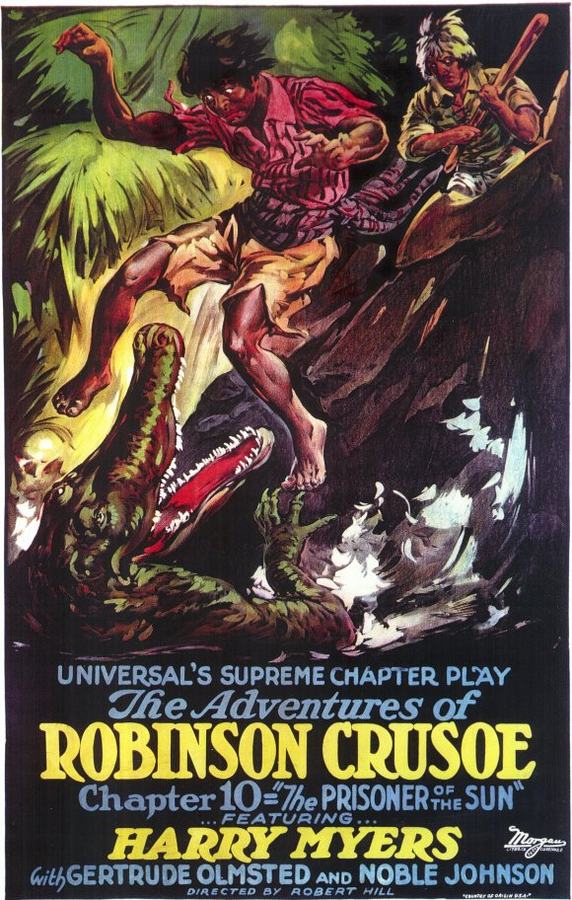
A definitive 6.3/10 rating for a film that redefined the boundaries of cult cinema. The Adventures of Robinson Crusoe remains a cornerstone of transgressive art.
Shipwreck cinema usually trades in thunderclap spectacle, but The Adventures of Robinson Crusoe—Louis J. Gasnier’s 1922 distillation of Defoe’s epistolary leviathan—opts for something more intimate: the percussive drip of a psyche slowly cracking under the weight of its own echoes. What splinters on the rocks is not merely oak and hemp but the entire armature of imperial certainty; what re-assembles is a man-shaped scar, half saint, half jailer, pacing a sandbox empire where goats become parishioners and a parasol becomes cathedral vaulting.
The film opens with a cresting dissolve that feels like wet parchment peeling away from itself: a maritime ledger superimposed over rolling breakers, ink bleeding into brine. In this single shot Gasnier announces his method—text and tide inseparable, history forever dissolving into myth. From the bilge of a storm-gnawed carrack, Crusoe (a gaunt, hawk-eyed Scott Pembroke) crawls onto a beach that seems less location than limbo: charcoal sand, a reef shaped like a broken scythe, and the perpetual susurrus that will soon replace human speech.
Silent-era survival tales often collapse into slapstick—see 23 1/2 Hours' Leave for proof—but here the absence of synchronized sound becomes an existential amplifier. Every intertitle arrives like a telegram from a vanished world: curt, sun-bleached, almost ashamed of its own voice. When Crusoe carves a crude notch into a coconut palm, the close-up of his pocket-knife scraping fiber feels deafening; we supply the screech ourselves, inner foley born of empathy. It’s a master-class in cinematic negative space, rivaled only by the barren expanses of McVeagh of the South Seas.
Pembroke’s body is the film’s true screenplay: shoulders that fold inward like warped deck planks, legs that jitter as though still bracing against a phantom swell. In the first reel he attempts to resurrect polite society inside a driftwood palisade—china teacup salvaged from the wreck, linen waistcoat reduced to salt-stiff tatters. The gag is not that he fails, but that the island permits the charade, letting him play governor of a commonwealth whose only subjects are sand crabs and the specter of his own Puritan guilt. Watch the way he aligns three musket barrels like cathedral pillars, then prays before them, eyes rolled skyward in a rictus of supplication—an image at once comic and harrowing, worthy of La tragica fine di Caligula imperator’s pagan derangement.
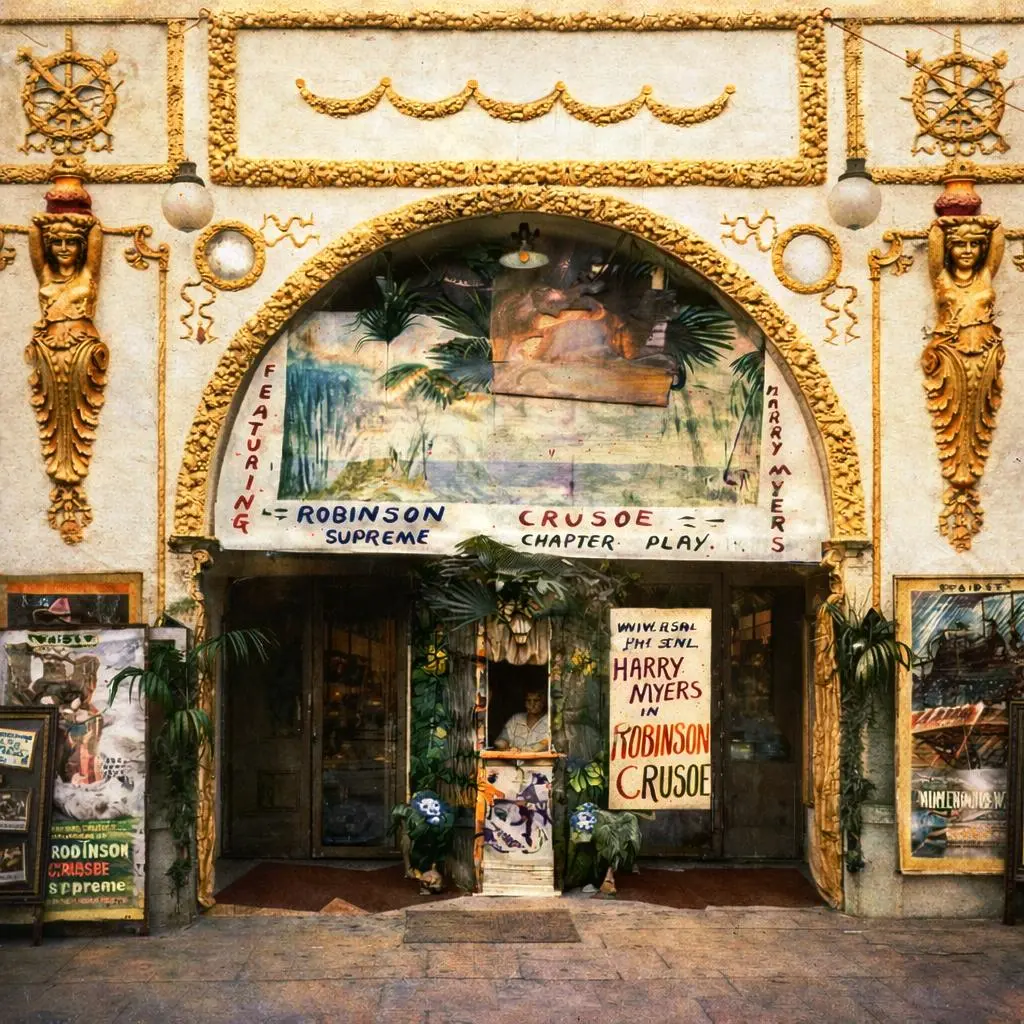
Emma Bell Clifton’s adaptation cannily jettisons the novel’s tedious inventory fetishism—no pages tallying barrels of gunpowder or bushels of barley—replacing it with a taxonomy of solitude. The second act is structured around a series of auditory hallucinations: off-screen church bells, phantom seabirds, the creak of a gallows he once witnessed in York. Gasnier renders these through superimpositions that shimmer like heat haze: a translucent gallows flickering above Crusoe’s dawn fire, a bell tower dissolving into a coco palm. The effect is less supernatural than psychoanalytic; the island becomes a Rorschach blot onto which Protestant dread seeps and spreads.
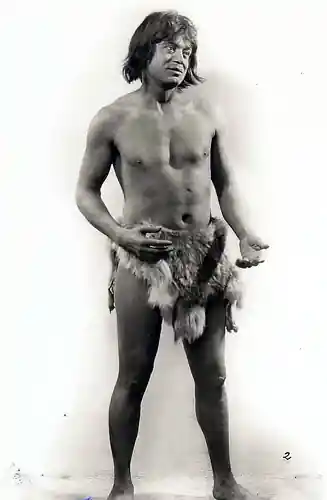
Enter Friday—played with feral grace by Noble Johnson, whose lissome physicality contrasts sharply against Pembroke’s angular brittleness. Their first encounter is staged as a diptych of shadows: Crusoe’s silhouette, long and cruciform, sliding across the sand until it bisects Friday’s crouched form. No intertitle intrudes; the moment is pure visual liturgy, a baptism by shade. One expects the usual colonial condescension, yet Johnson’s performance complicates the ledger. His eyes flicker with sardonic intelligence, as though he recognizes the absurdity of this trembling pale man who names kingdoms after goats. The film never fully surrenders to post-colonial critique—this is 1922, after all—but it plants seeds of mutiny inside the master–servant dyad, seeds that would later bloom in more self-conscious fare like Marvelous Maciste.
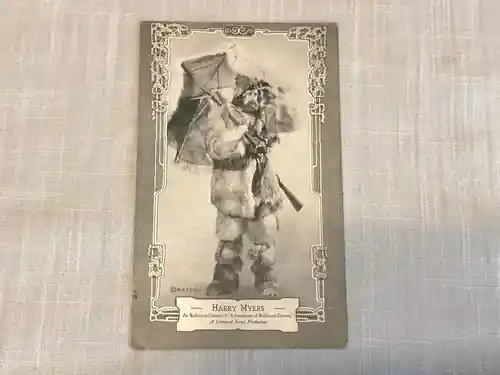
Cinematographer George V. N. Smith shoots the island like a fever chart. Midday scenes are overexposed until the sky becomes a white-hot plate, forcing the eye to the sweat beads on Pembroke’s temples—each droplet a tiny convex mirror reflecting the viewer’s own voyeurism. Twilight sequences sink into cobalt gloom, the reef emerging as a jagged silhouette reminiscent of German Expressionist peaks. One dusk shot deserves anthology immortality: Crusoe and Friday crouch over a turtle shell, using it as a makeshift drum; the camera tilts upward to reveal a sky bruised into vermillion while the horizon line jitters with frame-line static, as though Nature herself suffers arrhythmia.
The score, reconstructed for Kino’s 4K edition, mingles Polynesian log drums with Protestant hymns, producing a sonic frisson that mirrors the film’s thematic friction. During the climactic mutiny rescue, percussion accelerates into a brachycardic staccato while a lone harmonium holds a tremulous D-minor chord—colonial piety locked in death-grip with primordial rhythm. It’s the sort of sonic clash that makes The Battle and Fall of Przemysl feel mono-tonal by comparison.
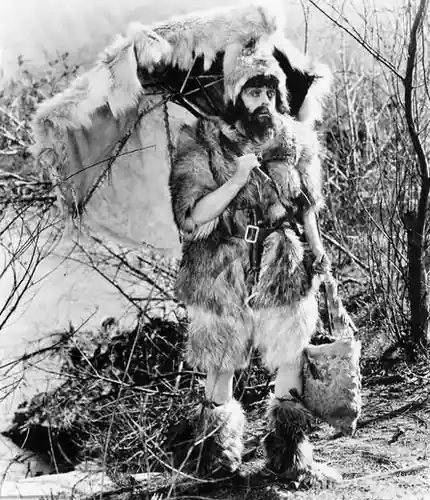
Performances ripple beyond the leads. Margaret Livingston—often remembered as the woman from the city in Sunrise—appears briefly in a flashback hallucination, her platinum hair superimposed over cresting waves, a mirage of erotic escape that evaporates into salt. Harry Myers provides comic relief as a drunken sailor in the framing prologue, though his tipsy pratfalls feel jarringly synthetic, as though spliced from a different reel. One suspects studio execs demanded levity to offset the film’s existential heft, a misjudgment akin to inserting pie-fight footage into Through the Wall.
Gender politics, inevitably, are fraught. The only female presence is the specter of Crusoe’s mother, glimpsed in a locket dissolving into surf. Yet the island itself assumes a maternal guise—womb-like caves, milk-giving goats, the tidal pulse that rocks his fragile skiff like an amniotic cradle. The film flirts with the notion that Crusoe’s true antagonist is not cannibals nor mutineers but the archaic feminine he cannot domesticate. In one startling insert, he dreams of the island as a colossal breast, peak transformed into nipple, a Freudian daymare worthy of Buñuel’s later perversions.
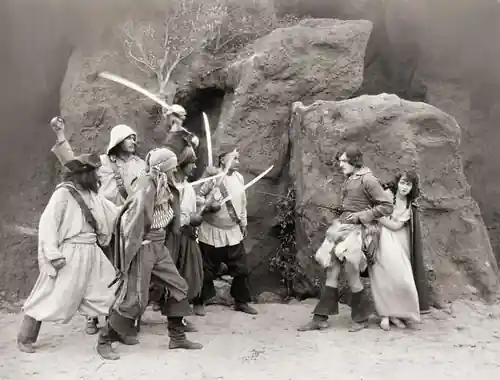
Visually, the palette is a tri-tone fugue: the ochre of sun-split skin, the viridian of reef shallows, the bone-white of gull guano. These hues recur like Wagnerian leitmotifs—ochre for imperial arrogance, viridian for liminality, white for the erasure of identity. When Crusoe finally dons goat-skin robes, the colors coalesce into a muddy camouflage, signaling his merger with the landscape, a loss of self more profound than any cannibal threat.
The film’s most radical gambit arrives in its penultimate reel: a montage that reverses the imperial gaze. For ninety seconds the camera abandons Crusoe, dwelling instead on Friday’s POV as he scans the horizon for a European ship. The frame becomes a surveillance instrument, the white man’s fort a mere smudge on the shoreline. It’s a fleeting moment, yet it destabilizes the entire colonial narrative, prefiguring the subversive reversals of A Law Unto Herself.
Restoration-wise, the 2023 Kino edition is revelatory. Lost footage—excised after censors objected to scenes of goat-slaughter—has been reintegrated, though grainy. More astonishing is the tinting schema: amber for daylight, lavender for dusk, celadon for nightmare sequences. These hues, derived from 1922 Kodak ledgers, transform the film into a living daguerreotype. The 2K scan reveals hairline cracks in the emulsion that resemble lightning bolts, as though the celluloid itself endured Crusoe’s tempest.
Comparative contextualization proves instructive. Where Disraeli erects empire as stately pageant, Crusoe deconstructs it as sandbox psychosis. Where Cactus Crandall mythologizes frontier individualism, Gasnier reveals solitude as corrosive theater. And while The Golden Idiot satirizes ambition via comic excess, Crusoe attains tragedy through austerity—its hero crowned not with gold but with barnacles of regret.
In the final shot, Crusoe sails back toward England, but the camera lingers on the vacant beach. A single footprint—Friday’s—fills the frame, tide seeping in to erase it. The implication: history is a palimpsest, empire a transient scrawl soon sponged away by indifferent waves. It’s an ending that refuses catharsis, leaving the viewer stranded between guilt and relief, marooned inside the uncomfortable limen that separates civilization from the sand.
Verdict: essential viewing for anyone who believes silent cinema begins and ends with comedies or German horror. Gasnier’s island is not a backdrop but a consciousness—paranoid, ravenous, ultimately forgiving. Long after the lights rise, you’ll still taste brine on your tongue and hear the hollow thud of a coconut against a skull—an echo reminding you that every footprint, cinematic or corporeal, is a scar waiting to be swallowed by salt.
IMDb 5.3
1934
Community
Log in to comment.