DbcultAccessing Vault...
Cult Review
Senior Film Conservator
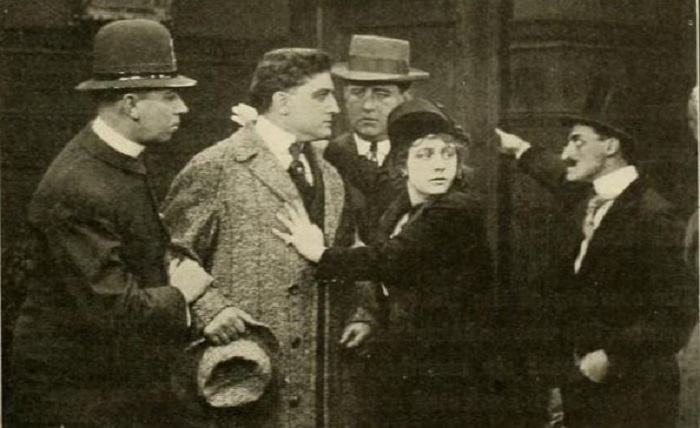
A champagne-bright engagement ring dangles over Chicago’s smoky cabarets like a guillotine blade; beneath it, a chorus girl’s laughter—too sharp, too knowing—cuts through the tuxedoed hush.
Nancy Mann Waddel Woodrow’s scenario, compressed into a brisk two reels, detonates a moral stick of dynamite inside polite society’s drawing room and dares the audience to sniff the cordite. The film’s engine is not the impending marriage of the blandly aristocratic lead (Thomas Commerford’s milquetoast millionaire) but the centrifugal spite of his so-called chums—Rapley Holmes and Francis X. Bushman, preening like peacocks on ether—who decide that homicide, or at least its counterfeit, constitutes a jolly jape. Their victim: Ruth Stonehouse’s flint-eyed showgirl, whose scarlet costume bleeds into the monochrome grain, a flare of crimson ambition.
Director (and presumed auteur) Harry A. Pollard—never renowned, forever hustling—compresses the city’s nocturnal metabolism into chiaroscuro shards. A single alleyway set, redressed by angle and shadow, becomes purgatory, courtroom, and lovers’ lane. The camera, restless as a newsboy, cranes over a fire-escape lattice to glimpse Stonehouse dangling a cigarette like a comma between sentences of contempt. Intertitles, lettered in a curling Edwardian scrawl, do not merely annotate; they jeer. “She knew too much—so she had to die—perhaps!” The dash and the conditional twist the knife.
Ruth Stonehouse, usually tasked with pearl-clutching ingenues, here unleashes a proto-femme fatale, equal parts venom and vulnerability. Watch her eyes in medium-close shot as the hoax unravels: the pupils dilate, not with fear but with the narcotic thrill of narrative power. She is the only performer who senses that melodrama is simply tragedy wearing tap shoes. When she slaps Commerford—an audible crack achieved by off-camera palm collision—the film’s entire moral ledger ricochets across the screen.
Where The Isle of the Dead traffics in Symbolist dread and During the Plague wallows in pestilential nihilism, The Battle of Love locates horror in social embarrassment—in the possibility that champagne might go flat. Yet the triangulation of guilt, performance, and resurrection binds all three. Viewers who relish the guilt-ridden clergyman of The Silence of Dean Maitland will recognize the same sulphurous whiff of sin here, merely lacquered with jazz-age glitter.
Woodrow’s intertitles deserve anthologizing. Consider: “Love is a battlefield where the wounded brag of their scars.” The line, tossed between scenes of pratfall farce, detonates like shrapnel. It is impossible, once heard, to un-hear—an epitaph for every romantic who ever mistook masochism for devotion. The film’s brevity (scarcely 24 minutes at sound speed) forces each syllable to multitask as exposition, epigram, and epistemological grenade.
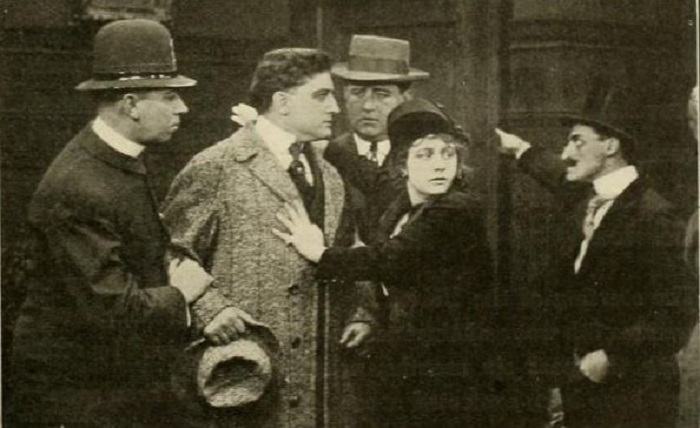
Bushman, later to flex heroic biceps in The Duke’s Talisman, here plays the ringleader as a hollowed-out dandy, his grin a billboard for moral bankruptcy. The performance anticipates the louche aristocrats in Le diamant noir but with a uniquely American flair: the connoisseurship of cruelty disguised as collegiate hijinks. When his prank sours, the camera lingers on his perspiring upper lip—a microscopic glacier of dread melting under klieg lights.
The women orbit in ellipses of power that the men misread as circles of subservience. Helen Dunbar’s matriarch, armed with a lorgnette that doubles as inquisitorial spear, skewers male hypocrisy with raised eyebrow semaphore. Lillian Drew’s loyal fiancée, ostensibly the naïf, engineers the final act’s absolution by weaponizing gossip itself—she becomes the first viral publicist, seeding courtroom galleries with sympathetic ears. The film quietly insists that in the modern city, information travels faster than virtue or vice.
Viewed today, the movie’s fake-murder prank vibrates with queasy resonance—an ancestor to swatting, deepfakes, and cancel culture. Yet the nitrate tenderness, the flutter of hand-cranked exposure, renders the barbarism oddly innocent. We occupy a century-long Möbius strip: our technology sophisticates while our ethics gyrate in place. The film’s final shot—a clasped hands silhouette against a sunrise painted on glass—feels less like closure than like a dare: “Prove you’ve evolved.”
Accompanied by a contemporary pianist versed in stride and noir dissonance, the movie metamorphoses. Each discordant cluster undercuts the onscreen guffaws; ragtime cadenzas collide with funeral marches. The effect resembles watching A Study in Scarlet while hearing the echo of bombs from With the Army of France. Silence, it turns out, is the most fertile soundtrack.
Most one-reelers of 1914 survive only as paper synopses or brittle lobby cards, yet The Battle of Love endures in a 35-mm print of flabbergasting clarity, thanks to a Missouri projectionist who sealed it inside a piano crate during the scrap-metal drives of WWII. The print bears lavender tinting during night scenes, a chromatic hallucination that suggests the world viewed through absinthe goggles. MoMA’s 2022 photochemical restoration reinstated these hues, refusing the modern orthodoxy of desaturated “authenticity.”
The DNA of The Battle of Love reemerges in The Spitfire where another woman’s reputation combusts for male sport, and in The Fugitive whose protagonist flees not law but shame. Even the jaunty nihilism of C.O.D. owes a bar tab to Pollard’s cocktail of mirth and malice.
Should you track down this spool—at a repertory house, on a DCP, or in the phantom flicker of a 16-mm society screening—let its brevity mislead you. The Battle of Love is a hand grenade wrapped in a Valentine. It argues, with jaunty malice, that every era believes itself too savvy for pratfall cruelty, yet each coughs up fresh blood on the cabaret floor. Laugh, gasp, then check your own ring finger for latent scars.
IMDb —
1920
Community
Log in to comment.