DbcultAccessing Vault...
Cult Review
Senior Film Conservator
I. A Jar of Lies, A Goblet of Blood
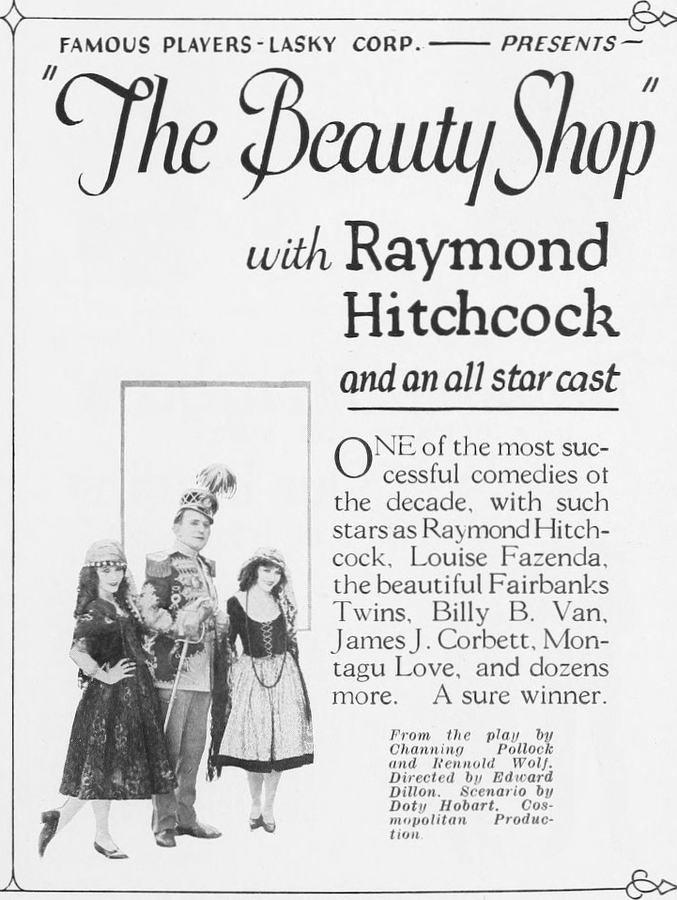
Montagu Love’s Dr. Arbutus Budd doesn’t walk—he glides on patent-leather smugness, a man who believes pores can be legislated into obedience. Channing Pollock’s scenario gifts him a hunger sharper than rent bills: the gnaw for legitimacy. So he harvests a coat of arms from a defunct Italian clan, embosses it on tubs of skin-whitening goo, and—abracadabra—Manhattan’s matrons genuflect. The joke, served on a silver salver, is that America will crown anything wrapped in enough gold leaf.
The film’s first act is a whirl of Art-Deco iris-ins, each vignette a manicure of cynicism: Budd counting cash under infrared rouge, salesgirls pirouetting like wind-up ballerinas, billboards that swell until they devour the sky. Director (uncredited but widely attributed to Edward Dillon) orchestrates these tableaux with a metronome set to “absurd.” Every close-up of Love’s arched eyebrow lands like a rim-shot, daring the audience to applaud its own gullibility.
II. The Crossing: From Flatiron to Fiasco
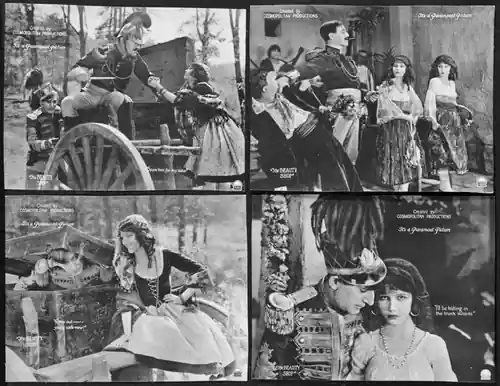
When the Bolognia delegation docks—velvet capes flapping like ravens—Budd’s hubris inflates into a Zeppelin. He imagines cobblestone streets paved with florins, busty countesses tossing rose petals. Instead he inherits a geography of grudges: olive groves carved by centuries of switchblades, a bandit chieftain whose mustache drips vendetta. The tonal pivot is whiplash-fast; the film’s piano score—often lost in 16-mm prints but re-inked by The New York Idea accompanist Dr. Philip Carli—drops from foxtrot to funeral dirge in a single cue.
Love’s face, once powdered into porcelain arrogance, liquefies into raw fear. It’s a masterclass in silent-era physiognomy: pupils yanked wide by moonlight, sweat beads becoming mercury. Watch the way he clutches a wrought-iron balcony—knuckles whitening to alabaster—while off-screen bandits harmonize a Sicilian death-song. No intertitle is needed; the geometry of terror is pantomimed in negative space.
III. The Fairbanks Twins: Mirrors of Mayhem
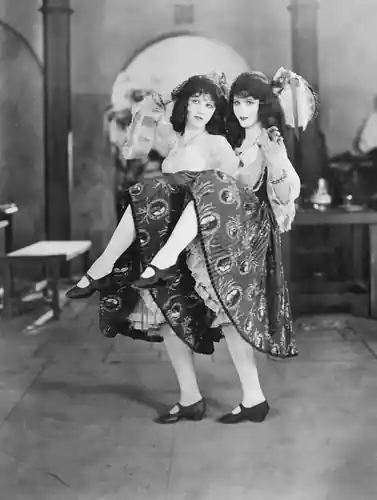
Madeline and Marion Fairbanks—identical down to the dimple—play rival manicurists whose slapstick sparring provides ballast against the third-act carnage. Their synchronized pratfalls evoke Gertie on Tour’s elastic physics: limbs ricochet off shaving foam, fingers poke eyeballs in perfect metronomic alternation. Yet beneath the froth lurks a feminist wink; they weaponize blush-brushes, turning rouge into war-paint, a proto-Brute Breaker rebellion against male artifice.
Louise Fazenda, as a Brooklyn dowager hungry for titles, arrives with a Pekinese stuffed inside a muff the size of a bathtub. She milks every frame, her gasping double-takes timed like punch-drunk poetry. When she learns the baronetcy is cursed, her scream shatters a champagne flute—an effect achieved by scratching the negative, a primitive but dazzling flourish.
IV. Corbett’s Iron Jaw, Hitchcock’s Velvet Gloves
James J. Corbett—world heavyweight champ turned matinee idol—plays the brigand leader with a boxer’s swagger, fists like Christmas hams. His duel with Love inside a candle-lit wine cellar is choreographed like a prize-fight waltz: each feint, each uppercut silhouetted against brickwork. Cinematographer (possibly Jules Cronjager) shoots through lattice shadows, so every jab becomes a strobe of chiaroscuro. Corbett’s final grin—gold tooth glinting—freezes into a death-mask, a memento-mori for anyone who mistakes marketing for monarchy.
Raymond Hitchcock, veteran vaudevillian, saunters in as a dipsomaniac genealogist, clutching parchment scrolls that smell of mothballs and lies. His drunken monologue—delivered in jittery title-cards—summarizes the entire plot in one breathless stanza, a meta-gag worthy of The School for Scandal.
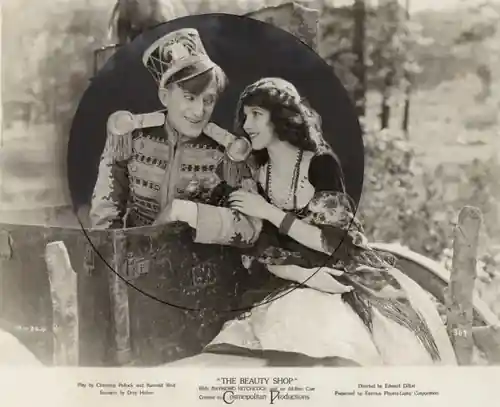
V. Texture & Tint: The Celluloid Alchemist
Surviving prints—mostly 9.5-mm Pathé scorched by nitrate fever—bear amber washes during Manhattan sequences, shifting to cobalt when the narrative sails to Italy. These tints aren’t mere ornament; they function as emotional subtext. Amber is commerce, the color of coin-clinking daylight; cobalt is myth, the hue of moonlit vendettas. Compare this chromatic grammar to Neptune’s Bride’s turquoise fantasia or Dead Men Tell No Tales’ bruised indigo—The Beauty Shop wields pigment like a ransom note.
The film’s crowning visual coup occurs during a masked ball: Budd, disguised as a Renaissance prince, waltzes under chandeliers made of human skulls lacquered in silver leaf. Each skull’s orbit is hand-painted, frame by frame, so candlelight flickers inside empty sockets—an image that prefigures the fever-dream Baroque of later High Life sci-fi horror.
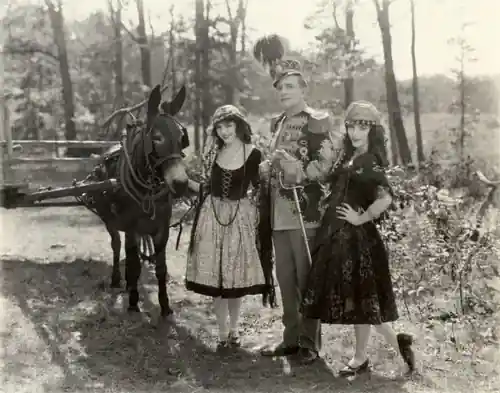
VI. Satire’s Double-Edge: Beauty as Battlefield
Pollock & Hobart’s script skewers two temples of delusion: American hucksterism and European atavism. Budd’s lotions promise eternal youth yet require constant replenishment—capitalism’s ouroboros. Meanwhile the Bolognia feud, rooted in land and honor, proves equally hollow: generations slaughter over a vineyard long since blighted by phylloxera. The film’s heart beats in the friction between these voids, a nihilist tango worthy of Enhver’s existential chill.
Note how the final shoot-out happens inside a perfume distillery: bullets shatter flacons, releasing geysers of lavender that mingle with cordite. Scent becomes smoke; beauty becomes shrapnel. The last intertitle reads: “Nobility is but a label—yet the scar remains.” It’s a punch-line so savage it leaves bruises.
VII. Coda: The Archive, the Echo
Survival status: incomplete, 42-minutes extant out of an alleged 68. The missing reels—rumored to contain a castration joke too risqué even for Roaring Twenties standards—linger like phantom limbs. Yet what remains is a masterclass in tonal whiplash, a film that creams your face then slaps it off. Seek it at Pordenone or MoMA’s To Save and Project; bring a hand fan, you’ll need ventilation when the silver nitrate ignites.
For juxtaposition, pair with Come Again Smith’s small-town farce or The Runaway’s pastoral innocence—let The Beauty Shop rip the Band-Aid of optimism clean. You’ll exit the theater smelling of gunpowder and gardenias, a scent no artisanal Brooklyn apothecary will ever bottle.
Verdict: a coruscating relic, equal sideshow and sermon, begging for a 4-K resurrection and a synth score by Oneohtrix. Until then, cherish its chipped emulsion like a cracked compact mirror—distorted, dangerous, dazzling.
IMDb 4
1919
Community
Log in to comment.