DbcultAccessing Vault...
4.3/10
Senior Film Conservator
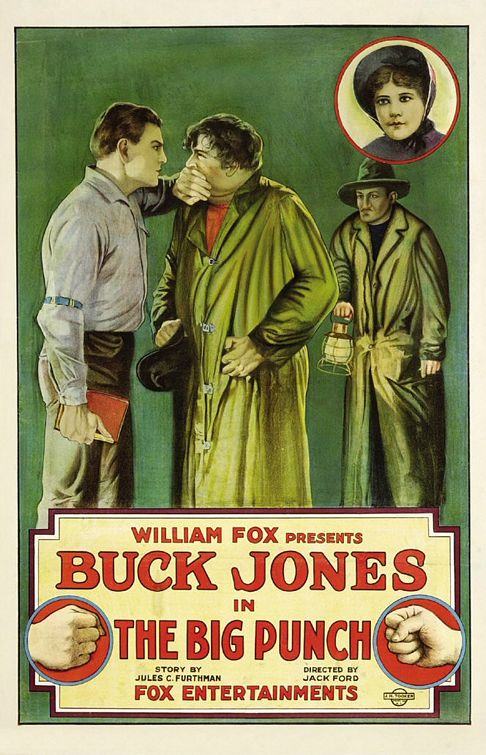
A definitive 4.3/10 rating for a film that redefined the boundaries of cult cinema. The Big Punch remains a cornerstone of transgressive art.
The Big Punch (1929) is a cinematic relic that marries the raw energy of Western pulp with the quiet introspection of a man grappling with his soul. In an era when Hollywood was still learning to balance spectacle with substance, this film stands as a testament to the genre’s potential for moral complexity. Buck Jones, in his role as the conflicted protagonist, embodies the paradox of a sinner seeking redemption, a theme that John Ford and Jules Furthman amplify with striking visual and narrative economy.
The film opens with a jarring contrast: Buck, a man of principle, is poised to enter theological seminary, a choice that suggests a lifelong commitment to virtue. Yet his world is upended when his brother and a band of associates, having fled from justice, pull him into their orbit. This act of familial loyalty—or perhaps complicity—results in Buck’s imprisonment, a narrative pivot that transforms a potential parable of piety into a meditation on the costs of blood ties. The prison sequences are rendered with stark realism, the clanging of iron doors and the hushed conversations of inmates underscoring the gravity of Buck’s situation. It is here, amidst the grim architecture of confinement, that he meets Hope Standish (Jennie Lee), a Salvation Army worker whose presence is both a beacon of hope and an implicit challenge to Buck’s moral inertia.
What follows is a masterclass in character-driven storytelling. Hope is not the archetypal angelic figure; instead, she is portrayed with a nuanced blend of warmth and resolve, her interactions with Buck laced with a quiet intensity that suggests mutual transformation. The film’s most compelling dynamic emerges in the push-pull between Buck’s criminal past and his burgeoning spiritual aspirations. Ford and Furthman refuse to offer easy resolutions, allowing Buck’s journey to unfold with the messiness of real human growth. His eventual return to his hometown, where he inherits the mission of a dying circuit rider, is less a triumph and more a continuation of a lifelong odyssey toward self-understanding.
The cinematography, though constrained by the era’s technical limitations, is purposeful. Ford’s use of wide, desolate landscapes mirrors Buck’s internal loneliness, while the tight close-ups during his conversations with Hope capture the unspoken tension between them. The script’s dialogue, sparse yet loaded with subtext, avoids melodrama, opting instead for understated exchanges that resonate with authenticity. This restraint is particularly evident in the scenes where Buck attempts to convert his brother, a subplot that serves as both a test of his newfound convictions and a commentary on the futility of imposing morality.
Thematically, The Big Punch operates on multiple levels. On the surface, it is a crime drama with the taut pacing of a noir, but beneath that lies a richer exploration of faith and identity. The recurring motif of the circuit rider—a man dedicated to spreading the Gospel across barren towns—serves as a metaphor for Buck’s own mission: to bridge the gap between his fractured past and an uncertain future. The film’s climax, wherein Buck confronts his brother’s redemption and his own feelings for Hope, is handled with a delicate hand; the resolution is neither wholly triumphant nor despairing, but rather a quiet acknowledgment that redemption is a continuous process rather than a finite achievement.
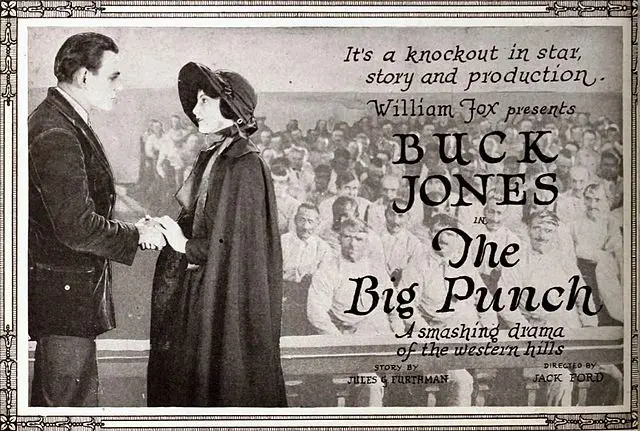
The performances are uniformly grounded. Buck Jones, though perhaps an unconventional choice for a seminary-bound figure, brings a rugged sincerity to the role that feels earned. Jennie Lee’s portrayal of Hope is a masterstroke of subtlety; her character’s strength is conveyed not through grand gestures but through the steadfastness of her gaze and the cadence of her voice. Supporting players, including Jack McDonald and Al Fremont, add depth without overshadowing the central narrative, their roles serving to highlight the broader societal forces at play in Buck’s journey.
In the context of Ford’s filmography, The Big Punch is a fascinating precursor to his later, more celebrated works. The director’s affinity for vast landscapes and morally ambiguous characters is evident, yet this film lacks the mythic resonance of The Searchers or the lyrical melancholy of Stagecoach. Instead, it occupies a transitional space, where the Western genre is still grappling with its own identity. This is not to diminish its value—rather, it underscores the film’s role as an important stepping stone in Ford’s evolution as a storyteller.
Comparisons to other films of the period are instructive. Like Lucrezia Borgia (1929), which similarly juxtaposes power and morality, The Big Punch uses its genre conventions to probe deeper philosophical questions. However, where Lucrezia Borgia leans into operatic excess, The Big Punch maintains a restrained tone, its power lying in its emotional restraint. Similarly, the film’s exploration of redemption echoes that of The Heart of a Hero (1929), though with a more grounded, less romanticized approach. Both films, however, share a preoccupation with the idea of legacy—how one’s actions shape not only their own identity but also the community around them.
The film’s greatest strength lies in its ability to balance narrative momentum with thematic depth. The subplot involving the escaped brother is handled with commendable care, avoiding the clichés of redemption-through-violence that plague many crime dramas. Instead, Buck’s influence on his brother is portrayed as a gradual, almost imperceptible shift, a testament to the film’s belief in the transformative power of genuine connection. This nuanced approach extends to Buck’s relationship with Hope, which is developed with a delicacy that resists romantic clichés. Their interactions are charged with unspoken longing, yet the film never reduces them to mere archetypes.
Technically, the film is a product of its time. The editing is brisk, the pacing deliberate, and the score—a blend of somber piano and haunting strings—complements the narrative’s introspective nature. The set designs, particularly the prison and circuit rider’s home, are rendered with a starkness that enhances the film’s thematic focus on isolation and moral purification. Yet, for all its technical simplicity, The Big Punch never feels dated. Its themes of self-discovery and the search for meaning remain strikingly relevant, a testament to the timelessness of its central question: Can a man truly outrun his past?
In conclusion, The Big Punch is a film that rewards patience and attention. It is neither a crowd-pleaser nor a cinematic showpiece, but rather a quiet, introspective work that lingers in the mind long after the credits roll. For modern audiences, it serves as a reminder of the Western genre’s capacity for nuance and depth, and for cinephiles, it is a fascinating artifact of early 20th-century storytelling. John Ford and Jules Furthman have crafted a film that is as much about the internal struggles of its protagonist as it is about the external conflicts that shape his journey. In an age where cinema often prioritizes spectacle over substance, The Big Punch stands as a quiet rebellion—a film that dares to ask difficult questions and offers no easy answers.
IMDb 6.8
1934
Community
Log in to comment.