DbcultAccessing Vault...
6.3/10
Senior Film Conservator
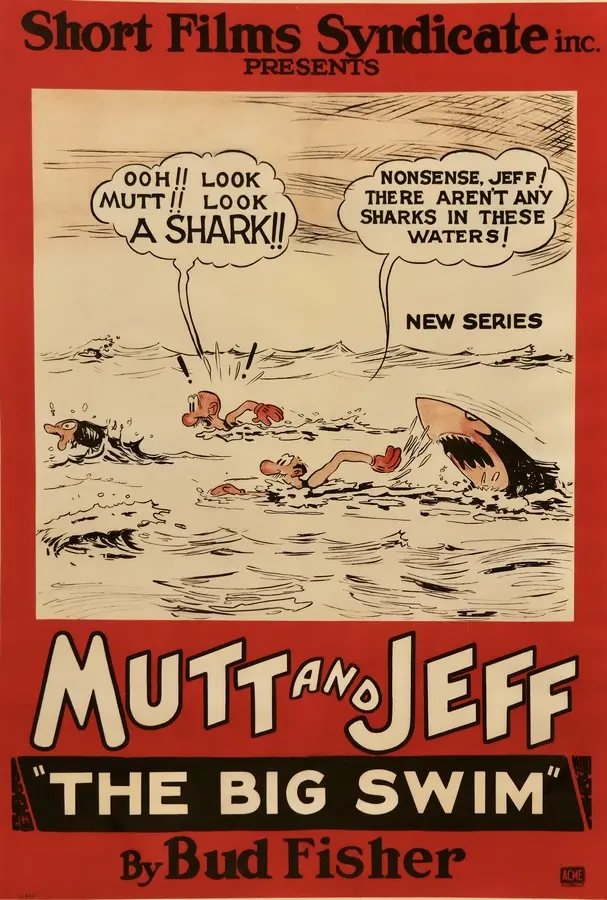
A definitive 6.3/10 rating for a film that redefined the boundaries of cult cinema. The Big Swim remains a cornerstone of transgressive art.
Short answer: Yes, but only if you have an appetite for the truly bizarre. The Big Swim is not your standard 1920s slapstick; it is a mechanical fever dream that prioritizes visual impossibility over narrative logic. It is for the viewer who finds Buster Keaton too grounded and Charlie Chaplin too sentimental. It is decidedly NOT for anyone looking for a coherent story or emotional depth.
1) This film works because it treats the physical world as a flexible playground for stop-motion sorcery.
2) This film fails because its frantic pacing leaves no room for character development or stakes.
3) You should watch it if you want to see the prehistoric roots of surrealist cinema and practical effects.
To understand The Big Swim, one must first understand the enigma of Charles R. Bowers. While contemporaries like Larry Semon were busy crashing cars, Bowers was busy animating them into existence. In this short, the 'Bowers Process' is on full display. This wasn't just film; it was an engineering feat. When Charley interacts with his environment, there is a tactile, heavy quality to the absurdity that modern CGI simply cannot replicate. It is clunky. It is mechanical. It is brilliant.
Take, for instance, the sequence involving the 'swimming' apparatus. In a standard comedy of the era, such as The Duck Hunter, the humor would derive from the character's incompetence. In Bowers' world, the humor comes from the terrifying efficiency of the machine. The machine works, but in a way that feels fundamentally wrong to the human eye. This uncanny valley is where Bowers lived, and it’s why his work remains so fascinating a century later.
Critics often compare Bowers to Keaton because of their shared stoicism, but that comparison is lazy. Keaton was a master of the body; Bowers was a master of the object. In The Big Swim, the environment is the star. The water isn't just a setting; it's a medium for Charley’s latest contraption to fail upward. Unlike the more traditional comedic beats found in A Milk Fed Hero, the gags here feel like they were designed by a mad scientist rather than a screenwriter.
There is a specific moment where a mechanical bird or gadget (common in Bowers' repertoire) intervenes in the action. The transition between the live actor and the stop-motion model is so seamless for 1926 that it creates a jarring, surrealist effect. It’s unsettling. It works. But it’s flawed. The flaw lies in the lack of a 'human' anchor. We don't care if Charley wins; we only care what he builds next.
The Big Swim is an essential watch for anyone interested in the technical evolution of cinema. If you’ve spent time with the social dramas of the era, like Lily of the Dust, Bowers will feel like a bucket of ice water to the face. It is a reminder that early cinema wasn't just trying to tell stories; it was trying to figure out what the camera could do that the stage could not. This film is a laboratory, not a theater.
However, for a casual viewer, the 15-minute runtime might feel like an eternity. The lack of a clear 'antagonist'—other than the laws of physics themselves—means the tension is non-existent. It is a series of 'look at this' moments. Fortunately, those moments are spectacular. Compared to the more structured humor of Golf, The Big Swim feels like an experimental art piece that accidentally ended up in a comedy program.
The cinematography in The Big Swim is deceptively simple. Bud Fisher and Bowers used static shots to allow the animation to breathe. By keeping the camera still, they made the impossible movements of the props feel more 'real.' This is a lesson many modern directors have forgotten. When the camera moves too much, we know it's a trick. When the camera is still and a brick starts to walk, we believe it. This film is a masterclass in the 'still-frame' illusion.
"Bowers didn't just make movies; he built nightmares that you could laugh at."
The pacing is relentless. There is no 'breather' scene. From the moment Charley enters the frame, the gears are turning—literally. This makes it a difficult watch for those used to the slow-burn pacing of films like Her Honor, the Governor. It is a sensory assault of 1920s ingenuity.
The Big Swim is a relic of a forgotten path cinema could have taken. Before the industry consolidated around the 'star system' and narrative realism, there were creators like Charles Bowers who wanted to turn the screen into a cabinet of curiosities. It is clunky. It is weird. It is occasionally frustrating. But it is never boring. If you can appreciate the craft of a man who spent weeks animating a single mechanical gag, then this is a high-priority watch. It is a 7/10 for history buffs and a 4/10 for those who just want a good laugh. Average it out, and you have a fascinating piece of film history that deserves to be seen, if only to remind us that movies used to be much, much weirder.

IMDb —
1923
Community
Log in to comment.