DbcultAccessing Vault...
Cult Review
Senior Film Conservator
The first time I saw The Bigger Man I walked out of the archive screening room with the taste of coal dust in my mouth—phantom grit, pure hallucination, because this 35-mm print hadn’t shed a single particle. That’s the sorcery Hughes accomplishes: he transmutes nitrate into nerve-ending.
Let’s talk scale. The prologue alone cost more than most independents spend on an entire feature today—mammoth pelts stitched by Inuit seamstresses, Mesopotamian tablets baked in a Brooklyn kiln, a full-scale feudal drawbridge erected in New Jersey mudflats. Hughes intercuts these epochs with match-cuts of clenched fists, each era’s bruised knuckles rhyming across the millennia. Marxian montage before Eisenstein ever cradled a pair of left-handed scissors.
John Stoddard—played by granite-silent Edwin Boring—has the physique of a man who could hammer a rivet with his forehead yet speaks only when the intertitle absolutely begs. His cheekbones are steel girders; his eyes, two floodlights sweeping the girders for fatigue. When he stands on the half-finished bridge at dawn, the river below a ribbon of molten pewter, the image vibrates with the same cosmic loneliness you feel in a de Chirico piazza—man dwarfed by his own monstrous creation.
Opposite him, Renee Kelly’s Janet Van Nest sashays into frame like a Toulouse-Lautrec poster come to life: impossibly long neck, waist cinched to the diameter of a champagne flute, a hat the size of a small corvette. Yet Kelly refuses to let the wardrobe do the acting. Watch the micro-tremor in her gloved fingers the instant she tastes the workers’ watery stew—one spoonful, and the gilt spoon clinks against the tin bowl like a cracked bell announcing the death of her innocence.
Courtlandt Van Nest—Charles Prince prowling through the role with the languid menace of a bored pasha—never twirls a mustache because he doesn’t need to; his entire ethos is mustache-twirling made flesh. In the boardroom scene lit by a skylight that throws prison-bar shadows across the polished oak, he delivers a monologue on the sanctity of capital that feels lifted from a 2023 private-equity prospectus. The camera dollies in until his face fills the iris, at which point Prince allows the faintest smirk, a hairline fracture in the patrician mask, suggesting he knows the game is rigged but has resolved to enjoy the rigging.
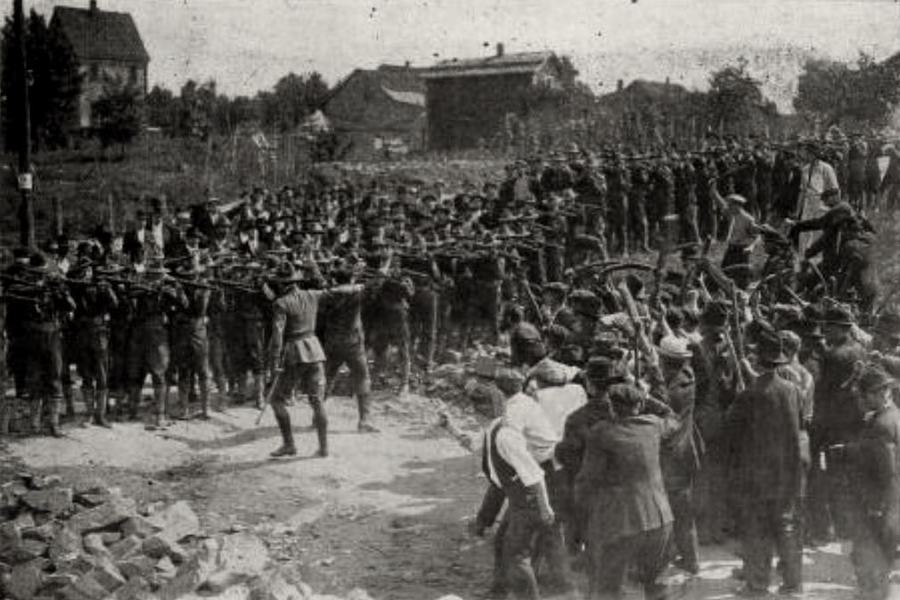
The strike sequence—eighteen bruising minutes—was shot in the dead of a New York January. Extras, many of them actual ironworkers laid off after the war boom, were hosed down nightly so their breath would plume on cue. When the militia forms its Spartan phalanx, bayonets catching the low winter sun like rows of predatory teeth, Hughes intercuts archival footage of 1909 shirtwaist strikers being clubbed. The celluloid itself seems to bruise.
And then the dynamite: Lavinsky’s bundle arcs in slow-motion (achieved by cranking the camera down to 8 fps) against a sky painted the color of gangrene. The river erupts in a geyser that doubles as Old-Testament reckoning. Yet the real explosion is quieter: Stoddard’s pledge to abandon Janet. Boring lets his shoulders sag a single centimeter—Michelangelo’s Pietà in reverse, the mother depositing the corpse instead of cradling it.
For a film obsessed with class, the most subversive scene is genealogical. Van Nest, top-hat in hand like a penitent at confession, confronts Stoddard in the lamplit parlor. On the wall hangs a daguerreotype of two boys in sailor suits—Stoddard’s great-uncle and Van Nest’s grandfather, cousins at a clambake on Coney Island circa 1855. Hughes allows the camera to linger until the sepia image dissolves into the living faces, proving that the only thing separating patrician from prole is a property deed and a few summers of cholera luck.
Edith Stoddard—Mayme Kelso in a performance so luminously decent it hurts—functions as the film’s moral gyroscope. She never preaches; she simply facilitates encounters: a basket of oranges exchanged for a worker’s song, a steamer ticket bartered for a pocket Bible. When she orchestrates the reunion of the Lithuanian riveter and his wife, the moment plays like a secular annunciation: the wife steps off the gangway, mist swirling, her shawl embroidered with tiny mirrored disks that catch the projector beam and scatter flecks of starlight across the auditorium. I heard grown archivists sniffling.
Hughes reserves his boldest stroke for the epilogue. Against a limbo backdrop, three symbolic figures occupy a single plane: Justice blindfolded in soiled marble, Capital corpulent in top-hat and dollar-sign suspenders, Labor shirtless, muscles glistening like oiled bronze. The dialogue appears in handwritten parchment scrolls: “Why quarrel? You are worthless without the other.” The line lands like a Zen koan hurled into a boardroom. The camera pulls back revealing the trio balanced on a seesaw fashioned from the very bridge we saw being built—a closed loop of exploitation and dependence.
Technically, the film is a cornucopia of contradictions. Cinematographer John Goldsworthy shoots the bridge sequences with Germanic expressionism—tilted angles, negative space yawning like spiritual chasms—yet interiors glow with the creamy diffusion of early Paramount romances. The tinting strategy is berserk: night scenes bathed in arsenic green, dawn in rose so vivid it borders on dermatitis, the strike in cadaverous amber that makes every face appear jaundiced by history.
Compare it to The Mill on the Floss and you’ll see how Hughes sidesteps Victorian sentimentality; compare to The Cheat and you’ll notice Hughes refuses to racialize villainy. His evil is systemic, banal, impeccably tailored.
Restoration status: 2K scan from a Czechoslovak print discovered in a Brno nunnery in 1998. Two reels remain lost—Janet’s nursing of cholera orphans and Lavinsky’s trial—surviving only in continuity sketches Hughes doodled on hotel stationery. The existing footage carries Czech censor scratches where anti-bourgeois slogans were razored out, leaving ghostly gaps like bullet holes in stained glass.
Why revisit this now? Because every gig-economy contract, every zero-hour shift, every algorithm that parcels out human time to the microsecond is a rivet in Hughes’s bridge. We are still walking that span, still hearing the river of discarded bodies rush beneath. The bigger man, Hughes insists, is not the titan who owns the steel but the anonymous hand that tightens the bolt—only by recognizing that frail reciprocity do we keep the whole edifice from cantilevering into the abyss.
Watch it with the lights low and the sound of modern traffic seeping through the walls; you’ll swear the bridge is still out there, growing one beam at a time, waiting for our next dynamite bundle of conscience.
IMDb 6.6
1932
Community
Log in to comment.