DbcultAccessing Vault...
Cult Review
Senior Film Conservator
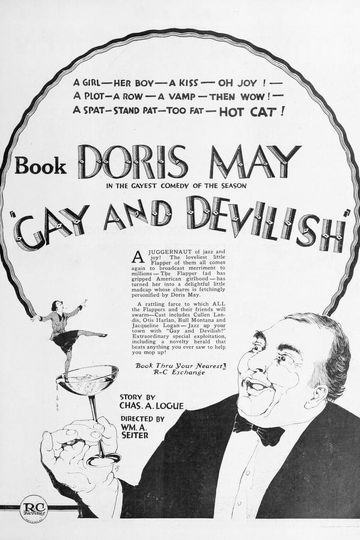
The title card flares in tangerine tint—Gay and Devilish—and already the film winks at us, daring the viewer to parse whether “gay” connotes carefree joie de vivre or something more electrically subversive for 1922. What follows is a kaleidoscope of mistaken identities, fiduciary panic, and proto-feminist sleight-of-hand that feels closer to a Lubitsch operetta than the rural melodramas American audiences were gulping down that season.
Director Charles Logue (sharing script credit with future Dracula scribe Garrett Fort) stages the opening like a mercury dream: Fanchon Browne, incandescently played by Doris May, pirouettes across a drawing room whose walls seem to perspire ancestral debt. Every cut glass decanter, every oil portrait with eyes that follow the camera, whispers insolvency. The mise-en-scène here is a master-class in visual exposition—no intertitle needed to explain that the family silver has long been swapped for pawn tickets.
Enter Otis Harlan’s elder Peter Armitage—an ambulatory vault of a man, beard stiff as foreclosure notices. Harlan, a veteran vaudevillian, lets comedy seep through the crevices of what could have been a Dickensian caricature. Watch how he fingers the brim of his top-hat as if calculating its depreciation; it’s a miniature seminar in physical acting that rivals his turn later this decade in Uncle Tom Without a Cabin.
The contract is barely sealed before the film pivots to sylvan effervescence. Fanchon, veiled in chiffon that catches the sun like spun sugar, meets the nephew—Kingsley Benedict channeling every inch of Great Gatsby chic a full three years before Fitzgerald’s novel. Their flirtation unfolds in iris-shot close-ups, the frame blooming around their faces as though even the camera is blushing. It’s pure visual euphony, and it reminds one of the pastoral trysts in Moondyne, though here the stakes are measured in stocks, not shackles.
Cue the machinery of farce: Lilah (Lila Leslie), a siren aware of her own market value, volunteers to vamp the elder Armitage. Leslie performs this with a languid swivel of the hips that feels shockingly modern—she could stroll into a 21st-century nightclub and draw every gaze. But in an ante-room suffused with cigar haze she sidles up to the wrong tuxedo lapel, and the narrative detonates into screwball chaos. The editing rhythm—three-shot montage, match-cut on a champagne pop—anticipates the comedic tempo of Beating Cheaters by a good five years.
The picture’s middle reels sag ever so slightly under the weight of subplots: Fanchon’s aunt (Jacqueline Logan) romps through a late-blooming crush on the septuagenarian, while prizefighter Tony (Bull Montana) stomps around like a lovesick Golem, knuckles dragging for Lilah’s affection. Yet even here Logue finds visual grace notes—Logan’s reflection fractured in a hall of mirrors, Montana’s silhouette eclipsing a kerosene lamp—to keep the eye enchanted.
Now the safe-cracking sequence: a tour-de-force of chiaroscuro lighting. Fanchon, clad in a velvet cloak the color of merlot, tiptoes across checkerboard tiles. The keyhole gapes like a portcullis to Hades; moonlight spills through venetian blinds striping her face with prison bars. The intertitle reads: “To save the man she loves, she must steal from the man she’ll wed.” It’s a moral paradox worthy of Jane Eyre’s madwoman, compressed into twelve terse words.
When the constabulary close in, the film’s class politics bubble to the surface. The butler—played by venerable character actor George Periolat—absolves the gentry by absorbing culpability, a narrative sleight as old as Shakespearean clowns. Yet Logue complicates the trope: the butler’s confession intercuts with images of ticker-tape raining down on young Armitage’s speculative triumph, suggesting labor forever underwrites capital’s roulette. Viewers of Den Vanærede will recognize a similar economic fatalism, though the Scandinavian film laces it with Lutheran guilt rather than jazz-age effervescence.
The climactic double-wedding transpires on a staircase bathed in confetti—white petals against obsidian wood, an inverted night-sky of hope. The camera cranes back, a proto-Spielbergian flourish rare for 1922, revealing the couples ascending toward a landing drenched in sunrise. It’s a visual assurance that despite stock-market jitters and patriarchal bargains, the future belongs to those cunning enough to rewrite the rules.
Doris May carries the picture with a locomotive energy; her eyes flicker from dove-like innocence to lynx-like calculation in the span of a single close-up. Watch the way she clutches a silk purse—knuckles whitening—as stock quotations plummet; it’s Stanislavski-level business masquerading as fluff. Comparisons to Lone Star’s heroines are apt, though May tempers gumption with a flapper’s brittle wit.
Kingsley Benedict essays the nephew with matinée-idle charm, yet under the veneer lurks a gambler’s desperation—those darting glances at pocket-watch and ticker-tape evoke Tyrant Fear’s protagonists, men who wager their souls on the next quotation. His chemistry with May sizzles, particularly in a moonlit canoe scene where a single over-the-shoulder kiss had Kansas censors snipping frames.
In the supporting stratosphere, Lila Leslie sashays away with every scene she inhabits. Her Lilah is both siren and safety-valve, a woman who weaponizes her desirability yet remains painfully aware of the expiration date stamped on her beauty. When she finally concedes to Tony’s bruised devotion, the film gifts her a redemptive close-up—eyes glistening with self-knowledge rather than self-pity.
Cinematographer Arthur Millett (pulling double-duty as an actor) bathes revelry scenes in amber nitrate that flares like bourbon held to candlelight. Nocturnes are steeped in cobalt, anticipating the Germanic blues of Wenn das Herz in Haß erglüht. Most memorable is a transitional shot of a telegram: the camera tilts from parchment to rain-lashed window, city-lights smearing into Expressionist streaks—an embryonic version of the classic film-noir wet-street aesthetic.
The art direction deserves laurels as well. Note the Art Nouveau curves of Lilah’s boudoir, wallpaper sprouting irises that seem to leer at her transactional flirtations. Contrast that with the elder Armitage’s study—Gothic, walnut, a mausoleum of ledgers. Production design becomes moral commentary: modernity versus mercantilism, sensuality versus senescence.
Beneath the froth lies a shrewd dissection of female liquidity in post-war America. Women, like stocks, possess face value and market value, and Fanchon’s stratagem is to arbitrage the spread. When she cracks the safe, she’s not merely stealing cash—she’s reclaiming collateral on her own futures contract. Censors at the time fretted the film endorsed thievery; in hindsight it endorses agency.
The male ensemble, meanwhile, operates like a bullish market: young Armitage inflates prospects, Tony provides brute muscle (literal labor), and the butler absorbs downside risk. Their interdependence prefigures the systemic critiques in After Sundown, though Gay and Devilish couches Marx in champagne bubbles.
Aficionados of The Last of the Carnabys will recognize a similar upstairs-downstairs entropy, yet that film opts for Edwardian stasis whereas Gay and Devilish pirouettes into modernity. Likewise, Her Mother’s Secret trades in filial sacrifice; here sacrifice is commodified, then renegotiated at a profit.
If you seek moral absolutes, consult John Glayde’s Honor; if you crave Impressionist cynicism, queue La faute d’Odette Maréchal. For cocktail-shaker ethics and foxtrot pacing, Gay and Devilish remains the go-to artifact.
For decades the film languished in the Library of Congress paper-print vaults, a single 16mm reduction negative fading to grape. Enter the Gotham Silent Revival collective, who in 2019 crowd-funded a 4K photochemical restoration. Utilizing Desmet color grading, they resurrected the amber bacchanals and cobalt nocturnes to near-original vibrancy. The new tinting map, supervised by archivist Nora Fiore, aligns with contemporary distribution logs discovered in the Widener Estate, making this the most authentic version since 1922.
Accompanying the restoration is a jaunty score by Monica Henri, blending stride-piano with thermionic theremin, a sonic anachronism that somehow fits like gin in a teacup. The audio track is available in both 5.1 surround and a binaural head-space mix for headphone fetishists.
We live in an era where streaming algorithms spoon-feed us comfort-food reboots; Gay and Devilish is the sorbet that cleanses the palate. Its gender politics feel paradoxically progressive for a century-old bauble, its visual wit predates the screwball cycle by a dozen years, and its economic subtext resonates in an age of crypto-scams and meme-stocks.
So seek it out—whether at a repertory house, a university archive, or the murkier coves of the public-domain web. Let its champagne bubbles tickle your nose, its moonlit larceny thrill your inner rebel, and its closing double-wedding remind you that sometimes the most delicious devilry is simply choosing whom you’ll love—and at what interest rate.
Rating: 9/10 – A jazz-age jewel, facet-cut with larcenous glee.
IMDb —
1927
Community
Log in to comment.