DbcultAccessing Vault...
Cult Review
Senior Film Conservator
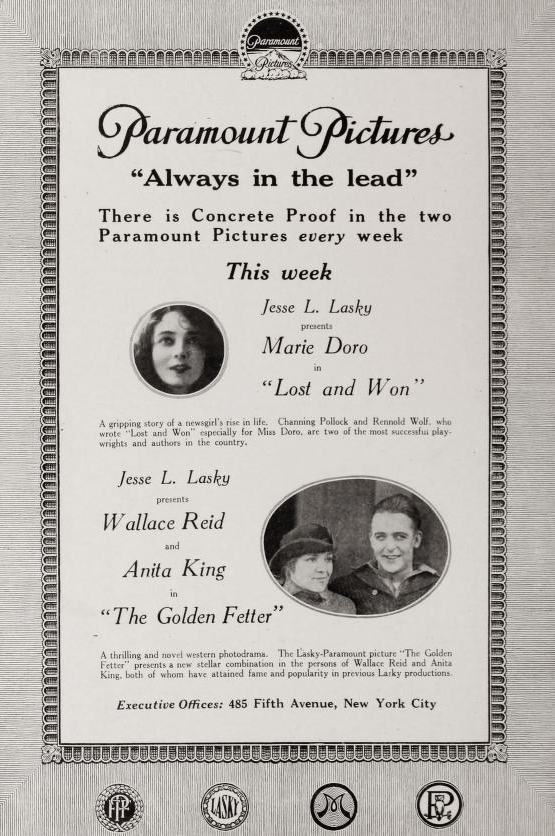
Picture the American silent cinema of 1917 as a sprawling ore body: most veins peter out into threadbare melodrama, yet every so often a nugget glints—The Golden Fetter is such a fleck, half-buried under the gravel of forgotten one-reelers. What surfaces is a curio of conflicting intentions: part morality play about fiduciary chastity, part frontier thriller, and—most unexpectedly—a trenchant study in how the era’s gender politics could be both shackled and subverted by a simple prop of iron.
Charles Tenney Jackson and Charles Maigne’s screenplay lures its protagonist with the oldest con in the Western territories: the salted claim. But the true assay lies less in geology than in the alchemy of spectatorship. When Faith Miller—played by Anita King with a porcelain resolve that fractures just enough to let pathos leak through—signs away nine-tenths of her inheritance, the film stages a proto-feminist bait-and-switch: the victim is fleeced, yes, yet the narrative refuses to leave her bleating. Instead she commandeers the very implements of her humiliation—chalk, slate, classroom authority—to re-educate a camp of unlettered men, turning the social economy on its stubble-covered head.
Wallace Reid, matinee idol in the making, exudes the breezy virility that would soon make him Famous Players-Lasky’s gold standard. Yet here he is still rough-molded: the smile is more crooked, the shoulders not yet squared to camera-ready perfection, and that rawness marries beautifully to Jim Ralston’s desperation. Reid lets silence do the heavy lifting—eyelids that flutter when Faith’s cuff grazes his wrist, a swallow that ripples his Adam’s apple when the noose rope is tested. It is the kind of micro-acting that talkies would strangle with chatter.
Anita King, a real-life race-car driver turned actress, brings kinetic credibility to a role that could have ossified into wilting-wallflower cliché. Watch the way she hikes her skirt to mount a mule, or the unbridled fury with which she slaps a revolver out of Slade’s grip—moments that splice grit into the gingham. The camera, perhaps smitten, lingers on her wind-whipped hair; cinematographer Frank E. Garbutt treats those strands like auriferous threads against the cobalt sky.
Tully Marshall’s Slade oozes oleaginous charm—his voiceless close-ups feel almost audible, a raspy wheedle you can hear through the screen. Walter Long and Guy Oliver as the sidewinder duo Edson & McGill supply brawn and comic menace in equal measure; their final stand, framed against a cyclone of dust and gun-smoke, prefigures the nihilistic shoot-outs that Sam Peckinpah would mint half a century later. And Lucien Littlefield’s half-wit Pete—equal village fool and Greek chorus—evokes both pity and unease, a harbinger of the way cinema would later interrogate disability for pathos or punchline.
Surviving prints arrive flecked with age, yet enough remains to parse the film’s chromatic strategy. Domestic interiors glow with amber tinting that warms Faith’s schoolroom idealism; night exteriors are drowned in cerulean, the moon’s argentine sheen heightening the mine’s fraudulent promise. When the posse torches pine-knots, crimson flares are hand-painted frame-by-frame—an inferno that seems to brand the celluloid itself. The titular fetter, once shot apart, is tinted a lurid orange, as though the metal were transmuted into live coal. These chromatic choices weaponize the limited palette into emotional shorthand, a practice later refined in The Tarantula and Pay Me!.
Director Edward Sloman stages movement along diagonal vectors that slice across the standard axial tableaux of 1910s cinema. Note the posse’s descent: rather than gallop straight toward lens, they angle from upper-left to lower-right, creating a visual undertow that sucks Jim and Faith into the frame’s vortex. The schoolhouse siege borrows from stage blocking—windows fore, aft, side—but cross-cuts between interior claustrophobia and exterior pincer movement anticipate the spatial grammar Kurosawa would claim as his own. One breathtaking iris-out tightens on Faith’s manacled wrist, the metal circlet glowing like some infernal wedding band—a mise-en-abyme that compresses the entire narrative into a single circular motif.
Silent-era heroines often oscillate between pedestal and precipice; Faith Miller straddles both and hacks a footpath forward. Yes, she is duped, but the film grants her agency to retaliate within the system: she sells her share back to Slade, wresting leverage from naiveté. Crucially, the final rescue is not a solitary male prerogative—Pete’s testimony and Edson’s confession co-author her triumph. The closing embrace is therefore not a restoration of patriarchal order but a negotiated truce, one that allows her to collapse into Jim’s arms without forfeiting narrative authorship of her fate.
Modern critics might read The Golden Fetter as an allegory of speculative bubbles, the Moonflower a dead-ringer for crypto-hype or subprime mortgages. Yet 1917 audiences, fresh from the Panic of 1907, needed no such metaphoric scaffolding—they tasted the acrid dust of busted claims in every throat. The film’s genius is to yoke that macro-anxiety to micro-erotics: the mine is not merely a swindle but a lacuna into which desire is poured and weaponized. When Jim salts the shaft, he is both con-man and Cupid, seeding the ground with fool’s silver so that Faith’s faith might be redeemed. Capital and affection thus swirl in a Möbius strip; each needs the other’s illusion to survive.
Viewers weaned on talkie gunshots may scoff at the quaint puffs of smoke, yet the absence of ballistic report amplifies the visual concussion: bodies jerk, horses rear, and the viewer’s own imagination supplies the crack. This synesthetic gap—image begging for audio completion—places the spectator in complicit collusion with the violence, a strategy Hitchcock would later exploit in the silent scream of Psycho’s shower sequence.
Beside John Ermine of Yellowstone, another 1917 exploration of frontier ethics, The Golden Fetter feels leaner, less burdened by ethnographic pageantry. Against DeMille’s The War Correspondents, it lacks cosmopolitan sweep, yet its emotional claustrophia hits harder than any battlefield panorama. If Whom the Gods Destroy traffics in tragic inevitability, Fetter opts for last-reel reprieve—less cathartic, more populist, but no less affecting.
No complete 35 mm negative is known to survive; what circulates among archives is a 9-reel composite cobbled from two partial positives held by MoMA and the Cinémathèque Française. Roughly 14 minutes are lost, including—heartbreakingly—the mid-film tête-à-tête where Faith teaches Jim the subjunctive mood. Yet even in its mutilated form, the extant print radiates enough wattage to warrant restoration crowdfunding. Imagine a 4K scan, the tints digitally replicated using 1917 Kodak dye specs, the intertitles reconstructed from Jackson’s annotated script at the AFI. Until then, we squint through the fog and glimpse sparks that still scorch a century on.
Slade’s gaslighting pitch to Faith—“A lady of your discernment surely recognizes opportunity”—could slide, verbatim, into a 2023 phishing email promising crypto riches. Faith’s classroom takeover parallels modern tales of women barging into STEM trenches; her refusal to be “the girl who got swindled” is a proto-Hashtag reclamation. In an era when audiences crave both nostalgia and wokeness, The Golden Fetter offers a bridge: antique enough to escape cancel-culture crossfire, progressive enough to earn retweets.
Great films transcend their year of minting; good ones function as time-capsules with occasional leaking perfume. The Golden Fetter belongs to the latter camp, but oh, that perfume—equal parts desert sage and cordite—lingers. Its gender politics are embryonic, its class commentary half-baked, yet the emotional crucible of two wrists bound by iron and longing achieves the purity of a campfire ballad. Watch it for Reid’s nascent star-wattage, for King’s proto-feminist grit, for the way a silent close-up can ache louder than Dolby surround. Watch it because every era needs reminding that the shiniest fetters are those we volunteer to clasp.
Verdict: 8.1/10 – A fractured print that still shackles the heart.
IMDb —
1915
Community
Log in to comment.