DbcultAccessing Vault...
Cult Review
Senior Film Conservator
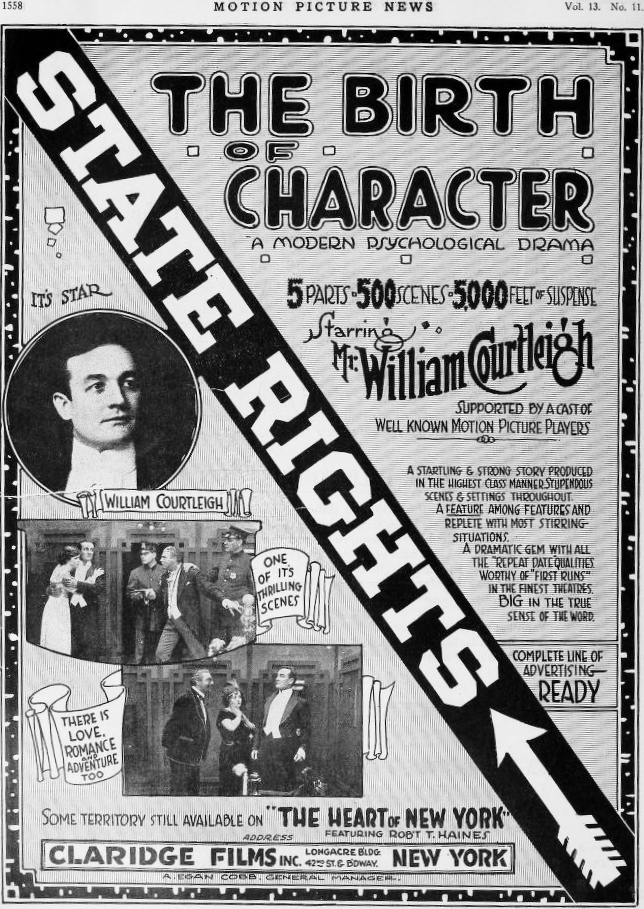
The cinematic landscape of the early 20th century was a fertile ground for allegorical tales, and Marc Edmund Jones's The Birth of Character stands as a compelling, if somewhat didactic, exploration of moral evolution. From its very opening, where an alchemist, poised at the precipice of execution, articulates a profound philosophy—that human character is not static, but a dynamic entity forged in the crucible of life's trials—the film establishes its ambitious thematic framework. This isn't merely a narrative; it's a philosophical treatise wrapped in melodrama, a visual sermon on the arduous journey towards self-realization. The alchemist's assertion, that "in the effort to conquer conditions about him, man finds his birth of character," serves as the guiding star for the tumultuous odyssey of Harry, our protagonist.
Harry, portrayed with a conflicted earnestness by William Courtleigh, is introduced at a pivotal juncture in his youth, caught between the celestial pull of Grace, his virtuous beloved whose influence represents the zenith of moral rectitude, and the gravitational drag of his dissolute companions, who embody the siren call of hedonism and recklessness. It is a classic Faustian dilemma, albeit one played out in the smoky backrooms of card games rather than arcane rituals. A devastating run of losses at the card table plunges Harry into a vortex of desperation, a state of profound vulnerability that paves the way for his initial moral lapse. At a lavish dance, the glittering allure of a diamond-studded hair ornament proves too potent a temptation for his weakened resolve. He succumbs, if only momentarily, to the impulse to steal. Yet, a flicker of his inherent goodness, or perhaps a nascent self-preservation instinct, compels him to immediately retract his hand, concocting a plausible, if transparent, excuse about the ornament merely having fallen. This fleeting transgression, however, is not without its silent witness: Darby, the master criminal, an architect of shadows, whose discerning gaze registers both Harry's momentary weakness and his quick-witted recovery. This encounter, subtle in its execution, is the insidious seed from which Harry's tragic descent will blossom.
The narrative, much like a spiraling eddy, inexorably draws Harry deeper into the underworld. His so-called friends, oblivious to the precipice upon which they teeter, drag him to a clandestine gambling den. This ill-fated sojourn culminates in a dramatic raid, orchestrated by Harry's bitter rival, Arthur Vane. In the ensuing chaos, Harry performs an act of unexpected gallantry, rescuing Alice, a young woman entangled in the illicit operations, from the clutches of the law. Alice, a complex figure who assists her father in managing the establishment, reciprocates Harry's impromptu heroism by guiding him through a secret egress, thus sparing him from arrest. This clandestine escape leads him directly into the lair of her father, who, to Harry's dismay, is none other than Darby, the very criminal mastermind who had observed his earlier moral wavering. This fateful introduction marks Harry's formal conscription into Darby's nefarious syndicate, transforming him from a morally ambiguous youth into an unwitting instrument of crime. His path, once merely divergent, now veers sharply downward, accelerating towards an abyss.
The irony is palpable: even as Harry's professional life descends into criminality, his personal life appears to ascend. He and Grace become engaged, a beacon of hope and conventional morality that remains tragically unaware of the shadow world Harry now inhabits. The juxtaposition is stark, highlighting the profound duality of Harry's existence. A dealer in opulent objects inadvertently provides the next catalyst for Harry's deepening entanglement, showcasing a magnificent necklace that quickly becomes the target of Darby’s machinations. Harry, now a seasoned operative, successfully executes the audacious burglary, his skills honed in the crucible of illicit enterprise. His success, however, only tightens Darby’s grip. The master criminal dispatches Harry to a fashionable house party, ostensibly to scout for further plunder. Fate, with its cruel sense of drama, orchestrates a devastating reunion: Grace is also a guest at this very soirée. In a moment of high tension, she, unaware of his identity, confronts the shadowy intruder and, with a resolute hand, discharges a firearm. Harry is struck. The bullet, a mere scratch, yet its symbolic impact is profound. Discovering the identity of her assailant, Grace is consumed by a maelstrom of shock, betrayal, and profound disappointment. Her subsequent words, delivered with a chilling scorn, sever their bond: she never wishes to see him again.
This gunshot, a physical wound barely perceptible, inflicts a far deeper laceration upon Harry’s soul. It is the ignominious nadir that precipitates his long-overdue epiphany. The alchemist's philosophy echoes: true character is born in the struggle to conquer conditions. Harry, now utterly stripped of his illusions and his love, resolves to reclaim his humanity. He surrenders to the authorities, accepting the harsh penalty for his transgressions. Imprisonment becomes his purgatory, a necessary crucible for the forging of his new self. Upon his release, however, the world proves unforgiving. Branded an ex-convict, he finds doors slammed shut, opportunities denied, and society’s judgment a relentless, suffocating weight. His only solace, ironically, comes from the very underworld he sought to escape. This societal ostracization underscores a poignant truth about redemption: the internal transformation is often insufficient without external acceptance.
Yet, a glimmer of hope persists, embodied by Alice. Having fallen deeply, unselfishly in love with Harry, she refuses to abandon him. Her devotion transcends his past misdeeds, compelling her to act as his unlikely advocate. She approaches Grace, pleading with her to transcend the bitterness of betrayal, to offer Harry a chance at genuine atonement. Grace, after a period of profound internal struggle, finally relents, a testament to the enduring power of compassion and perhaps a lingering affection. Alice, with a heart heavy with unrequited love but resolute in her desire for Harry's happiness, orchestrates their reunion, sending Harry to Grace. He secures a position, a foothold in legitimate society, and begins to demonstrate a nascent but genuine strength of character. His steadfast refusal to revert to his criminal past, however, incurs the wrath of his former underworld associates. Threatened and imperiled, he is once again saved by Alice’s selfless intervention, a sacrifice he repays with a cruel public snub when with Grace he meets her on the street, now proudly at Grace’s side.
This act of callous ingratitude shatters Alice's fragile heart, transforming her selfless love into a burning inferno of vengeful hate. The narrative, having seemingly charted a course towards redemption, now takes a sharp, dramatic turn into the treacherous waters of retribution. Darby, ever the opportunist, willingly exploits Alice’s wounded pride, luring Harry back to his den under false pretenses. Alice, consumed by her desire for Harry to witness the full, bitter fruit of his actions, shrewdly maneuvers to draw Grace into the underworld as well, ensuring she becomes a horrified spectator to her ungrateful lover’s impending punishment. The tension escalates, culminating in a dramatic denouement where Darby, poised to mete out a final, fatal justice to Harry, is thwarted by the timely intervention of the police. Grace, having employed a cunning ruse to alert the authorities, emerges as the unlikely savior, rescuing both herself and Harry from the clutches of the criminal underworld. The film thus concludes with a narrow escape, a fragile redemption, and the lingering question of whether true character, once born, can ever fully erase the scars of its violent genesis.
In the nascent years of cinematic storytelling, when the medium was still grappling with its potential beyond mere novelty, films often served as moral parables, cautionary tales designed to both entertain and instruct. Marc Edmund Jones’s The Birth of Character, a title that boldly declares its thematic intent, is a quintessential example of this era. It’s a narrative less concerned with the minutiae of plot than with the grand sweep of a soul’s odyssey, framed by the philosophical musings of an alchemist facing immolation. This opening, a daring philosophical preamble, immediately elevates the film beyond a simple crime drama, positing that human identity is not a fixed state but a dynamic process of evolution, forged in the relentless struggle against external forces and internal weaknesses. This is not merely a story of good versus evil; it's an exploration of the arduous, often painful, process through which an individual's true essence is revealed and solidified.
The film introduces us to Harry, portrayed by William Courtleigh with a blend of youthful naivete and burgeoning susceptibility. He is a man at a crossroads, emblematic of every individual caught between divergent paths. On one side stands Grace, an embodiment of virtue and moral clarity, her presence a constant, albeit sometimes ignored, reminder of a better life. On the other, his companions, whose influence gravitates towards the superficial and the illicit. This initial setup is a classical dramatic trope, reminiscent of countless morality plays. However, Jones imbues it with a psychological realism that resonates even today. Harry’s descent is not immediate or cartoonish; it begins subtly, with a moment of financial desperation at a card game. This vulnerability makes him susceptible, not to grand evil, but to a fleeting, impulsive transgression: the temptation to steal a diamond ornament. It’s a small act, quickly retracted, yet it serves as the fateful observation point for Darby, the master criminal. This scene, brief though it is, is crucial. It’s a powerful illustration of how seemingly minor moral compromises can open the door to far greater perils, echoing the insidious nature of temptation that one might find explored in films like The Devil's Daughter, where moral frailty is consistently tested.
Darby, the shadowy puppet master, represents the external "conditions" against which Harry must struggle to achieve his "birth of character." His initial encounter with Harry is almost accidental, yet Darby's keen eye for human weakness marks Harry as a potential recruit. The subsequent raid on the gambling joint, orchestrated by Harry's rival Arthur Vane, is another pivotal moment. Harry’s spontaneous act of heroism in saving Alice, a girl assisting her father (who turns out to be Darby), from arrest, inadvertently seals his fate. This sequence, with its dramatic escape through a secret door, thrusts Harry directly into Darby’s sphere of influence. From this point, Harry’s trajectory is clear: he becomes a tool, a pawn in Darby’s criminal enterprise. The film skillfully portrays this gradual entanglement, demonstrating how easily a well-meaning individual can be corrupted when circumstances align with pre-existing vulnerabilities. It’s a descent that feels disturbingly plausible, avoiding the overt sensationalism that some contemporary narratives might employ, preferring instead a more psychological erosion of character.
The duality of Harry’s life, his engagement to the pure Grace juxtaposed with his deepening involvement in crime, creates a palpable tension. Grace, played by Muriel Ostriche, is the symbol of the life Harry is forfeiting, the innocence he is betraying. Her unawareness of his secret life amplifies the tragedy, making her eventual discovery all the more impactful. The theft of the valuable necklace, a successful burglary orchestrated by Harry, signifies his full immersion into Darby’s world. He is no longer merely tempted; he is an active participant. The house party sequence is the dramatic fulcrum of the narrative. Here, fate intervenes with cruel precision, bringing Grace and Harry together under the most agonizing circumstances. Grace, in defending herself or others, shoots Harry, not knowing it's her beloved. This moment is not just a plot device; it is a profound symbolic act. Grace, the embodiment of Harry’s moral compass, metaphorically wounds the corrupted part of him. Her subsequent realization and utter repudiation of him—"I never want to see you again"—serves as the ultimate catalyst for his self-reckoning. It is the destruction of his external validation, forcing him inward to confront the ruins of his own making. This dramatic confrontation, a clash of innocence and corruption, carries a weight that can be compared to the moral dilemmas found in films like The Deep Purple, where characters are forced to confront the harsh realities of their choices and the consequences that ripple through their relationships.
The second act of The Birth of Character is dedicated to Harry’s arduous path towards redemption. His surrender and subsequent imprisonment are presented not as a punishment, but as a necessary purification. It’s a voluntary embrace of consequence, a direct response to the alchemist’s decree that character is forged through struggle. The film unflinchingly portrays the harsh realities of an ex-convict’s life: ostracization, closed doors, the constant judgment of society. This societal rejection is crucial, emphasizing that the "birth of character" is not a solitary act but also requires a degree of societal forgiveness and reintegration. Harry’s struggle here is external as much as internal, highlighting the systemic barriers to true redemption.
Alice, however, emerges as the film’s most complex and ultimately tragic figure. Her initial entanglement with Darby’s criminal enterprise is mitigated by her unselfish love for Harry. Her plea to Grace, her relentless advocacy for Harry’s second chance, is an act of profound self-sacrifice. She facilitates his reunion with Grace, knowing full well that her own love for him is unrequited and that she is essentially paving the way for his happiness with another. This selfless act is then met with Harry’s cruel and public snub, a moment of breathtaking ingratitude that reveals a lingering immaturity or perhaps a desperate need to solidify his new, respectable identity by completely severing ties with his past, including those who helped him. This is the film’s most emotionally charged and morally ambiguous scene, showcasing the brutal realities of human relationships and the often-unintended cruelty that can stem from self-preservation. It is a moment that resonates with the raw emotional honesty found in stories of societal judgment and personal sacrifice, perhaps even more acutely than some of the more melodramatic turns in films like East Lynne, where a woman's fall from grace is met with unforgiving social censure.
Alice’s transformation from selfless benefactor to vengeful orchestrator is entirely credible. Her love, once pure, curdles into a potent hate, fueled by Harry’s callous disregard. This sets the stage for the film’s dramatic climax. Darby, ever the opportunist, readily joins forces with a scorned Alice, luring Harry back into his den. Alice, in a calculated act of retribution, ensures Grace is present to witness Harry’s impending doom, believing that only through such public humiliation and suffering can her own pain be assuaged. The tension is masterfully built, leading to Darby’s final, deadly confrontation with Harry. Yet, the narrative, true to its moralistic core, provides a last-minute reprieve. Grace, demonstrating her own growth and resourcefulness, employs a clever ruse to alert the police, leading to their dramatic intervention. The rescue is swift, preventing a tragic end and allowing Harry and Grace to escape the clutches of the underworld.
In terms of cinematic craft for its time, The Birth of Character, while perhaps lacking the overt stylistic innovations of some of its contemporaries, delivers a compelling narrative with clear character arcs. William Courtleigh’s portrayal of Harry is nuanced, capturing the internal struggle of a man torn between vice and virtue. Muriel Ostriche’s Grace is suitably angelic, providing the moral anchor for the story. Marc Edmund Jones’s script, though heavy on the allegorical, manages to weave a story that keeps the audience invested in Harry’s fate. The use of distinct character types—the virtuous beloved, the corrupting influence, the tragic figure caught in between—is effective in conveying the film’s moral lessons without entirely sacrificing dramatic engagement. The pacing, typical of early features, allows for a deliberate unfolding of events, giving weight to each moral decision and its consequence.
Ultimately, The Birth of Character is more than just a crime drama; it's a philosophical exploration of human potential and fallibility. It asks whether true character can be forged only through the fires of adversity and whether redemption, once earned, can truly erase the indelible marks of past transgressions. The film’s alchemical opening serves as a powerful metaphor, suggesting that just as base metals are transformed into gold, so too can a flawed individual be refined through suffering and self-awareness. It’s a poignant reminder that the journey towards becoming a "man" (or woman) of character is fraught with peril, demanding constant vigilance, unwavering resolve, and sometimes, the selfless intervention of others. Even when confronted with ingratitude, as Alice demonstrates, the path to true character is often paved with sacrifices that go unacknowledged. The film leaves us contemplating the enduring power of choice, the insidious nature of temptation, and the profound, often painful, process of self-creation. It’s a testament to early cinema’s ability to tackle profound themes with both dramatic flair and moral conviction, carving out a space for itself not just as entertainment, but as a genuine reflection on the human condition.
IMDb —
1927
Community
Log in to comment.