DbcultAccessing Vault...
Cult Review
Senior Film Conservator
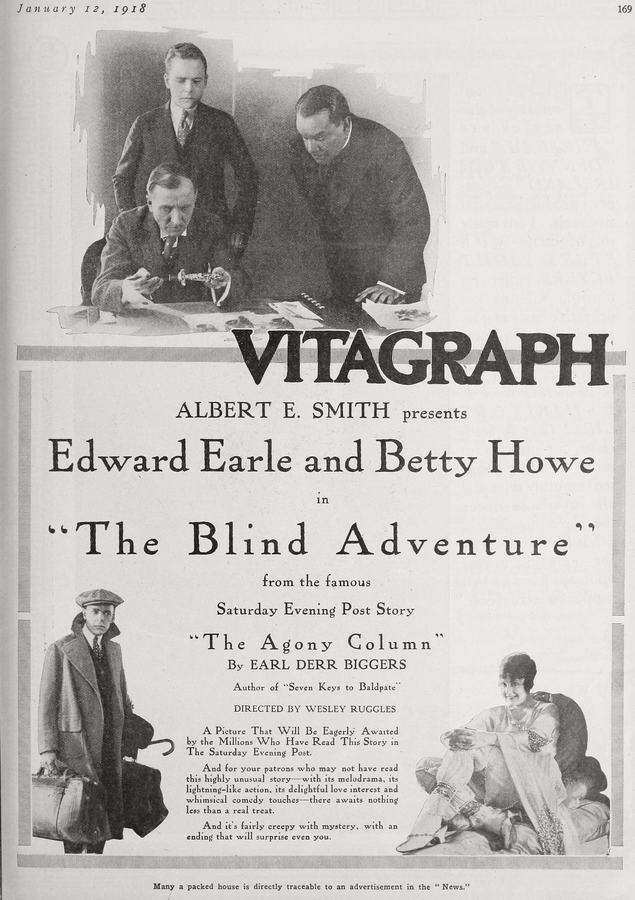
Stepping into the cinematic landscape of The Blind Adventure feels akin to unearthing a forgotten treasure, a silent-era relic that, despite its age, resonates with surprisingly modern psychological depth. This film, a testament to the ingenuity of early narrative construction, doesn't merely tell a story; it performs a complex ballet of deception, romance, and the profound power of human imagination. At its core, we find a protagonist, Geoffrey West, whose initial infatuation blossoms into an elaborate, almost theatrical, pursuit of affection. His method? Not the conventional bouquet of roses or a polite introduction, but an audacious, meticulously crafted web of fiction designed to captivate and ultimately ensnare the object of his desire, Marion Larned. It’s a premise that, even today, sparks a fascinating debate: is such an elaborate ruse charmingly romantic or inherently manipulative? The film dares to explore this ambiguity, inviting us to ponder the ethics of love forged through artifice.
The genesis of this elaborate scheme is beautifully, almost poetically, simple. Geoffrey spots Marion in a London restaurant, her gaze fixed on the 'agony' column – a repository of personal pleas and clandestine communications. This seemingly innocuous detail becomes the catalyst for his extraordinary plan. He places his own ad, a bold invitation to a stranger, a direct challenge to the anonymity of urban life. Marion's response isn't immediate capitulation but a sophisticated counter-challenge: a week of daily letters, each proving his worthiness, his capacity to be 'interesting.' This sets the stage for the true genius of the narrative: Geoffrey's invention of a gripping tale of murder, intrigue, and confession. It’s a brilliant narrative device, showcasing not just the character's wit but also the screenwriter's understanding of human psychology and the allure of a good story. This aspect of the film, the storytelling within the story, reminds me of how narratives themselves can become characters, shaping destinies, much like in The Stolen Play, where the very act of artistic creation or imitation drives the central conflict, albeit with different stakes. Here, the 'play' is purely for Marion's heart.
Eulalie Jensen, portraying Marion Larned, delivers a performance that transcends the often-melodramatic confines of the silent era. Her expressions, subtle yet profound, convey a woman of intelligence and sensibility, initially intrigued, then deeply moved, and finally, utterly bewildered by the unfolding drama. It's a testament to her skill that we, as viewers, are drawn into her emotional journey, experiencing her fascination, her growing concern for Geoffrey, and her eventual shock. Edward Earle, as Geoffrey West, embodies the audacious suitor with a captivating blend of charm and intensity. He must convince us, through silent gestures and nuanced expressions, of both his genuine affection and his cunning intellect. The success of the film hinges on the believability of their connection, even as it's built on a foundation of elaborate deceit. Their silent interplay is a masterclass in conveying complex emotions without uttering a single word, relying solely on the power of the gaze, the tilt of a head, the subtle tremor of a hand.
The narrative's escalating tension, particularly when Geoffrey 'confesses' to the fictitious murder, is masterfully handled. Marion's desperate attempts to shield him from the law, believing his story implicitly, highlight the immersive power of his fiction. It’s a fascinating exploration of empathy and the human desire to protect those we care for, even when that care is predicated on a lie. The stakes feel genuinely high, not just for the characters, but for the audience, who are privy to the deception yet compelled to witness its consequences. This intricate dance between truth and fabrication, where a character's actions are driven by a perceived reality that we know to be false, creates a unique kind of dramatic irony. It’s a sophisticated narrative technique that speaks volumes about the creative ambition of early cinema, pushing beyond simple hero-villain tropes to explore the more convoluted terrain of human relationships. One might even draw parallels to the moral quagmire presented in The Unpardonable Sin, where characters grapple with profound ethical dilemmas, though the nature of the 'sin' here is one of romantic trickery rather than grave transgression.
Then, the sudden, jarring intrusion of World War I into this personal drama serves as a powerful reminder of external forces shaping individual destinies. The global conflict, rather than a mere backdrop, becomes an active participant in the plot, forcing Marion's father to hasten her return to the United States. This abrupt shift from a romantic charade to a stark reality underscores the fragility of personal pursuits in the face of monumental historical events. It’s a clever narrative pivot, injecting an element of urgency and grander scale into what could otherwise have remained a contained, intimate story. The war acts as a catalyst, propelling the characters towards a forced separation and, ultimately, towards Geoffrey’s desperate pursuit and final confession. This intersection of personal drama with global catastrophe is a recurring theme in cinema, often used to amplify emotional stakes, much as it can be seen in the broader historical context of films like The Cabaret, where societal upheaval often dictates individual choices and fates.
The climax unfolds on the transatlantic steamer, a confined space that intensifies the emotional pressure cooker. Geoffrey's confession, delivered not in a dramatic courtroom or a clandestine meeting, but amidst the vast, indifferent ocean, is a moment of profound vulnerability. His admission that the entire murder mystery was a fabrication, a grand romantic gesture designed solely to win her heart, is both audacious and disarmingly honest. It forces Marion, and indeed the audience, to re-evaluate everything that has transpired. Was his deception unforgivable, or was it a desperate, albeit misguided, act of love? The film leaves us to ponder this ambiguity, refusing to offer easy answers. This nuanced portrayal of romantic tactics, where the line between genuine affection and cunning manipulation blurs, is a hallmark of intelligent storytelling, even in the nascent days of cinema.
The screenplay by Earl Derr Biggers and George H. Plympton is remarkably sophisticated for its time, demonstrating a keen understanding of pacing, character development, and dramatic tension. They craft a narrative that unfolds with a compelling rhythm, drawing the audience deeper into its intricate web with each passing scene. The use of the 'agony' column as a plot device is particularly inspired, perfectly capturing a slice of London life from that era while also serving as a unique catalyst for the entire romantic entanglement. It's a testament to their writing that the story, despite its silent presentation, never feels simplistic or underdeveloped. Instead, it offers layers of interpretation, inviting contemplation on the nature of truth, the power of narrative, and the often-irrational impulses of the human heart.
Visually, The Blind Adventure showcases the evolving artistry of silent film cinematography. While it might not possess the grand scale or revolutionary techniques of later epics, it excels in its intimate portrayal of character and emotion. Close-ups are used effectively to convey the subtle shifts in Marion's reactions and Geoffrey's intense determination. The set designs, particularly the London restaurant and the ship, are convincing and provide a strong sense of place, grounding the fantastical romantic plot in a tangible reality. The editing maintains a brisk pace, ensuring that the audience remains engaged with the unfolding drama, never allowing the silent medium to feel ponderous. It’s a reminder that even without synchronized sound, early filmmakers were adept at crafting immersive and emotionally resonant cinematic experiences, using every tool at their disposal to communicate their vision. The visual storytelling, much like in Lost in Darkness, relies heavily on mood and atmosphere to convey psychological states, albeit with a different narrative focus.
The supporting cast, including Charles A. Stevenson, Frank Norcross, and Percy Standing, provides solid performances that flesh out the world of the film. While the focus remains squarely on Geoffrey and Marion, these characters contribute to the overall authenticity and dramatic weight of the story. Stevenson, as Marion's father, effectively conveys the paternal concern and the societal pressures of the era, particularly when faced with the outbreak of war. Their presence helps to anchor the more fantastical elements of Geoffrey's romantic machinations, providing a believable social context against which the main drama unfolds. It's a well-rounded ensemble, ensuring that even minor roles contribute meaningfully to the overarching narrative.
Reflecting on The Blind Adventure today, one can't help but appreciate its audacity. It's a film that asks us to consider the lengths to which one might go for love, and the complex interplay between truth and fiction in human relationships. Is Geoffrey's act a grand romantic gesture or a disturbing manipulation? The film wisely leaves this question open-ended, allowing viewers to draw their own conclusions, a characteristic that elevates it beyond simple entertainment. It challenges us to empathize with both characters, understanding Geoffrey's desperate yearning and Marion's bewildering journey through a fabricated reality. This psychological complexity is a testament to the film's enduring appeal, proving that even a century ago, filmmakers were grappling with themes that remain profoundly relevant in our contemporary world. It’s a fascinating precursor to later romantic dramas that delve into similar questions of authenticity and perception, echoing, in a different vein, the intricate deceptions found in character studies like Dr. Rameau, where identity and reality are constantly under scrutiny.
The ending, with Geoffrey's confession aboard the ship, is particularly poignant. It's not a tidy resolution but a moment of raw truth that forces both characters to confront the foundation of their burgeoning connection. The sudden outbreak of war, while a plot device, also serves as a metaphor for the chaotic forces that can disrupt even the most carefully constructed personal narratives. It underscores the idea that life, much like love, is often an unpredictable adventure, filled with unexpected turns and revelations. The film's title, The Blind Adventure, aptly captures this essence – the leap of faith, the journey into the unknown, both in love and in life itself. It’s a narrative that, despite its silent presentation, speaks volumes about the human condition.
In conclusion, The Blind Adventure is far more than a historical curiosity; it's a compelling piece of cinematic artistry that deserves renewed attention. Its intricate plot, nuanced performances, and thematic depth offer a rich viewing experience. It reminds us of the power of storytelling, not just as entertainment, but as a force capable of shaping perceptions, forging connections, and ultimately, revealing truths, even if those truths emerge from a foundation of elaborate fiction. For enthusiasts of early cinema, or anyone interested in the evolution of romantic drama, this film is an absolute must-see, offering a fascinating glimpse into the imaginative storytelling capabilities of the silent era. It’s a film that lingers in the mind, prompting reflection long after the final intertitle fades, much like the lingering questions presented in a thoughtful drama such as The Heart of Lady Alaine, where emotional landscapes are explored with considerable depth. The film's cleverness lies in its ability to make us question the very nature of what we perceive as real, and how far one is willing to go to secure affection, even if it means constructing an entire world of make-believe. The use of the personal column, the daily letters, the fabricated murder – each element is a stroke of narrative brilliance, building towards a climax that is both surprising and emotionally resonant. It stands as a testament to the fact that even in an era without dialogue, filmmakers were crafting intricate, psychologically charged narratives that explored the deepest facets of human desire and deception. The enduring appeal of such a story speaks to universal themes that transcend time and technological advancements in filmmaking.
IMDb 6
1934
Community
Log in to comment.