DbcultAccessing Vault...
Cult Review
Senior Film Conservator
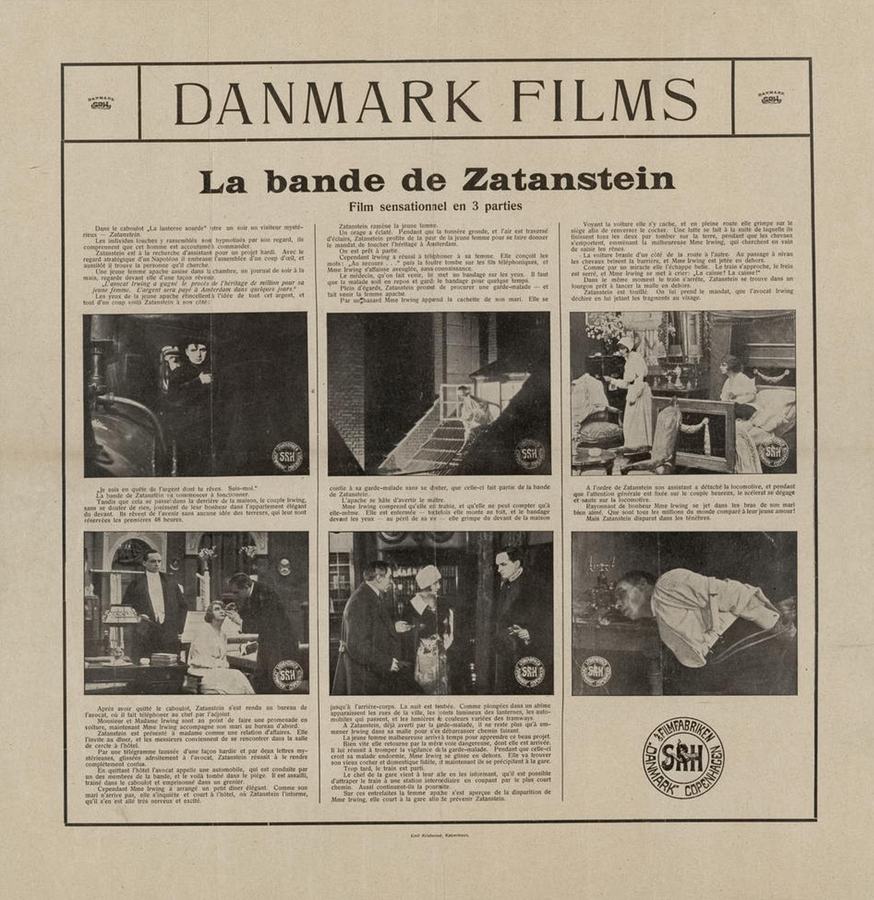
A nocturne soaked in kerosene and kohl, Zatansteins Bande detonates the crime-film blueprint long before noir’s cigarette smoke ever curled around a Venetian blind. Directed with berserk precision by an anonymous maverick at Nordisk Film, this 1916 Danish export feels like stumbling into someone else’s nightmare printed on nitrate: faces emerge from pitch-black voids, iris shots become peepholes into perdition, and the city itself—a maze of gables and gaslamps—breathes like a wheezing lung.
The storyline, deceptively simple on ledger paper, mutates onscreen into a ritual. Our mephistophelian recruiter Zatanstein (Valdemar Møller, channeling both Murnau’s demon clerk and the urban legend your landlady whispers about) doesn’t want gold; he wants gravity—to unhook the celestial clockwork and watch citizens flail in moral zero-g. His pitch seduces through omission: no mention of loot, only transformation. Each recruited soul trades certainty for vertigo, a bargain the Expressionists found sexier than any silk-stockinged femme.
Enter the Apache girl Naja (Anna Müller), a flinty prism of colonial guilt and proto-feminist defiance. Her dance-hall contortions, equal parts Butoh and can-can, weaponize voyeurism; when she consents to the scheme, it’s less greed than grievance against a world that fetishized her heritage in circus tableaux. Müller’s performance—eyes narrowed as if perpetually sighting down a rifle—prefigures the Destiny: or, the Soul of a Woman refrain of women weaponizing destiny itself.
The ensuing assemblage of misfits could populate a Brechtian ballad: Emilie Sannom’s trapeze veteran whose chalk-dust makeup can’t mask existential vertigo; Peter S. Andersen’s disgraced financier, pockets turned inside-out like a surrender flag; and Charles Løwaas’s anarchist whose eyes literally sparkle—achieved by double-exposing star-fields whenever he rants about dynamastic renewal. Their collective objective: to infiltrate the city’s subterranean switch-room and reroute power so sunrise projects their silhouettes, giant and godlike, onto the clouds. Call it cinema’s first attempted crowd-funded eclipse.
Cinematographer George Schnéevoigt (later to lens The Avalanche) treats light like a sadist treats perfume—sparingly, precisely, with intent to suffocate. Interiors are carved via razor-sharp side-lighting that bisects faces into public mask and private wound. Exterior streets dissolve into pure chiaroscuro: cobblestones glisten like obsidian, fog eats silhouettes, and every lamppost becomes a gallows for out-of-work angels.
Compare the urban tableaux to The Shadows of a Great City, yet note how Zatansteins Bande refuses moral polarity; its shadows don’t hide villains, they birth them. The camera stalks characters at ankle height, turning everyday setts into craggy cliff-edges. One vertiginous shot—filmed from a hot-air balloon drifting above rooftops—anticipates the city-symphony genre by half a decade, rendering citizens as bacilli under microscope. Modern viewers may detect DNA strands later spliced into Metropolis and M.
Intertitles, scarce as hen’s teeth, arrive in fractured haiku rather than exposition: “Midnight kneels / Zatanstein walks / the city holds its breath.” Typography jitters, letters quivering like guilty consciences. This minimalism weaponizes ambiguity; we’re never sure if the conspiracy succeeded, failed, or transcended binary outcomes—a narrative vacuum that pulls your imagination face-first into the gears.
Valdemar Møller’s Zatanstein is less character than contagion. He modulates charm with clinical detachment, extending pauses until silence grows fangs. Watch how he introduces the heist: fingers steepled beneath chin, eyes half-lidded as if listening to subterranean choirs. It’s hypnotism without hokum, a precursor to Schreck’s Count Orlok yet steeped in urbane menace rather than verminous gothic.
Müller’s Naja counterbalances with kinetic fury. Where Zatanstein calcifies, she liquefies—sliding across frames like mercury, her costume’s beaded fringe writing Morse code against the backdrop. Their pas-de-deux of seduction and suspicion culminates in a shadow-play tango: projected silhouettes merge, devour, separate, leaving us to question whether intimacy transpired or we merely witnessed the idea of intimacy. Censors at the time reportedly trimmed three frames fearing subtextual sapphic tension between Naja and the banker’s wife—proof that even 1916 sensed the film’s queer undercurrents.
Surviving prints contain no official score, yet every modern screening births new sonic interpretations—my favorite: a Copenhagen ensemble deploying detuned musical saws and slowed heartbeats sampled from ICU monitors. The result crawls under your epidermis, turning each flicker of celluloid into a cardiac event. Historians speculate original exhibition may have featured live improvised percussion on brake drums and typewriters, aligning with Dada soirées erupting across Europe that same year.
This sonic openness underlines the film’s core modernity: it demands active spectatorship. Like the anarchist’s unexploded bomb, the missing soundtrack becomes a lacuna where audience anxiety pools. You become an accomplice, filling gaps with the thrum of your own circulatory system—a meta-heist stealing your composure.
While Danish cinema of the era exported syrupy melodramas, Zatansteins Bande smuggled subversion across borders, arriving in Berlin disguised as morality play and infecting future Weimar aesthetics. Compare its criminal cabal to Lang’s Dr. Mabuse or the doomed revolutionaries in Chûshingura; yet note how Nordisk’s film refuses redemption arcs. Here, crime doesn’t punish; it reveals—peeling back civic veneer until civilization’s raw plumbing glistens.
Feminist scholars cite Naja as prototype for the femme fonctionnaire—woman as operational catalyst rather than erotic decoration. She doesn’t soften the masculine trajectory; she bends it toward entropy, a narrative insurgency later mirrored in For the Queen’s Honor though with monarchical stakes swapped for street-level anarchy.
For decades the film slumbered in a Norwegian herring-merchant’s barn, reels fused like strata of geological panic. The 2018 Danish Film Institute 4-K restoration salvaged 67 of an estimated 78 minutes, replacing lost segments with tintled stills and translated intertitles that mimic original jitter. The resulting hybrid—part motion, part tableau—paradoxically intensifies the fever-dream texture. Streaming platforms label it “incomplete”; purists counter that incompleteness is the film’s natural state, a wound that refuses sutures.
Those lucky enough to catch archival 35-mm screenings report hallucinations of additional footage: a brief close-up of Zatanstein’s eye dilating; Naja crushing a monarch butterfly between thumb and forefinger. Whether these are mnemonic phantoms or clandestine fragments the projector whispers only to insomniacs remains deliciously irresolvable.
Great art doesn’t comfort; it colonizes. Zatansteins Bande invades your psychic infrastructure, installs anxiety like malware, then vanishes leaving you to police the wreckage. It’s a film you don’t merely watch; you survive. Yet survival begets addiction—I’ve returned to it nightly for a fortnight, each viewing peeling fresh scabs from urban reality. When I traverse neon boulevards now, I sense Zatanstein’s gaze flickering in traffic lights, urging complicity.
Comparative touchstones abound—The Man Who Came Back trades crime for colonial guilt, Il film rivelatore interrogates surveillance—yet none fuse formal radicalism with pulp frisson this subliminally. Even Hearts and the Highway romanticizes the road, whereas Zatansteins Bande asphalt-chews romanticism itself.
Seek it not for answers but for contagious questions: Is villainy a virus or vaccine? Does modernity breed conspiracies or merely cameras to film them? And if you stare too long into the city’s dead spaces, might something stare back, whispering heists that outrun morality? The film refuses closure, ending mid-gesture—as if the projector itself were recruited, absconding mid-scheme.
In short, Zatansteins Bande is a molotov hurled into the future’s bloodstream, still burning a century later. Approach with caution; exit with combustion. And when dawn breaks the morning after, don’t be surprised if your shadow lags a second behind, negotiating terms with the receding night.
IMDb 6
1922
Community
Log in to comment.