DbcultAccessing Vault...
5.4/10
Senior Film Conservator
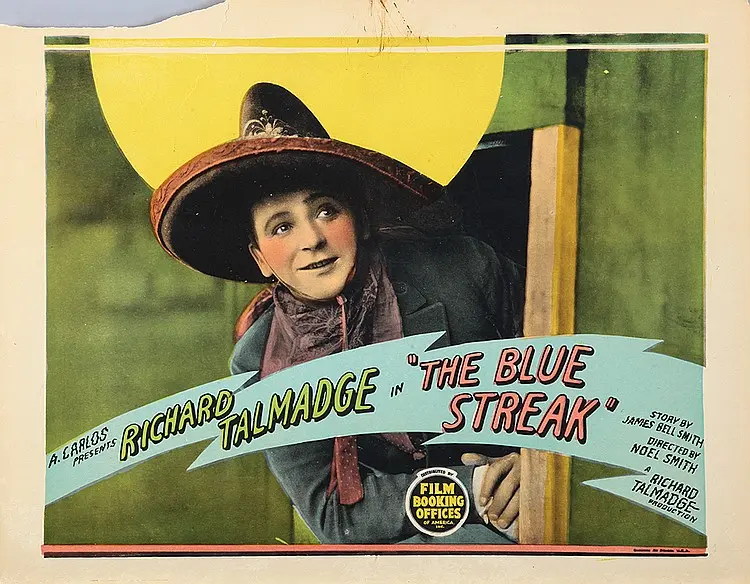
A definitive 5.4/10 rating for a film that redefined the boundaries of cult cinema. The Blue Streak remains a cornerstone of transgressive art.
Is The Blue Streak (1926) worth watching today? Short answer: Yes, but only if you view it as a primitive blueprint for modern action cinema rather than a dramatic masterpiece.
This film is for the silent cinema completionist and the stunt enthusiast who wants to see the roots of parkour. It is not for the viewer who demands psychological depth or a plot that doesn't rely on massive coincidences.
1) This film works because Richard Talmadge’s physical performance transcends the limitations of 1920s storytelling.
2) This film fails because the narrative structure is a flimsy clothesline designed only to hang action sequences upon.
3) You should watch it if you want to see a star who performed his own death-defying feats decades before CGI existed.
Richard Talmadge was never going to win an award for his range of facial expressions. In The Blue Streak, his performance is measured in vertical leaps and sprint speeds rather than emotional beats. He plays the 'young man' archetype with a kinetic energy that makes his contemporaries look stationary. While other films of the era, like Three X Gordon, attempted to balance social commentary with entertainment, The Blue Streak is unapologetically a vehicle for Talmadge's athleticism.
Consider the scene where he first arrives at the Mexican border. The way he moves through the environment isn't just walking; it's a constant state of readiness. He treats the set like a gymnasium. This physical presence is what carries the film through its slower introductory phase. The plot is thin. The stunts are thick. This trade-off is the film's defining characteristic.
Talmadge’s background as a stunt double for Douglas Fairbanks is evident in every frame. There is a specific moment during his escape from the kidnappers where he uses a wooden beam to pivot his entire body weight. It is a move that feels modern, almost like something out of a Jackie Chan film. It’s not just a stunt; it’s a rhythmic piece of choreography that justifies the film's existence.
The writing by James Bell Smith doesn't bother with the nuances of probability. Our hero happens to meet the exact girl he saved once before, and she happens to be going to the exact same remote mining location in Mexico. It’s a double-down on coincidence that would be laughed out of a modern writers' room. However, in the context of 1926 action-adventures, this was the standard shorthand for 'destiny.'
The conflict involving the misdirected mine shipments is equally simplistic. The villains are recognizable by their sneers and their lack of tactical foresight. Unlike the more complex political undertones found in Prohibition, the stakes here are purely transactional. Money is being stolen, a girl is in danger, and only a very fast man can fix it. It’s primal storytelling.
The kidnapping sequence serves as the film’s midpoint pivot. It is here that the pacing shifts from a travelogue to a frantic survival thriller. The transition is jarring. One moment we are looking at the dusty landscapes, the next we are in a high-stakes escape. This lack of smooth modulation is common for the era, but it feels particularly abrupt here because Talmadge is so much more interesting when he’s moving than when he’s sitting in a cell.
The Blue Streak is worth watching if you are a student of film history or an admirer of early stunt work. It offers a fascinating look at how 1920s Hollywood utilized the 'Mexican Frontier' as a lawless playground for American heroes. While it lacks the prestige of a film like Confessions of a Queen, it makes up for it with sheer, unadulterated energy.
The film is a short, punchy experience. It does not overstay its welcome. If you go in expecting a deep character study, you will be disappointed. If you go in expecting to see a man jump off things in high-waisted trousers, you will be delighted.
The cinematography in The Blue Streak is functional rather than poetic. Unlike the expressionist shadows that were beginning to creep into European cinema, this film favors high-key lighting and wide shots. This was a practical choice. You can't appreciate a Richard Talmadge stunt if the camera is too close or the lighting is too moody. The audience needs to see the distance between the roof and the ground.
The location shooting provides a gritty texture that studio sets of the time couldn't replicate. The dust feels real. The heat feels palpable. When Talmadge is running through the mining camp, the uneven terrain adds a layer of genuine peril to his movements. It’s a stark contrast to the more polished, indoor feel of Lost: A Bridegroom.
There is a brutal simplicity to the way the camera tracks the action. There are no fancy pans or tilts. The camera sits back and lets the athlete do the work. It’s honest filmmaking. It doesn’t try to hide the wires because there aren’t any. The danger is the draw.
1926 was a year of transition. You had the high-concept drama of Spartak and the comedic experiments of You're Pinched. In this landscape, The Blue Streak occupied the middle ground of the 'Poverty Row' actioner. It didn't have the budget of the majors, but it had a star who was willing to break his neck for a nickel.
When compared to Solid Ivory, which leaned into sports-themed heroism, The Blue Streak feels more dangerous. There is a sense of genuine lawlessness in the Mexican setting that gives the film a slight edge. It isn't just a game; it's a rescue mission. However, it lacks the narrative cohesion of The Man from Glengarry, which managed to weave its action more tightly into the character's motivations.
Pros:
- Incredible physical performance by Richard Talmadge.
- Fast pacing that avoids the typical silent film 'drag.'
- Authentic location shooting that adds grit.
- A clear, easy-to-follow conflict.
Cons:
- Thin characterizations for everyone except the lead.
- Predictable plot beats.
- Minimal artistic ambition beyond entertainment.
The Blue Streak (1926) is a kinetic relic. It is a film that knows exactly what it is: a delivery system for Richard Talmadge’s acrobatics. While the story is as dry as the Mexican desert it’s filmed in, the physical feats remain impressive nearly a century later. It works. But it’s flawed. It’s the kind of film that reminds us that before movies were art, they were attractions. If you go in looking for an attraction, you’ll find a great one here.
IMDb 6.3
1936
Community
Log in to comment.