DbcultAccessing Vault...
Cult Review
Senior Film Conservator
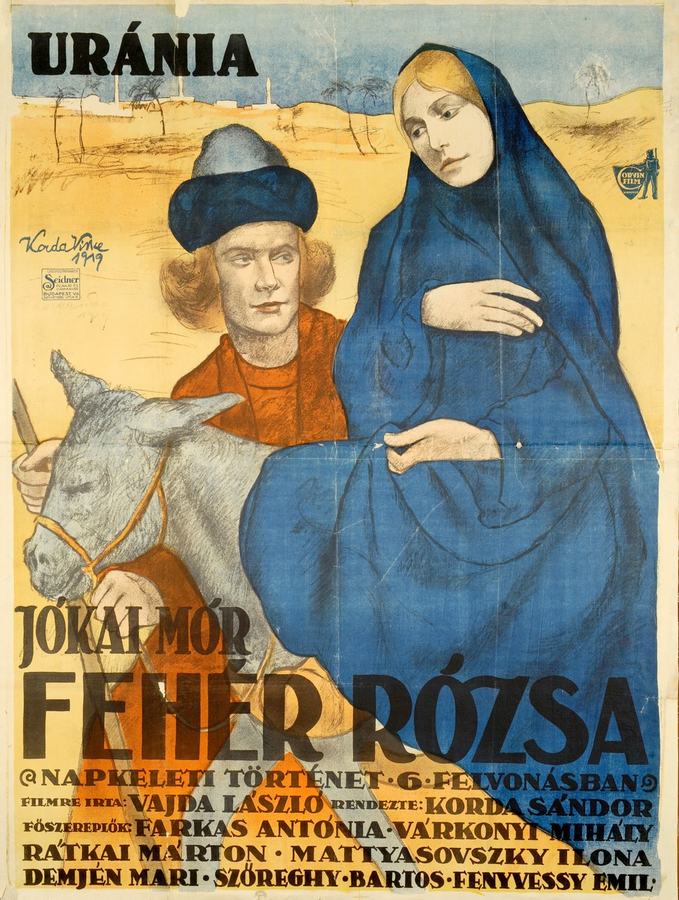
From the opening frame, Fehér Rózsa immerses the viewer in a chiaroscuro world where darkness is not merely a backdrop but a character in its own right. The cinematographer exploits the stark contrast between the coal‑black that envelops the village and the occasional burst of sea‑blue (#0E7490) that glints off the Danube’s distant ripple. This chromatic decision feels intentional, echoing the emotional turbulence of Ilona (María Corda) as she navigates a labyrinth of secrets. When the white rose first appears, it is bathed in a soft halo of yellow (#EAB308), a fleeting beacon of hope that quickly dissolves into the surrounding gloom. The deliberate restraint of color mirrors the film’s thematic preoccupation with restraint versus revelation, a visual metaphor that resonates long after the credits roll.
\n\nThe diary serves as both plot engine and narrative foil, its ink‑stained pages a conduit between past and present. Ilona’s discovery of the aristocrat’s confession initiates a cascade of flashbacks that are deftly intercut with present‑day machinations. This structural choice recalls the non‑linear storytelling of the silent classic The Honor System (slug:the-honor-system), yet Fehér Rózsa avoids the melodramatic pitfalls that often accompany such techniques. Instead, each temporal shift is anchored by a sensory cue—a gust of wind, the rustle of silk—that signals to the audience an imminent jump in chronology. The result is a tapestry that feels both intricate and accessible, allowing viewers to piece together the mystery without feeling patronized.
\n\nMaría Corda’s portrayal of Ilona is a masterclass in restrained emotiveness. She conveys longing through a lingering gaze, a tremor in her fingers as she threads a needle, and the slightest quiver in her voice when she whispers the name Eszter. Márton Rátkai, as János, juxtaposes his partner’s softness with a rigid, almost militaristic posture, his eyes constantly scanning the horizon for threats—both real and imagined. Nusi Somogyi’s Eszter, though sparingly present, radiates an ethereal melancholy that lingers in every reflective surface. Victor Varconi’s Árpád injects a charismatic volatility that recalls the roguish charm of characters in Made in America (slug:made-in-america), but his motives remain inscrutable until the final act, where his betrayal feels both inevitable and shocking. The supporting cast—Gyula Szöreghy and Gyula Bartos as rival merchants—provide a grounded counterpoint, their exchanges peppered with regional idioms that enrich the film’s cultural texture.
\n\nAt its core, Fehér Rózsa interrogates the notion of sacrifice through the symbolism of the eponymous flower. The rose, pristine yet destined to wilt, mirrors Ilona’s journey from naive optimism to hardened resolve. The film suggests that true sacrifice is not the relinquishment of love but the willingness to confront its raw, unvarnished truth. This thematic thread intertwines with questions of identity: Ilona’s discovery that Eszter’s story parallels her own forces a confrontation with the self‑constructed narratives that have guided her life. In this regard, the film aligns with the introspective mood of Anny – en gatepiges roman (slug:anny-en-gatepiges-roman), where personal histories become labyrinthine mirrors.
\n\nThe auditory design of Fehér Rózsa is as meticulously crafted as its visual counterpart. A sparse, piano‑driven motif recurs whenever the white rose is referenced, its notes lingering like pollen in the air. Ambient sounds—crackling hearths, distant church bells, the rustle of wheat—are amplified to create an immersive soundscape that grounds the narrative in a palpable reality. When the storm erupts during the climactic square scene, the thunder is not merely a weather event but an aural representation of the characters’ internal upheaval, echoing the sonic intensity found in The Eyes of the Mummy (slug:the-eyes-of-the-mummy).
\n\nWhen placed beside contemporaneous works such as The Valentine Girl (slug:the-valentine-girl) and Die Pagode (slug:die-pagode), Fehér Rózsa distinguishes itself through its unflinching commitment to psychological depth over melodramatic spectacle. While Die Pagode revels in exotic set pieces, Fehér Rózsa confines itself to a single village, allowing the audience to explore every crevice of its social fabric. Moreover, the film’s reliance on visual symbolism—particularly the recurring white rose—evokes the poetic minimalism of A Weaver of Dreams (slug:a-weaver-of-dreams), yet it retains a narrative drive that keeps viewers emotionally invested.
\n\nThe director’s hand is evident in the measured pacing; scenes linger just long enough to allow tension to thicken without succumbing to tedium. The decision to employ long takes during the market sequences invites the viewer to observe the subtle choreography of everyday life, echoing the observational style of Up the Road with Sallie (slug:up-the-road-with-sallie). Yet, when the narrative demands a pivot—such as Árpád’s sudden confession—the camera snaps to tighter frames, heightening immediacy. This oscillation between expansive and intimate framing underscores the film’s central paradox: the public versus the private self.
\n\nSince its premiere, Fehér Rózsa has been lauded for its nuanced portrayal of post‑war Hungarian society, earning a place in academic curricula that examine cinema as a conduit for historical memory. Its influence can be traced in later Hungarian auteurs who echo its thematic preoccupations—most notably in the works of István Szabó, where the interplay of personal and collective trauma remains central. The film’s enduring relevance is also evident in contemporary retrospectives that pair it with Mästertjuven (slug:mastertjuven), highlighting a shared fascination with objects that embody both beauty and burden.
\n\nFehér Rózsa transcends its era through a marriage of visual poetry, layered performances, and a narrative that refuses to simplify complex emotions. It challenges audiences to contemplate the cost of secrets, the weight of heritage, and the fragile resilience of love. For cinephiles seeking a film that rewards repeated viewings, the white rose offers an ever‑unfolding bloom of meaning. Its meticulous craftsmanship, from the subdued palette to the resonant score, ensures that each viewing reveals a new petal, a fresh hue, a deeper shade of humanity.
\n
IMDb 6.4
1933
Community
Log in to comment.