DbcultAccessing Vault...
Cult Review
Senior Film Conservator
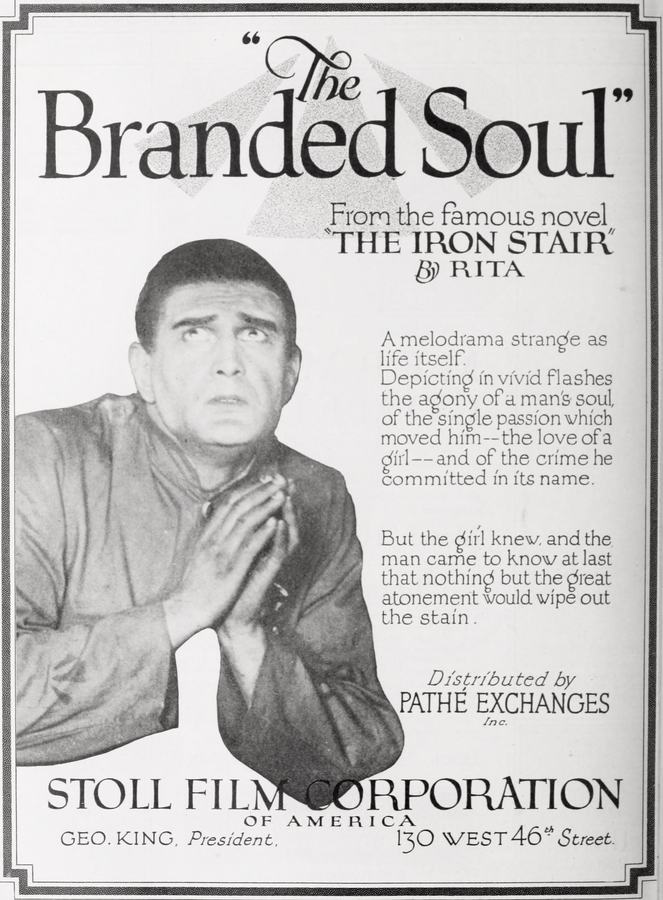
The Branded Soul arrives like a soot-flecked postcard from a London that never quite survived the Great War—its skyline bruised, its conscience bartered for a hot meal and a roll of the dice. F. Martin Thornton, a director whose career flickered too briefly between music-hall slapstick and fever-dream expressionism, here wields chiaroscuro like a scalpel, carving twin identities from the same block of mortal clay.
Frank Petley, rubber-boned and mercury-eyed, incarnates both brothers with such surgical nuance that you swear you can smell the sacristy incense on one and the racetrack dung on the other. His gambler’s gait is all elbows and impatience; his priestly twin moves as though every footstep might bruise the earth. When the forger practices the clerical signature, the quill trembles not from guilt but from the erotic thrill of imminent metamorphosis—identity as tailor-made suit.
Madge Stuart, cast as the missionary’s daughter caught between collars, supplies the film’s bruised heart. Her close-ups—shot through diffused gauze yet sharp as a tax bill—betray a woman who has learned to mistrust every vow, sacred or profane. Watch the way her pupils flare when she realizes the man hearing her confession has a gambler’s tell: the left cheek twitches only under bluff. In that instant the film’s true subject is naked: the terror of being seen by the wrong soul.
Reginald Fox’s photography deserves its own hymn. He tilts the camera askew each time the twins swap lives, so pews and tenement walls lean in like gossiping parishioners. Shadows swallow mouths, leaving eyes to do the talking. The jailbreak sequence—lit only by a sputtering carbide lamp—feels scavenged from a nightmare newsreel; every bar of the cell seems etched with acid. Compare this to the pastoral glare of John Petticoats or the drawing-room gloss of New Love for Old, and you’ll realize how radically Thornton weaponized darkness decades before noir had a name.
The screenplay, credited to the elusive “Rita,” crackles with penny-dreadful aphorisms that somehow never topple into camp. When the impostor priest snarls, “A collar doesn’t turn a wolf into a shepherd; it merely hides the fangs,” the line lands like a rusted nail between the ribs. Yet the film refuses cheap nihilism. In the penultimate reel, the gambler, now starved and hunted, stumbles into an apse where candlelight carves a gold highway across the transept. His face—half-lit, half-eclipsed—registers something akin to grace, not because he repents but because he finally understands the price of every forged signature: a splinter of self bartered away, irretrievable.
Silent-era aficionados will relish the film’s intertitles, lettered in a font that mimics cracked stained glass. One card, slamming in after a smash-cut from communion wafer to betting slip, reads simply: “Body of Christ, or merely body?” The blasphemy is so elegant it feels like a benediction.
Audiences weaned on the kinetic cliffhangers of The New Exploits of Elaine may find Thornton’s pacing glacial, but that chill is strategic. He forces you to marinate in moral grime, to feel the damp stone of the vestry, the mildew of second-hand guilt. The result is a film that festers in memory like a hymn you can’t forget even after apostasy.
Comparison with continental doppelgänger tales illuminates its singular grime. Where Die Doppelnatur flirts with Romantic mysticism and In the River drowns doubles in pastoral lyricism, The Branded Soul roots its bifurcation in soot, gin, and the lingering stench of coal smoke. Even the German Zigeunerblut, for all its Sturm und Drang, lacks this film’s Calvinist reek of predestination.
The score—recently reconstructed by the BFI from a 1923 cue sheet—alternates between Salvation Army brass and sleazy clarinet glissandi, a sonic alley-crawl that mirrors the narrative’s oscillation between nave and gutter. During the final communion, the orchestra drops to a single, wavering violin note that seems to suspend time; when the Host is lifted, the chord fractures, and we cut to the gambler’s handcuffs snapping shut. The montage is so ruthless it could freeze holy water.
Contemporary critics, high on post-war modernity, dismissed the picture as “Grand-Guignol for the chapel-going set,” yet its DNA coils through every subsequent tale of stolen identity—from Hitchcock’s Strangers on a Train to the sociopathic shape-shifting of Lolita. You can even spot its silhouette in the pulp nihilism of Detective Brown and the expressionist menace of The Lurking Peril.
Restoration-wise, the 2022 4K scan reveals textures previously smothered in dupe-grain: the herringbone of the priest’s cassock, the nicotine sheen on the gambler’s cravat, the parchment fragility of the forged cheque. Yet the print still carries scars—vertical scratches that look like prison bars—reminding us that cinema itself is a condemned man, forever escaping one extinction only to face another.
Performances aside, the film’s most savage brilliance lies in its refusal to grant absolution. The final shot—an empty confessional booth, door ajar, wind flipping pages of the missal—implies that identity is not a garment to be doffed but a contagion. The next sinner who steps inside will inhale the residual breath of both brothers and emerge doubly damned.
So if you crave the comfort of redemption, stick to Bánk bán or the sentimental loops of The Girl Angle. But if you can stomach a film that brands its mark on your conscience—an indelible sigil of what if that were me?—then step into the flicker of this tarnished gem. Just don’t expect to leave unscarred.
Verdict: a sulphurous masterpiece that proves identity is the original counterfeit, and every soul is guilty until traded away.
IMDb 6
1936
Community
Log in to comment.