DbcultAccessing Vault...
4.6/10
Senior Film Conservator
A definitive 4.6/10 rating for a film that redefined the boundaries of cult cinema. The Brass Bottle remains a cornerstone of transgressive art.
A London architect uncorks a jinn and learns that every wish carries the freight of its opposite.
There is a moment, roughly halfway through Sidney Morgan’s The Brass Bottle, when the camera lingers on a marble sphinx suddenly materialised in Hyde Park. Moonlight glazes its alabaster haunches; behind it, a constable’s bull’s-eye lantern trembles like a trapped star. That single tableau distils the film’s intoxicating formula: Edwardian restraint pitched headlong into Arabian Nights delirium. Viewed today, the 1923 silent feels less like a quaint curio than a prophetic dream of modern London—its cranes, oligarch basements, and air-brick vanity flats—where overnight fortunes rise from desert money and nobody questions the surreal.
Thomas Anstey Guthrie—whose 1900 novel supplied the bones—was the Oscar Wilde you called when you needed a social set piece skewered rather than merely satirised. Collaborating with Morgan, he prunes the book’s picaresque sprawl into a brisk three-act fable without sacrificing the acidic snap of drawing-room hypocrisy. The result is a screenplay that pirouettes between slapstick and scalpel, never forgetting that every joke is also a fracture line in Britain’s class mosaic.
Morgan, a veteran of costumed romps like The House of Temperley, directs with a proto-expressionist tilt: windows skew trapezoidal when the jinn’s power surges; shadows elongate across stripped-paper walls like spilled ink. Yet he keeps the performances tethered to recognisable humanity, a restraint that prevents the fantasy from floating into the weightless ether where so many silent spectacles vanish.
Doris Lytton’s Seraphina is no swooning ingénue; her gaze carries the steely glint of a woman who has read The Yellow Book and learnt how stories punish compliant heroines. Watch the micro-twitch at the corner of her mouth when Horace’s magically erected mansion erupts from the ground: delight wrestles with moral arithmetic, and the battle is painted in the 18 inches between her clavicle and eyebrow.
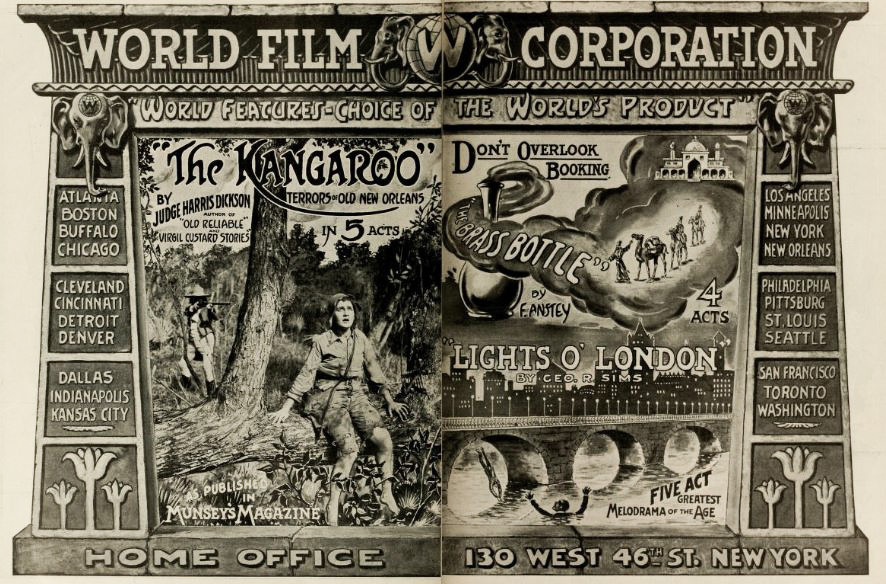
As Fakrash, Lawrence Grossmith swaggers through the frame with the languid authority of a music-hall Mephisto. He never once glances at the camera—a cardinal sin in 1923 comedy—yet commands attention through the sinuous choreography of his hands, as though conducting an invisible orchestra of atoms. When he folds space to teleport a dowager’s tiara onto the head of a street sweeper, the gesture is both benediction and pick-pocketing.
Mary Brough, playing the rampaging aunt, supplies the film’s piston of vulgar energy. She enters each scene as if shot from a cannon, petticoats flapping like battle standards, and leaves with the carnage of punctuation marks strewn across the intertitles. Her comic timing is so precise you can almost hear the trombone slide that the orchestra would have supplied in a 1923 picture palace.
Special-effects maestro Walter Stull devised the jinn’s miracles through a cocktail of double exposure, glass shots, and under-cranked extras. When the villa’s minaret spirals skyward, it is actually a matte painting on hinged glass, rotated by stagehands whose elbows remain just out of frame. The accelerated bloom of rose vines up the façade was achieved by shooting one frame every five minutes over an autumnal dusk, then printing at 18 fps—an early instance of what we now call time-lapse. The seams show, but the flicker of hand-cranked shutter becomes part of the spell: reality itself seems to hiccup.
Chromatically, the restoration leans into the original tinting notes: amber for interiors, viridian for exteriors, a shock of fuchsia when the jinn’s power peaks. The eye learns to read these tonal shifts as emotional subtitles, a syntax more immediate than words.
Beneath the froth lies a scalding critique of Edwardian mercantile culture. Horace’s poverty is architectural: he designs airy villas for others while dossing in a cramped bedsit whose window frames the chimney pots of a city that refuses to let him ascend. The jinn, a colonial import trapped in a bourgeois ornament, literalises Britain’s habit of looting the globe then locking wonders in curiosity cabinets. Every wish that enriches Horace does so by destabilising the same imperial order that once bottled Fakrash.
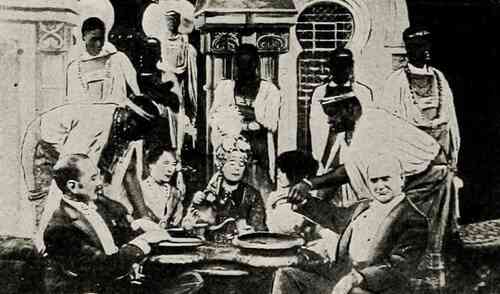
Contrast this with The Virginian, where upward mobility is earned through gun-barrel stoicism; here, advancement is conjured, suspect, and ultimately rejected. The film’s radical thesis: love purchased by spectacle is counterfeit currency; only the risk of poverty confers authenticity. It is a sentiment that lands with extra gravity in a post-2008, pre-Brexit Britain where housing bubbles burst like soap films.
Surviving cue sheets suggest a score stitched from Joplin rags, Saint-Saëns’ Bacchanale, and vaudeville hits like The Camel Walk. Syncopation becomes the sonic metaphor for social mobility: rhythms stride, stumble, then catch the beat anew. Contemporary reviewers praised the “nerve-jangling crescendo” that accompanied the sphinx scene, implying players who knew when to let silence pool like quicksilver before slamming the downbeat.
Today, a resourceful accompanist can recreate the effect with a digital sampler, but the film breathes just as vividly under a single piano, provided the performer understands that comedy is timing and fantasy is rubato.
Seraphina’s final refusal to be “won” by transaction marks the film as quietly proto-feminist. Unlike the heroines of The Octoroon or The Adventures of Kathlyn, she does not stand atop a narrative plinth waiting to be bestowed. When Horace relinquishes the third wish, she steps forward, pockets the shattered brass shards, and whispers—through the intertitle—“Let us build, brick by brick, a life too small for giants.” It is a line that rings across a century, echoing in every contemporary rom-com that dares to suggest partnership trumps rescue.
Place The Brass Bottle beside The Pursuit of the Phantom and you see two diverging paths of 1923 fantasy: one grounded in whimsy, the other in noir-tinged obsession. Both traffic in doubles and desire, yet where Phantom chases doppelgängers through Expressionist alleys, Bottle opts for sunlit absurdity. Meanwhile The Rattlesnake offers the American West’s moral absolutism; Britain’s answer is moral elasticity wrapped in a joke.
Across the Atlantic, A Trip to the Wonderland of America sells fantasy as manifest destiny; Morgan’s film is more cautious—miracles arrive, disrupt, then politely excuse themselves, leaving the social order shaken but upright, like a Victorian gentleman after too many brandies.
Though eclipsed by later bottle-centric comedies—think The Thief of Bagdad or One Thousand and One Nights—Morgan’s film pre-empts their central irony: unlimited power yoked to limited imagination. The 1964 Tony Randall remake flattens the class critique into bedroom farce; the 1923 version retains the sting that magic, unexamined, merely magnifies the flaws of its master.
Archivally, the film survives in a 4K scan from a 35 mm nitrate held at the BFI, with one reel salvaged from a 28 mm show-at-home print discovered in a Devon attic. The restoration team opted to leave in the gate weave and occasional emulsion bloom—scratches that flicker like candle soot—arguing, rightly, that perfection would vandalise the film’s hand-made soul.
We live in an age when algorithmic jinns promise to fulfil our desires before we have finished articulating them. The Brass Bottle whispers a century-old warning: wishes are contracts written in disappearing ink. Horace’s redemption lies not in the grandeur of his dreams but in his willingness to sweep up the shards once the spell shatters—a humility our influencer culture could do well to emulate.
So seek it out, whether in a rep cinema with live accompaniment or a streaming window on your laptop at 2 a.m. Let its flicker remind you that every age believes its own illusions are exempt from hubris, and every age needs a comedy that laughs loud enough to crack the bottle before the bottle bottles us.
—Review by a devoted nitrate junkie still hunting for the scent of attar in the digital age.
IMDb —
1932
Community
Log in to comment.