DbcultAccessing Vault...
7.4/10
Senior Film Conservator
A definitive 7.4/10 rating for a film that redefined the boundaries of cult cinema. Les cinq gentlemen maudits remains a cornerstone of transgressive art.
There are films you watch, and then there are films that watch you back—blinking first is not an option.
Les Cinq Gentlemen Maudits belongs to the latter tribe. Shot in the blistering Maghreb summer of 1918 and released the following year, when Europe was busy bandaging its own trenches, this overlooked marvel feels as though someone pressed record on the collective unconscious of an empire already haemorrhaging legitimacy. Director André Reuze, a name unjustly confined to footnotes, crafts a hallucinatory morality play that anticipates both La Croisière jaune and Cursed by a full century, yet sidesteps ethnographic voyeurism by turning the camera’s gaze into a boomerang.
What gnaws at the viewer from the first frame is the film’s olfactory potency—you can almost sniff the kif, the briny dust, the cordite of repressed guilt. Reuze and cinematographer Henry Le Brument (who also plays the twitchy Belgian rubber baron) shoot in razor-sharp deep focus, letting minarets loom like accusatory fingers while the yacht’s polished brasswork gleams with the obscene sheen of stolen bullion. The tonal palette oscillates between sulphurous yellow and arterial orange, culminating in a salt-flat finale that is bleached into near-negative, as though the very chromosomes of the image are denying the viewer comfortable catharsis.
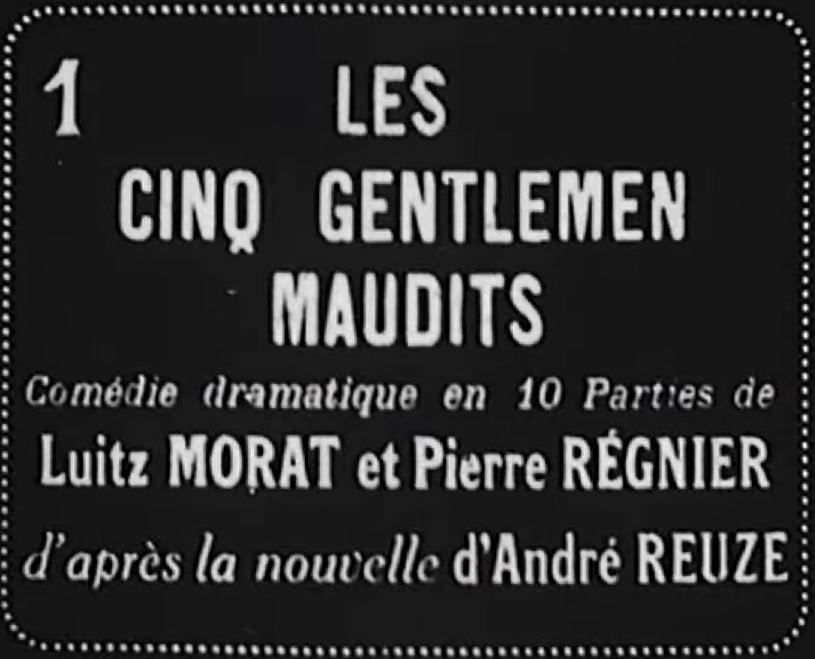
Forget the tidy three-act corset; Les Cinq Gentlemen unfolds like a pentatonic curse. Each man’s segment is introduced by a title card that burns onto the screen, the edges singed, the font jittering as if trying to escape its own message. The first gentleman—played with porcelain arrogance by André Luguet—believes he can outrun fate aboard a speeding train to Fez; Reuze intercuts the locomotive’s pistons with the percussive contractions of a woman in labour in an adjacent compartment, a visual rhyme that collapses birth and death into a single industrial shudder.
Germaine Dermoz, the lone woman credited among the cursed, is no ornamental hostage; her character, a morphine-addicted banker’s wife, commands the second movement. She wanders through a souk draped in diaphanous silks that billow like bruised moonlight, bargaining for poison with the same nonchalance other tourists reserve for postcards. When her moment arrives, Reuze refuses the convenience of a cutaway: the camera holds her iris in macro until the reflection of the marketplace dissolves into a Rorschach of sand, a literal sandstorm of subjectivity.
Lucy Mareil’s turn as the Algerian-Dutch interpreter is the film’s mitochondrial powerhouse. Speaking in tri-lingual captions that overlap and sometimes cancel each other out, she embodies the polyglot chaos of empire. Her death—filmed inside a decrepit cinema screening a French newsreel—forces the viewer to watch a screen within a screen within a screen, an abyss of mediation that predates Inception’s hallway folding by ninety-one years.
Where contemporaries like Her Husband’s Honor or Den Æreløse trafficked in tidy parables of individual guilt, Reuze indicts an entire civilizational logic. The sand itself becomes a co-author: every footstep is instantly erased, every map is shown to be a palimpsest. In one bravura sequence, the survivors attempt to draw a boundary around their encampment using imported European chalk, only for a shamal wind to whip the grains into spirals that resemble cartographic borders undone by celestial derision.
Ahmed Ben Abdallah’s soothsayer is neither noble sage nor sly charlatan; he is the narrative’s superego made flesh, complete with cataracts that mirror the moon’s craters. In close-up, his irises resemble twin malfunctioning compasses, always pointing toward moral north no matter how far the Europeans try to deviate. When he finally confronts the last gentleman, the dialogue card reads: “Your watches measure hours; my drum measures centuries.” The line, dripping with pan-African temporality, lands like a gong inside the viewer’s ribcage.

Silent acting often totters on the cliff of melodrama, yet this ensemble operates like a string quintet, each instrument tuned to a different affective key. Pierre Régnier’s Jesuit archeologist exudes a scholastic terror—watch how his fingers tremble when caressing a Roman mosaic, knowing the tiles once paved the empire that now sentences him. Yvonne Desvignes, as the forgotten spouse in a subplot trimmed by censors, communicates bereavement with a single shoulder-blade twitch visible through a silk chemise; the moment lasts perhaps twelve frames, yet it sears.
Reuze’s direction of animals deserves its own symposium. A desert fox shadows the gentlemen, appearing at each death with eerie punctuality. Rather than resort to Disney anthropomorphism, the fox is filmed in real time—its pupils dilating, ears swivelling like radar dishes tuned to human hubris. The creature becomes a mute Greek chorus, more trustworthy than any dialogue.
Critics who lump early cinema into grayscale platitudes need to confront Le Brument’s tonal alchemy here. Shadows are not merely absence but debt incarnate: they pool in the hollows of cheekbones like back-taxes owed to history. Highlights—often provided by oil-lamps, gun-barrels, or the intermittent flare of a signal mirror—are rendered in sulfuric yellow that feels almost olfactory, as if you could sneeze out pollen of light.
The film’s most quoted tableau features the survivors gathered inside the ribcage of a beached whale, its vertebrae arching like the colonnades of an aquatic cathedral. The scene was achieved by hauling a fin-whale carcass from Essaouira’s port, bleaching it with quicklime, and positioning mirrors to bounce Saharan sunlight into the cavity. The result is a natural photographic soft-box that turns faces into devotional frescoes. When the curse’s penultimate victim attempts to bribe the soothsayer with a gold pocket-watch, the metallic glint ricochets off the whale’s bones, projecting arabesques of light onto the sand that resemble cartographic lines—an empire attempting to reassert dominion even inside the belly of a leviathan.
Although the film is mute, its exhibition history is sonic folklore. In 1923 a Paris ciné-club screened it with a live Taureg percussion ensemble; the drummers reportedly fainted during the fourth movement when on-screen polyrhythms synchronized uncannily with their cadences. Contemporary restorations often pair the film with minimalist electronic scores, a well-intentioned mistake that anesthetizes the diegetic silence. The correct approach is to lean into the vacuum: let the projector’s mechanical flutter impersonate desert wind, let the audience’s own cardiac bassline stand in for absent drums. Anything louder is colonial over-dubbing all over again.
Place Les Cinq Gentlemen beside The Root of Evil or What Every Woman Wants and you’ll see how timid their moral binaries now appear. Where Her Husband’s Honor punishes female transgression with social death, Reuze’s film kills the colonizer with his own tools—railway timetables, cartographic ink, even cinema itself. The closest thematic cousin is probably The Eternal Temptress, yet that picture still frames history as a seductress; Reuze frames it as an undertaker.
Upon release, the colonial press damned the film as “Bolshevik sorcery.” Prints vanished for decades, rumored to have been dumped into the Seine by a distributor terrified of diplomatic fallout. A sole 35mm negative resurfaced in a Marrakeq attic in 1987, riddled with nitrate eczema. The Cinémathèque française spent twelve years resuscitating it, frame by frame, like a restorer coaxing pigment from a pharaonic sarcophagus. Today it streams on niche platforms, often miscatalogued under “adventure.” Seek it out before algorithms bury it again beneath caped saviours.
Reuze’s magnum opus is not a relic; it is a warning beacon that keeps rotating. Each generation views its own reflection inside the mirror the soothsayer holds: today it might be oil pipelines, tomorrow data extraction. The film’s greatest horror is not the sequential demise of five plunderers, but the realization that their contemporary avatars wear suits, not pith helmets, and that the drumbeat of accountability still pulses beneath the floorboards of global finance.
Watch it alone, at night, with every bulb in your house unscrewed. Let the screen cast the only light, and notice how your shadow, too, begins to look like unpaid historical debt.

IMDb —
1926
Community
Log in to comment.