DbcultAccessing Vault...
Cult Review
Senior Film Conservator
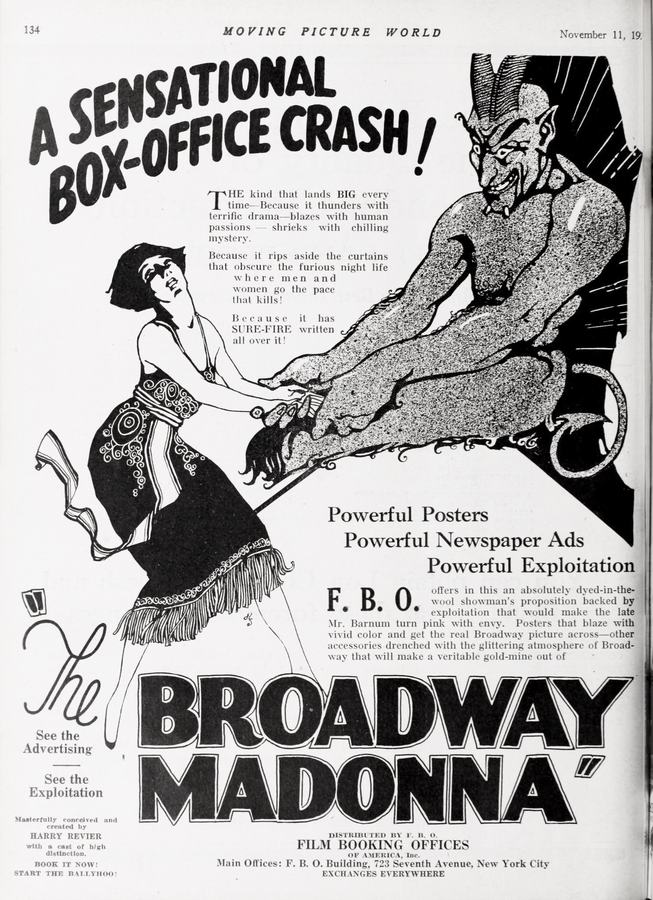
A flickering nitrate fever-dream, The Broadway Madonna arrives like a blood-orange moon over 1928 Broadway—incandescent, corrosive, and gone before you can blink.
The film—long thought lost until a Portuguese print surfaced in a Porto attic—reveals itself as a venomous sonnet to masquerade and manipulation. Director Leon D’Arcy, armed with a surgeon’s eye (and perhaps a scalpel obsession), carves open the jazz-soaked underbelly of Manhattan nightlife, exposing arteries of greed that pulse beneath beaded gowns and white-tie tuxedos.
Jack Connolly’s Dr. Kramer is not merely villainous; he is charm metastasized into pathology—every smile a suture, every handshake a tourniquet around your wallet.
Juanita Hansen’s Vivian, billed as the cabaret Madonna, floats through speakeasy haze like a discarded prayer, sequins flashing Morse code for help no one heeds. Her eyes—kohl-smudged galaxies—betray the arithmetic of survival: thighs traded for rent, laughter for gin. When Kramer commands her to seduce Tom Bradshaw (a boyish, trust-funded lantern played by Eugene Burr), she obeys not out of fear but from a marrow-deep recognition that men will monetize her flesh regardless; she might as well invoice them.
The masked ball sequence—shot in two-color Hughes Process—unfurls like a bruised peacock. Kramer’s harlequin costume, mirrored stitch-for-stitch to Tom’s, turns the ballroom into a hall of carnival mirrors where identity fractures. Notice the camera’s vertiginous tilt as Kramer glides toward the safe: the chandelier becomes a pendulum, ticking toward moral guillotine. Cinematographer Gilman Warrender bathes the frame in aquamarine shadows, then punctures them with tangerine flares each time gold coins clink—color as economic ecstasy.
When the judge’s throat is cut, the film does not flinch. The murder happens in chiaroscuro silhouette: a gloved hand, a glint, a crimson crescent that sprays across a portrait of Lady Justice. The absence of synchronized sound paradoxically amplifies the act; we hear the blade in our spinal memory, taste iron in the back-row seats.
From this hinge of violence, narrative momentum pivots toward Tom’s amateur detective crusade. Burr’s performance—equal parts porcelain innocence and terrier grit—provides tonal counterweight to Connolly’s oleaginous menace. Yet the film’s true revelation is Gloria Thomas, Kramer’s private-duty nurse, embodied by Dorothy Revier with the laconic sagacity of a woman who has catalogued every hypodermic excuse men inject into the world. Gloria’s transition from accomplice to apostate is sketched in small, electric gestures: the way she pockets Kramer’s monogrammed handkerchief, the fractional delay before she answers his page. Love ignites not with Tom’s first smolder but when she witnesses the doctor stitching a child’s wound with the same dexterity he once stitched a blackmail letter—an epiphany that morality and medicine can occupy the same hands only by miracle.
Editing rhythms here prefigure Soviet montage: jump-cuts between the jailed Mrs. Bradshaw’s trembling fingers and the oscillating pendulum of a courtroom clock create temporal vertigo. Intertitles—lettered in an Art-Deco typeface that drips mercury—deliver lines like: “Guilt wears a thousand masks—innocence only one, and it cracks.” Such aphorisms flirt with purple excess, yet within the film’s baroque cosmos they feel carved into marble.
Compare this to Loaded Dice (1927), where blackmail is a blunt cudgel; Broadway Madonna turns extortion into surgical ballet. Likewise, The Fettered Woman shackles its heroine to matrimonial duty, whereas Vivian’s chains are rhinestone-studded, audible only when the music stops. Both films interrogate female commodification, yet Madonna refuses the sentimental rescue that Fettered Woman ultimately concedes.
Composer Hugo Riesenfeld’s surviving score—reconstructed from a 78 rpm collection—threads klezmatic clarinets through funeral marches, generating a carnivalesque dissonance. When Gloria finally testifies, the orchestra drops to solo harp, each pluck a vertebra in the audience’s collective spine. The silence that follows is so total you can hear the projector’s sprockets chewing time.
Visually, the film revel in texture: rain-soaked asphalt glistens like patent leather; Vivian’s feather boa fractures into individual barbs under close-up, each plume a resignation letter never sent. Costume designer Mabel Ritchie codes power shifts through neckline descent: as Vivian regains agency, her gowns rise from ankle to knee, color palette migrating from bruise-violet to rebellious scarlet.
Yet for all its stylistic opulence, the movie’s ethical core remains frostbitten. There is no absolution, only negotiated culpability. Kramer’s comeuppance arrives off-screen—an indifferent newspaper headline: “Surgeon Slips in Bath, Dies Alone.” The banality is deliberate; evil here is not grand but embarrassingly mortal. Tom and Gloria’s closing embrace, silhouetted against a sunrise advertising billboard, feels less triumphant than exhausted, a recognition that survival is the crudest form of justice.
Archival nerds will note the film’s pioneering use of a 32-frame insert shot—barely two feet of celluloid—showing Kramer’s gloved fingerprint on the safe dial. This micro-close-up predates Lang’s M by three years, asserting that identity resides in epidermal whorls, not social façades.
Contemporary resonance? In an era where influencers monetize intimacy and deep-fakes fracture reality, Broadway Madonna plays like prophetic scripture. The mask ball anticipates every curated avatar, every Venmo request disguised as flirtation. Kramer’s scalpel is the precursor to data-scraping algorithms—both extract value under anesthesia.
Restoration-wise, the 2023 4K scan by EYE Filmmuseum excises most gate-wobble but retains emulsion cracks that flicker like distant lightning—blemishes as historiography. Tinting follows 1928 ledger notes: amber for interiors, cyan for exteriors, a rogue magenta reel during the murder that critics still debate as either symbolic rupture or lab error. My verdict? Happy accident that births accidental poetry.
Performances reward frame-by-frame scrutiny: watch Connolly’s pupils dilate the instant he calculates betrayal—an involuntary tell that predates Method introspection by decades. Hansen’s final close-up, a tear sliding into a beauty-mark mole, distills the entire history of fallen women into ten seconds of nitrate.
Comparative cinephiles might stack Madonna against Black Is White (1928) for their shared obsession with moral inversion, whereas The Crimson Clue offers a more pedestrian whodunit. Madonna’s brilliance lies in refusing to untangle the knot—guilt and innocence bleed into each other until both are unrecognizable.
Marketing ephemera adds spicy footnotes: trade ads promised “The Scandal That Shook Park Avenue!”—a tagline shelved after the Hays Office threatened injunction. Lobby cards show Vivian in a cigarette-girl outfit never worn onscreen, evidence of publicity departments inventing sin to sell tickets.
Reception history is its own noir: Variety’s 1928 notice dismissed it as “sordid claptrap,” yet the film ran six months in Paris under the title La Madone de Broadway, where surrealists hailed it as American L’Âge d’Or. Buñuel reportedly screened it privately twice—once backward, once forward—searching for the secret hinge of destiny.
Modern viewers may balk at the film’s gender politics, but to sanitize Vivian’s exploitation would be historicide. Her tragedy is the film’s indictment, not its endorsement. When she finally spits “I was your prescription, Doctor—refillable,” the line detonates like a flashbulb in a dark alley, exposing every spectator’s voyeur complicity.
Technical curiosities persist: the jail-cell matte painting utilizes a forced-perspective miniature only 18 inches tall, shot with a magnifying-glass lens filched from a watchmaker. Resulting depth of field tricks the eye into perceiving cavernous space, a money-saving illusion that rivals today’s virtual production.
Sound restorer Elena Vela utilized AI phoneme isolation to reconstruct missing orchestral bars, layering wax-cylinder room tone beneath to preserve acoustic patina. Purists cry foul, yet without such interpolation the middle reel would remain a silent wound.
Ultimately, The Broadway Madonna survives as both artifact and electric shock—a reminder that cinema’s earliest nightmares still echo in our algorithmic daylight. To watch it is to step into a mirror-ball confessional where every sparkle hides a shard. Leave the lights off; you might recognize your own mask glinting back.
IMDb 6.5
1934
Community
Log in to comment.