DbcultAccessing Vault...
Cult Review
Senior Film Conservator
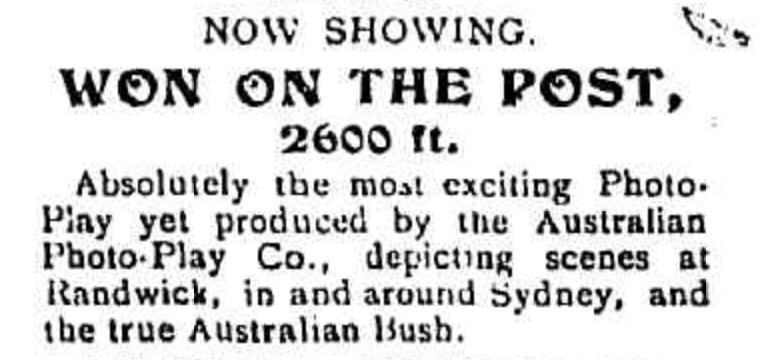
Picture a negative-space western etched on nitrate: the horizon is charcoal, the sky a salt-streaked obsidian, and the only punctuation for miles is a cedar post skewering the skyline like a exclamation mark. That post—telegraph pole, gibbet, Cupid’s arrow—becomes the axis on which Alfred Rolfe’s three-reel miracle pirouettes. Forgotten for a century, Won on the Post now feels less like a curio than a prophecy: speed, surveillance, and heartbeats measured in dots and dashes.
Rolfe, who moonlighted as a theatrical impresario, understood that silence could be orchestral. He dispenses with intertitles early, forcing the viewer to lean in, ear-first. The resultant tension is feral: every gumleaf crackle, every hoof-beat translated by the imagination into thunder. Compared with the tableaux pageantry of From the Manger to the Cross or the static pugilism of The Corbett-Fitzsimmons Fight, this 1906 vignette feels caffeinated—an antipodean jolt that anticipates montage before Eisenstein ever gripped scissors.
The story, deceptively simple, is a Möbius strip: a wanted bushranger (played by Rolfe himself under the pseudonym ‘Alfred Rofe’) intercepts a gold escort, not for bullion but for bandwidth—he needs the troopers’ relay station to send a single clandestine message to his beloved. She, in turn, has bet her father’s homestead on the Melbourne Cup, wagering that her lover can outrun both the law and the telegraph. The climax arrives when the bushranger’s horse collapses within sight of the finishing post; he sprints the final furlong, ties the telegram to the upright, and collapses. The telegraphist daughter decodes the missive—part confession, part marriage proposal—moments before the police line forms. The shutter closes on her ecstatic yes, the wire humming like a live vein above their heads.
It’s the type of narrative that could fit on a postage stamp, yet Rolfe inflates it into cosmic melodrama. The scarlet sunset is hand-tinted, frame by frame; the Morse key’s click superimposed on the image as animated sparks—primitive but hypnotic. You half expect the screen itself to gallop off the reel.
Cinematographer Robert Stewart shoots the bush as if it were Mars: every termite mound becomes a cathedral spire, every mirage a moral lapse. Note the sequence where the camera tilts up a telegraph pole until only sky remains—an early example of vertical cinema predating Instagram by a century. Or the iris-in on the heroine’s eye, pupils reflecting galloping silhouettes, a trick borrowed from magic-lantern phantasmagoria but repurposed for kinetic dread.
Compare this visual audacity with the pastoral calm of Glacier National Park or the pious tableaux of Life and Passion of Christ. Where others pose, Rolfe propels. The camera actually rides pillion on a second horse, predating the motorcycle-shot chase in A Motorcycle Adventure by a full decade. Dust smears the lens; instead of cutting, Stewart leaves the blemish, turning imperfection into documentary vérité.
Contemporary screenings came with lecturer, piano, and occasionally the scent of eucalyptus oil pumped into theatres—a proto-4D gimmick. Archivist accounts describe audiences gasping when the telegraph sparks ignite the frame, convinced the projector itself is ablaze. The film’s absence of intertitles forces spectators to become co-authors, filling negative space with personal dread. In that sense, Won on the Post is the first interactive cinema: a choose-your-own-interpretation where the stakes are literally life, love, property.
Made two years after Australia federated, the short is steeped in anxiety about communication networks taming the continent. The telegraph line slices through sacred Songlines; the bushranger’s sabotage reads as anti-modern sabotage. Yet Rolfe refuses villainy: his outlaw is a gentleman rogue, more Robin Hood than Ned Kelly, thereby softening imperial guilt. Indigenous presence is spectral—an extra’s arm, a shadowed corroboree rhythm on the soundtrack—but that erasure itself speaks volumes about settler amnesia.
Scholars often bracket Australian silents between the bushranging Kelly Gang and the cosmopolitan The Squatter’s Daughter. Won on the Post occupies the liminal void—too reflexive for mere genre, too populist for the arthouse. Its DNA resurfaces later in the existential chases of Way Outback and even the apocalyptic stillness of The Mystery of the Rocks of Kador.
The cast list is sparse, possibly apocryphal. Rolfe allegedly played leads under multiple names to dodge contractual wrangles. Whoever embodies the bushranger, his physical lexicon is exquisite—thighs clamped against saddle leather, spine arcing like a drawn bow. The heroine (unidentified, sadly) communicates via eyebrows alone: one millimetric lift equals a soliloquy. Together they enact what I’d dub the ‘antipodean swoon’—a kinetic fusion of stage melodrama and bush folklore, miles away from the statuesque poses in Parsifal.
Only fragments survive—two partial 35 mm reels discovered in a Tasmanian farmhouse, fused together like a Daguerreotype sandwich. NFSA archivists bathed the nitrate in a solution of gum arabic and eucalyptus, teasing apart 3,217 frames. The restoration reinserts lost lavender tinting, sourced from a 1907 trade-paper chromatic guide. The result is bruise-beautiful: ambers that bleed into bruise-violet whenever the lovers lock eyes.
Because we too live tethered to posts—fiber-optic, 5G, doom-scrolling. Rolfe’s 11-minute miracle reminds that speed was once romantic, that data could still carry the scent of horse sweat. In an age where every image is instantly duplicable, here is a film that physically combusted, had to be coaxed back from chemical death. Watching it is like holding your breath inside a bottle: you hear your own pulse, and somewhere inside the glass, the echo of a century-old hoofbeat still trying to outrun tomorrow.
Verdict: A sun-bleached fever dream that fuses chase, romance, and media theory into a single brittle nitrate frame. Imperfect, incandescent, indispensable.
IMDb 7
1929
Community
Log in to comment.