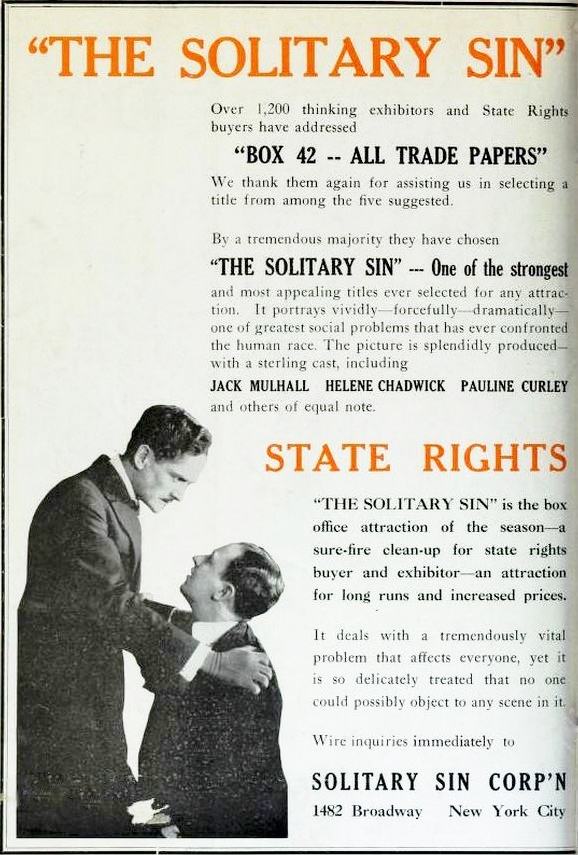
The Uncomfortable Mirrors of Silence
Beneath its moralizing veneer, The Solitary Sin constructs a sociological diorama where whispers become destinies. Director William Parke transforms the familiar coming-of-age framework into a laboratory of cause and effect, exposing how information vacuums breed catastrophe. The film’s opening tableau—children playing stickball on cobblestone streets—belies the fissures beneath their shared geography. Bob’s father (Leo Pierson, radiating stoic concern) initiates clinical instruction at the dining table, his measured gestures contrasting sharply with the hospital sequence where veined eyeballs and necrotic limbs serve as visceral object lessons. These scenes possess an almost newsreel quality, foreshadowing the documentary realism later seen in Johnny Get Your Gun.
Anatomy of Degeneration
Gordon Griffith’s performance as Edward delivers the film’s most unsettling arc. His descent isn’t signaled by melodramatic outbursts but through minute physical deteriorations—trembling hands during card games, sweat-sheened temples in church pews. Cinematographer Fred LeRoy Granville employs claustrophobic close-ups during Edward’s solitary scenes, his widening irises reflecting gaslight flames as if witnessing damnation itself. The asylum sequence anticipates expressionist techniques seen in A bánat asszonya, with distorted angles framing barred windows. Edward’s final appearance—blanketed in a straitjacket—evokes not pity but profound discomfort about society’s failure to address psychological turmoil.
"What germinates in silence ripens in ruin—this is the film's merciless horticulture."
The Performance Paradox
Irene Davis as John’s abandoned fiancée crafts devastating emotional shorthand. Her realization of his infection unfolds through props: a crumpled diagnosis letter, a withdrawn engagement ring, the deliberate folding of a lace handkerchief. This tactile storytelling echoes the economic precision of The Waifs. Jack Mulhall’s John exudes rakish charm early on—twirling walking canes, winking at shopgirls—making his third-act disintegration horrifyingly plausible. The syphilis reveal employs clever visual metaphor: a shattered perfume bottle staining hotel carpet, its viscous spread mirroring disease progression.
Moral Architecture
The film’s moral absolutism reveals fascinating tensions. Bob’s idyllic marriage (scored with excessive floral arrangements and simpering glances) borders on propaganda, yet Arthur Redden’s performance injects ambiguity—his eyes occasionally flicker with something resembling suppressed curiosity. Production designer William Cameron Menzies codes environments symbolically: Edward’s bedroom features barred headboards and locked drawers, while John’s apartment drips with velvet decadence. These spaces become psychological extensions, reminiscent of the class commentary in Egyenlőség.
Taboo as Cinematic Language
George D. Watters’ script navigates censorship minefields through ingenious implication. Edward’s "solitary sin" is never named but conjured through recurring motifs: sticky candlesticks, frayed doorknobs, and a startling shot of steam hissing from a tea kettle. John’s exploits materialize via montage—lipstick stains on collar points, a parade of discarded hairpins, shadowed figures behind pebbled glass. This visual lexicon creates what critic Miriam Hansen termed "voluptuous abstraction," allowing audiences to project their own understanding onto suggestive imagery. The technique predates more sophisticated implication in Kak oni lgut.
Contrapuntal Editing as Judgment
Editor Doane Harrison crafts transcendent parallels through cross-cutting. A scene of Bob lecturing his own son intercuts with John’s agonized grip on hospital bedsheets. Most audacious is the wedding night sequence: Bob’s tender kiss dissolves to Edward’s convulsing fingers against asylum walls. These juxtapositions transform narrative into argument, echoing the ideological editing of The Aryan. The film’s rhythm accelerates as consequences mount—dizzying Dutch angles accompany Edward’s breakdown, while John’s final walk employs funereal slow-motion.
Pathology as Spectacle
The hospital sequence remains historically significant for its unflinching depictions. Makeup artist George Bau’s syphilitic sores—glistening lesions constructed from beeswax and glycerin—elicited walkouts during premieres. Yet these grotesqueries serve narrative purpose: they transform abstract morality into visceral warning. The clinical detachment of Bob’s father (“Note the ulcerative patterns”) clashes with the audience’s horror, creating cognitive dissonance later explored in medical procedurals like Law of the Land.
The Legacy of Didactic Fear
Modern viewers must wrestle with the film’s reductive sexuality. Edward’s masturbatory madness aligns with 19th-century medical quackery (see Tissot’s Onania), while John’s syphilis narrative perpetuates stigmatization. Yet within its historical context, the film constitutes radical intervention. By visualizing consequences mainstream cinema avoided, it ignited public discourse—church groups screened it alongside Honor's Altar as cautionary double features. The very existence of Edward’s storyline challenged Production Code taboos years before enforcement.
Subtextual Landmines
Beneath the surface, intriguing contradictions emerge. Bob’s "healthy" marriage lacks visible passion—his wife exists as nurturing archetype, not flesh-and-blood woman. Meanwhile, John’s pre-diagnosis scenes vibrate with sensual joy; his dancehall partners exhibit more authentic chemistry than the marital ideal. The film unintentionally argues that sexual knowledge sterilizes pleasure, a tension later examined in The Goat. Even the title proves ironic—Edward’s "solitary" sin impacts family honor, employment prospects, and community standing.
Restoration Revelations
The 2020 Library of Congress restoration uncovered fascinating details: subtle hand-tinting in brothel scenes (amber gaslights, crimson lips), and alternate takes where Edward’s mother (Kate Lester) weeps over medical bills. Most revealing is an excised subplot involving Bob’s momentary doubt—discovered in a Czech archive print, it shows him lingering outside a burlesque theater. This complexity, censored for moral clarity, suggests deeper artistic ambitions than the release version implies. Such discoveries invite re-evaluation alongside reconstructed silents like Telephones and Troubles.
Through the Prism of Time
Ninety years later, The Solitary Sin functions best as cultural archeology. Its terror tactics—medical gore, Gothic asylum tropes—now seem antiquated, yet its core provocation endures: what happens when society outsources sexual education to alleyways and fear? The film’s power lies not in solutions but in its anxious questions. Like Bound and Gagged, it demonstrates how silent cinema weaponized visual language to confront unspeakable subjects. Those flickering frames preserve an eternal truth: ignorance breeds not innocence, but collateral damage.
In the chiaroscuro of its morality, we glimpse cinema's embryonic power to disturb, warn, and ultimately humanize the forbidden. The boys on that sun-dappled street remain frozen in amber—one destined for light, others for darkness—their diverging paths a celluloid ghost haunting our ongoing conversation about desire and consequence.