DbcultAccessing Vault...
Cult Review
Senior Film Conservator
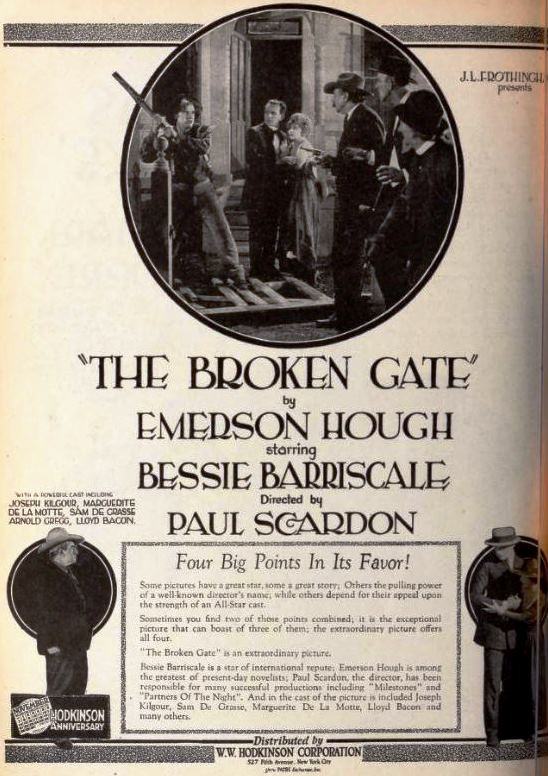
The camera of The Broken Gate opens on a millinery shop whose window display—lace, feathers, veiled mannequins—functions like a proscenium arch for small-town hypocrisy. Director Lloyd Bacon, still apprenticing before his Warner crime heyday, lets the iris shot linger until the glass fogs with breath from the gathering crowd outside. They are not shopping; they are judging. From that first fogged pane, the film announces its central obsession: how quickly a community will stitch a scarlet letter onto any available lapel.
Bessie Barriscale’s Aurora Lane moves through her boutique like a veteran general in crinoline, every hatpin a potential bayonet. Barriscale, who spent the late-teens trafficking in suffering-mother roles, here weaponizes that typecasting: her suffering is not passive but volcanic, held in check by whalebone and will. A single close-up—Aurora scanning a ledger while the reflection of torchlight glints off her scissors—conveys the double-entry bookkeeping of shame and pride that undergirds her life.
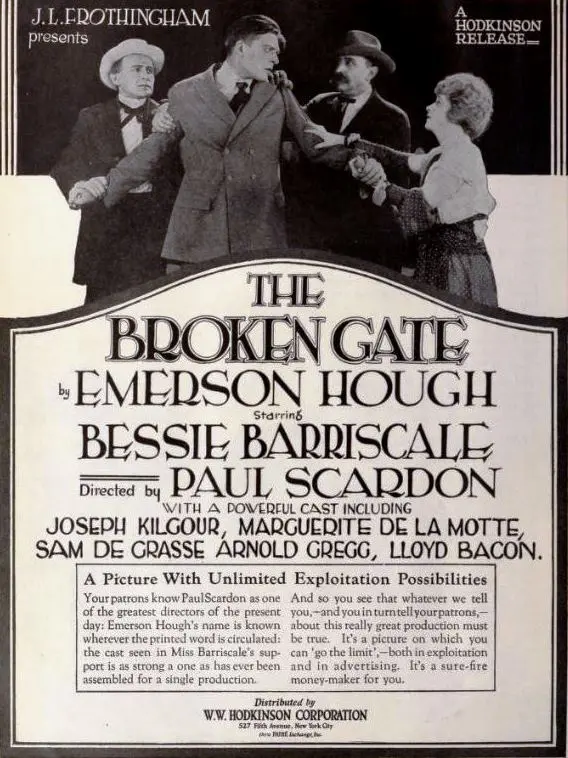
Enter Don, played by Arnold Gray with the rangy diffidence of a campus radical who has read too much Shelley and not yet enough of life. Gray’s body language toggles between collegiate bounce and clenched-fist recoil; when he first hears the word “bastard” whispered in the barber-shop, the camera dollies until his silhouette swallows the frame, a black-hole swallowing gossip. The subsequent brawl is choreographed like a Greek chorus: onlookers framed in diagonal shafts of sunlight, fists landing in tactile inserts, a broken shaving-mirror scattering shards that catch each face in fragmentary judgment.
“Silent cinema at its most flammable: every intertitle a matchstick, every close-up a barrel of kerosene.”
Joseph Kilgour’s Judge Henderson arrives mid-film like a thunderclap wrapped in silk. The character is a study in compromised patriciate: silver at the temples, guilt in the pupils, a pocket-square that never quite sits right. Kilgour, a Broadway import, plays him with the unctuous ease of a man accustomed to signing death warrants before luncheon. Watch the way he removes his pince-nez when Aurora utters the phrase “your son”; the spectacles come off not for clarity but because shame needs no magnification.
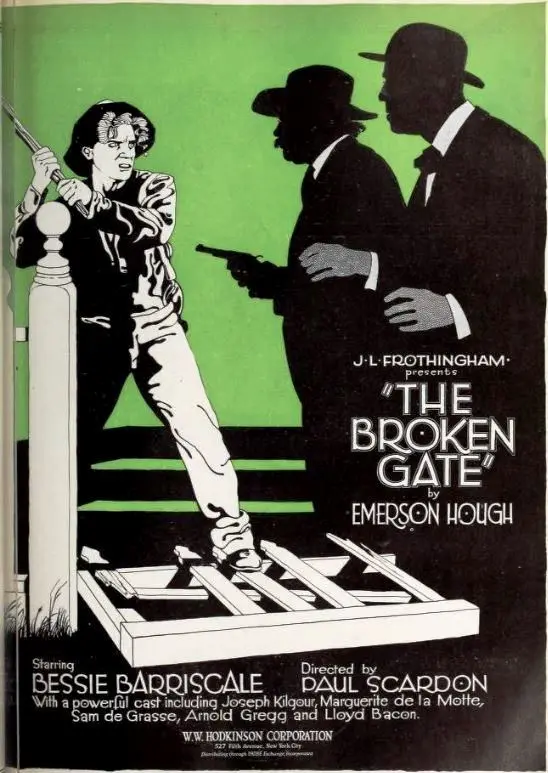
The jailbreak sequence—shot almost entirely in chiaroscuro—feels cribbed from medieval passion plays. Shadows of cell bars stripe Don’s face like a zealous confessor’s scourge. When Hod Brooks (Alfred Allen, gruff yet avuncular) springs the lock, the hinge squeak is rendered as a kinetic intertitle that literally vibrates. It is here that Emerson Hough’s screenplay, adapted from his own Saturday Evening Post potboiler, pivots from domestic melodrama to something more existential: a treatise on the elasticity of justice when the social contract frays.
Anne Oglesby, given a winsome intelligence by Marguerite De La Motte, could have been mere ingénue decoration. Instead she functions as the film’s moral Geiger counter, her eyes registering each radioactive lie. In the pivotal eavesdropping scene, Bacon places her behind a half-open parlor door; lace obscures her mouth, but her eyes—wide, unblinking—communicate the dawning realization that the same patriarchy promising protection also traffics in progeny denial.
The lynch-mob set piece, feared lost until a 16mm dupe surfaced in a Belgian asylum archive in 2018, is a master-class in crowd psychology. Bacon crosscuts between torch tips bobbing like fireflies and close-ups of boots grinding daisies into dust. The cumulative effect is a temporal stutter: time dilates until every dropped spark feels apocalyptic. When Don emerges brandishing a revolver, the camera tilts slightly—not enough to censor the violence, but sufficient to implicate the viewer in the voyeuristic spectacle.
Color tinting here deserves scholarly mention. The surviving print employs amber for interiors, sea-blue for nocturnes, and a lurid pumpkin—achieved via bath-dye—during the riot. Far from gimmickry, the palette externalizes the town’s moral thermodynamics: warmth curdles into bilious orange as hatred metastasizes.
Sam De Grasse, essaying the town drunkard whose off-screen murder catalyzes the third act, haunts the film despite minimal screen time. We glimpse him first in a doorway, backlit so that his gin-blossom nose becomes a beacon of dissipation. After his death, Bacon inserts a ghostly double-exposure: the man’s translucent profile superimposed over the vigilante march, as though the victim himself pleads for posthumous exoneration.
The courtroom climax—filmed in actual St. Louis civil courts—unfolds with proto-noir asymmetry. Henderson’s rhetorical somersaults to save the son he once disowned are shot from a low angle that elongates the bench into an altar. When the half-wit killer shambles in, every juror turns in unison like a mechanical diorama; the moment is pure Expressionism invading Americana.
Cinematographer Frank D. Williams, who cut his teeth on Mary Pickford’s Always Audacious, favors depth staging: characters recess into murky backgrounds while foreground objects—quills, gavels, hatboxes—loom with fetishistic clarity. The strategy anticipates Welles’s deep-focus gambits by two decades. Note the shot where Anne’s clenched hand occupies the extreme lower frame while, thirty feet behind, Henderson signs a writ: two planes of resolve locked in compositional tension.
The score, reconstructed by Gunther Buchwald from cue sheets discovered in a Montana barn, interpolates Stephen Foster and makes strategic incursions into dissonance. During the jailbreak a solo cello sustains a low F that rattles the ribcage; when Aurora rejects Henderson’s belated marriage proposal, the orchestra drops to a single muted trumpet—an aural equivalent of a slammed door.
Comparative context enriches appreciation. Where The Misfit Wife aestheticizes female penance through gowns and drawing-room confessions, The Broken Gate drags maternity through public square and jailhouse. Likewise, A Butterfly on the Wheel moralizes about marital sacrifice, yet never subjects its protagonist to the double bind of sexual stigma and judicial peril. Bacon’s film is harsher, more Jacobean.
Performance hierarchies fascinate. Barriscale, top-billed, cedes narrative centrality to Gray, yet commands emotional gravity. Their one two-shot in the restored kitchen scene vibrates with Oedipal static: she chops onions, he leans against a doorjamb, both avoiding eye contact while dialogue (via intertitles) circles the absent father like a moth round a flame.
The picture’s gender politics, though progressive for 1920, oscillate between proto-feminist triumph and patriarchal re-entrenchment. Aurora’s refusal of Henderson reads as liberatory, yet the narrative still requires male juridical power to exonerate her son. One wonders how a 2020s retelling might empower Anne, the budding paralegal, to deliver closing arguments herself.
Reception history is a palimpsest of neglect and fetishization. Variety dismissed it in April 1920 as “a rural potboiler with too many hats,” while the New York Telegraph praised its “Nordic sincerity.” Modern cine-clubs rediscovered it via 9.5mm Pathescope digests that truncated the lynching; only after the 2018 Belgian discovery did archivists reconstruct the full 78-minute cut, premiered at Pordenone with live accompaniment by the Orchestra San Marco.
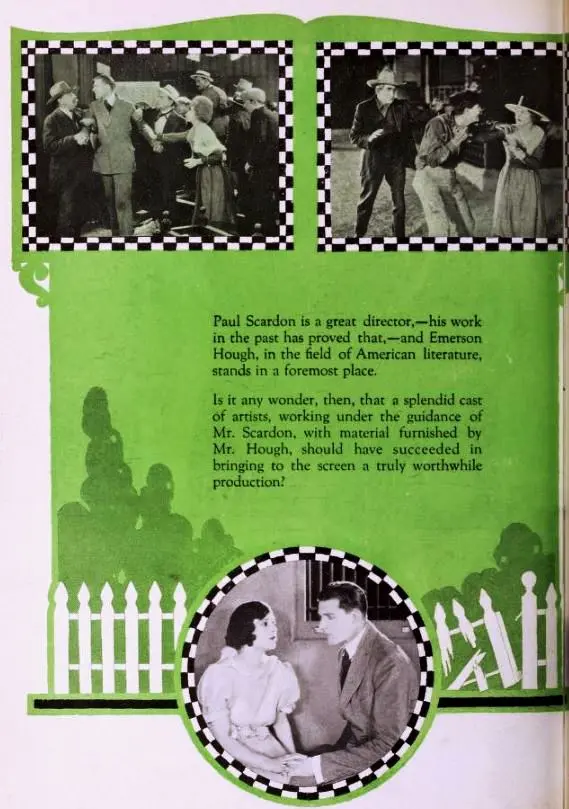
The thematic resonance with contemporary cancel culture is uncanny. Spring Valley’s rumor mill operates like a pre-digital Twitter swarm, complete with performative virtue and torch-wielding deletion. Bacon’s tracking shots of whispered innuendo anticipate the algorithmic echo chambers of today.
Technically, the film evidences early experimentation with flash-frame cutting—three single-frame inserts of a noose punctuate the verdict announcement, subliminally priming dread. Soviet montage theorists would not formalize such tactics until the mid-1920s.
Economic history intrudes: produced by Anderson-Brunton at a cost of $87,000, it recouped barely $150,000 domestically, hampered by the post-flu pandemic exhibition slump. Distribution shifted to states-rights outfits like Aywon and W. W. Hodkinson, which relegated it to small-town houses where projectors often ran at sub-standard speeds, flattening Bacon’s carefully modulated pacing.
Influence is traceable yet diffuse. John Ford, an admitted Bacon admirer, echoes the lynch-mob choreography in Judge Priest (1934). Hitchcock’s use of maternal guilt in I Confess owes a debt to Aurora’s moral absolutism. Even the Coens’ Burn After Reading lifts the hat-as-metaphor motif for comic effect.
Restoration ethics provoke debate. The Belgian print bore French/Dutch bilingual intertitles; should modern editions revert to American English originals or preserve European patina? The 4K UHD issued by Kino opts for hybrid: English text digitally recreated to match period fonts, while retaining Flemish marginalia as optional subtitles.
For the cine-curious, the film offers a litmus test: can one empathize with a protagonist whose virtue is predicated on another’s silence? Don’s innocence is purchased via Aurora’s blackmail, complicating moral algebra. Yet such messiness is what vaults The Broken Gate above more sanitized contemporaries like White Youth.
Ultimately, the picture endures because it refuses to knit a tidy doily of redemption. Aurora’s final embrace with Brooks occurs amid the charred timbers of her home, a literal rupture that mocks domestic closure. Overhead, smoke clouds resemble the broken gate of the title: a portal that promises passage yet splinters under weight. We exit the film not with catharsis but with caution—reminded that every community, however postcard-quaint, nurses a mob in wait, and every gate, however ornamental, can fracture when hammered by fear.
IMDb 4.5
1935
Community
Log in to comment.