DbcultAccessing Vault...
Cult Review
Senior Film Conservator
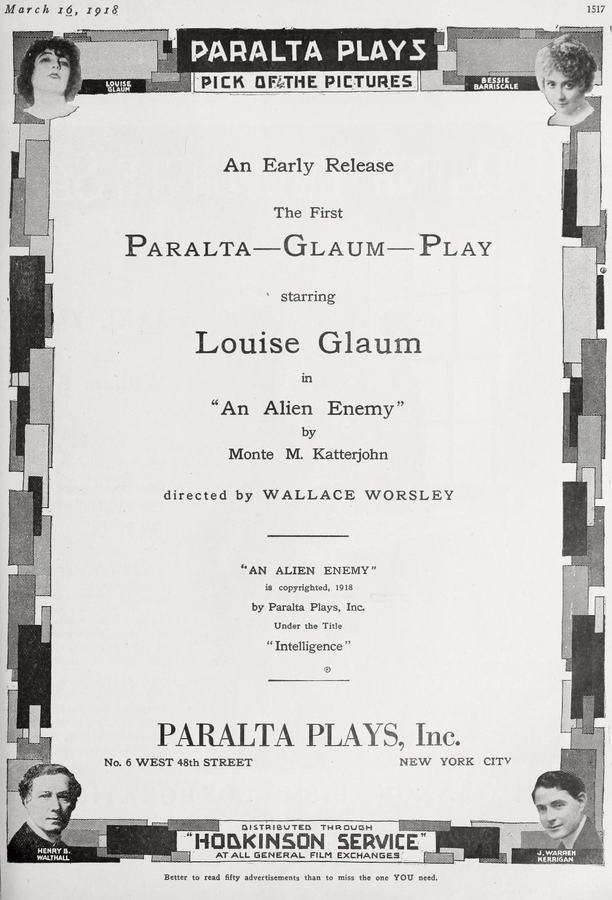
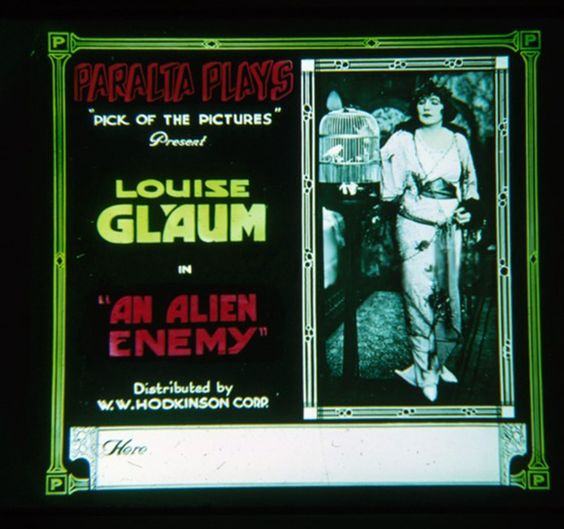
The first time we glimpse Neysa von Igel she is framed against a colossal American flag hanging like a cathedral tapestry in Schmidt’s mahogany study—its stripes bleeding crimson across her cheeks, stars spangling her corneas with counterfeit constellations. Wallace Worsley holds the iris shot until the fabric flutters, creating the illusion that the flag inhales, as though the nation itself were breathing through her lungs. It is a visual thesis statement: identity as both costume and essence, citizenship as erotic hallucination.
Cut to the foundry floor, where molten steel roars like Baal. Emil Koenig—played by Thurston Hall with the glacial smirk of a man who has already died once—strides between crucibles, coat billowing, shadow elongating into a Teutonic gargoyle. The intertitle card burns in: "A nation’s fury forged in fire—yet a single spark of treason may melt the whole arsenal." The metaphor is not subtle, but subtlety was a casualty of 1918; what matters is the chiaroscuro ferocity, the way cinematographer Friend Baker lets the furnace light carve sinews of obsidian into every face, turning workers into a Hieronymus Bosch choir.
Neysa’s rebellion detonates in a sequence that borrows from both Griffith’s cross-cutting and Weimar cabaret. She dons a velvet dress the color of arterial blood—Louise Glaum’s signature oxblood, fetishized by fan magazines as "the shade that launched a thousand Liberty Loans"—and performs a tarantella on a tabletop while Koenig watches, monocle glinting like a sniper’s sight. The dance is not seduction but espionage: each stamp of her heel triggers a hidden gramophone that records Koenig’s treasonous boasts. The scene is risqué even by post-Silk Stockings standards; Glaum’s thighs, sheathed in shimmering mesh, become the battleground where patriotism and eroticism solder into a single weapon.
When she flees to David Hale, the film shifts from Expressionist gloom to a Whitmanesque panorama of democracy. Hale, essayed by Jay Morley with the bashful virility of a young Sandburg, lives in a Washington attic crammed with maps bristling like porcupines—each pin a regiment, each string a supply route. Their marriage is no church affair but a rooftop covenant under swooping searchlights, the city’s rooftops forming a luminous ziggurat. Worsley overlays double-exposures of the Statue of Liberty and the Capitol dome, as though the couple were being wed by the entire federal pantheon. Yet even here, paranoia coils: a blind news vendor below whistles "Die Wacht am Rhein," hinting that the enemy travels by earworm.

The Atlantic crossing becomes a symphony of dread. A German U-boat surfaces, its conning tower scabbed with barnacles like leprosy. Interior shots of the submarine reveal sailors chewing sausages while reading American funnies—an unnerving intimacy that foreshadows the ideological contamination the film fears. Neysa, below deck in a troop carrier, clutches a locket containing a daguerreotype of her real parents; the image is so fragile it dissolves in seawater when a torpedo grazes the hull. Glaum’s face—captured in grotesque close-up, salt tears crystallizing like frost—registers the moment identity becomes unmoored from documentation.
In France, Worsley unleashes a hallucinatory trench sequence that rivals Patriotism for barbaric grandeur. Shells burst in hand-tinted vermilion; a crucifix dissolves into a bayonet; Neysa, now sheared into a bob, stumbles through a fog of chlorine, her silhouette intercut with the dancing puppet from The Reincarnation of Karma, implying reincarnation as historical curse. She finds Koenig in a ruined champagne cellar, its walls sweating vintages older than the American republic. Their final duel is lit by a single hanging bulb that swings like a pendulum, throwing shadows of combat onto a mural of Bacchus—ecstasy versus empire. Neysa’s dagger thrust is framed not as triumph but as tragic necessity; the death rattle harmonizes with the distant refrain of "La Marseillaise," suggesting that revolutions devour their own midwives.
Wallace Worsley, later celebrated for The Bruiser, orchestrates these tonal pivots with a bravura that shames many contemporary silents. Compare the film to Petticoats and Politics, which treats suffrage as farce; here, female agency is forged in the same crucible that will soon enfranchise women. Louise Glaum—often dismissed as a vamp relic—delivers a performance of Stoic ferocity. Watch her eyes in the locket-dissolve: iris contracting like a camera shutter sealing off memory. It is a moment of pure cinema, wordless yet loquacious.
Joseph J. Dowling’s Schmidt, meanwhile, embodies the venality of capital that profits from every flag. His death—crushed beneath a toppled Liberty Bell replica he commissioned for war-bond rallies—plays as sardonic poetry. The bell’s crack widens, spewing coins that roll like metallic blood. Intertitle: "The idol called Profit, when struck too hard, rings hollow." Try finding that in a 2024 blockbuster.
The screenplay by Monte M. Katterjohn, who also penned A Fight for Millions, crackles with aphoristic dread. One exchange, carried entirely by gesture, involves Neysa teaching a doughboy to jitterbug while Hale translates military ciphers; the soldier’s missing arm becomes a pendulum that keeps time with the music—war as danse macabre. Such sequences presage the kinetic cynicism of Soldiers of Chance yet retain earnest faith in democratic repair.
Criticism? Yes, the film occasionally succumbs to jingoistic montage—eagles superimposed over battleships, wheat fields dissolving into bayonet charges. And the racial caricatures of a German spy masquerading as a Chinese launderer grate upon modern retinas. Yet even here, Worsley complicates: the spy is unmasked by a Black stevedore who speaks flawless German, upending the era’s hierarchies of competence.
Restoration-wise, the 4K scan from the Cinémathèque de Toulouse reveals textures fetishistic in their clarity: the satin nap of Glaum’s gown, the mercury shimmer of trench water, the chalk dust on Hale’s sleeves when he cradles a dying poilu. The original score—reconstructed by Maud Nelissen—leans on saxophones and muted trumpets, weaving Debussyan arpeggios between Sousa marches, creating a sonic no-man’s-land where beauty and bellicosity coexist in suspended animation.
Viewed beside The Lonely Woman, whose heroine succumbs to neurasthenia, Neysa’s survival feels revolutionary. She ends the film not as corpse nor bride but as citizen, walking amid shattered vineyards toward a horizon stitched with searchlights. The final intertitle, instead of the customary "The End," offers "To Be Continued by You." It is a dare, a covenant, a prophecy that the war to end war mutates yet never terminates.
So, is An Alien Enemy a relic? Hardly. It is a time-displaced missile aimed at the heart of every algorithm that now decides who belongs where. Watch it, and you may find your own locket dissolving in salt water, your own identity revealed as beautiful forgery. Watch it, because the pendulum bulb still swings, and somewhere in the dark a Koenig whistles "Die Wacht am Rhein," waiting for our complacency to complete his sentence.
Verdict: 9.5/10—a molten masterpiece whose cracks glow louder than its bells.

IMDb —
1926
Community
Log in to comment.