DbcultAccessing Vault...
Cult Review
Senior Film Conservator
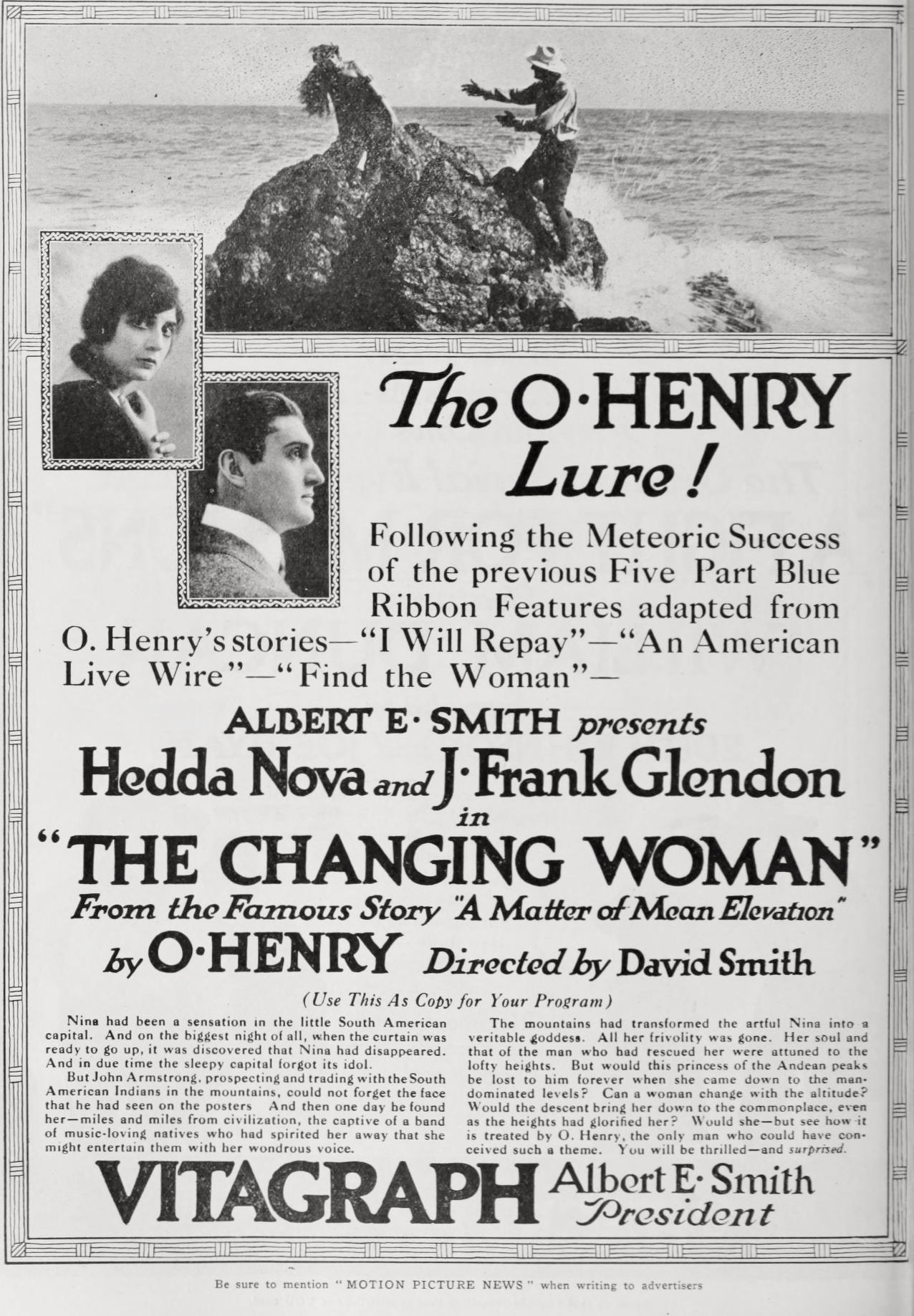
Step into the flickering shadows of the silent era, and you’ll often find narratives that, despite their age, resonate with an almost unsettling prescience. Such is the case with The Changing Woman, a film from 1922 that, even a century later, still probes the fragile interplay between identity, environment, and the relentless pull of societal expectations. Penned by the formidable duo of Robert A. Sanborn and the legendary O. Henry, this cinematic endeavor transcends mere melodrama, offering a profound commentary on authenticity and the masks we don, both willingly and unwillingly.
At its core, The Changing Woman introduces us to Hedda Nova, portrayed with an exquisite blend of theatricality and nascent vulnerability by Hedda Nova herself (a fascinating meta-casting choice that adds another layer to the film's exploration of performance). She is an opera diva, a creature of the stage and its attendant adulation, touring the vibrant, yet often untamed, landscapes of South America. Her world is one of thunderous applause, opulent costumes, and the constant, intoxicating hum of admiration. Every encounter is a stage, every interaction a performance, designed to elicit the desired response from her audience, whether it be a sold-out opera house or a casual admirer. She is, in essence, a persona perfected, a living embodiment of the 'diva' archetype, charming all who cross her path with a practiced grace that belies deeper introspection.
Yet, amidst this chorus of praise, there exists a discordant note: Johnny Armstrong, played by J. Frank Glendon. Armstrong is a man cut from a different cloth, seemingly immune to Nova's carefully constructed allure. His cynicism is a palpable force, a shield against the manufactured sentiments he perceives in Nova and, perhaps, in women generally. He represents the stark realism that contrasts sharply with Nova's flamboyant artistry. Their initial interactions are a fascinating dance of defiance and disinterest, a prelude to the seismic shifts that will soon upend both their worlds. This dynamic, a clash of performative charm against jaded pragmatism, sets the stage for a narrative that delves far beyond simple romantic entanglement.
The narrative takes a dramatic turn when Nova is thrust into a situation utterly antithetical to her carefully curated existence: capture by an Indigenous tribe. This is not merely a plot device; it is a profound symbolic act. Stripped of her finery, her audience, and her accustomed comforts, Nova is forced to confront herself in a raw, unvarnished state. The wilderness becomes a crucible, burning away the artifice, leaving only the essential human beneath. This experience, though harrowing, is ultimately transformative. It’s a powerful echo of narratives found in other films where characters are forced to confront their true selves away from societal pressures, perhaps even more starkly than in something like The More Excellent Way, which explores personal sacrifice within a societal framework, or the emotional intensity of Anny - en gatepiges roman, where a protagonist faces the harsh realities of life on the streets. Here, the challenge is existential.
It is in this desperate state that Johnny Armstrong re-enters her life, not as a cynical observer, but as a rescuer. His act is not born of a previously expressed affection, but perhaps a deeper, unspoken sense of duty or even an unconscious recognition of her underlying humanity. The journey back to 'civilization' becomes the heart of the film's exploration of change. Away from the scrutinizing gaze of society, away from the expectations of her profession, Nova sheds her diva persona like a snakeskin. Her arrogance dissolves, replaced by a quiet resilience, a newfound humility born of survival. Armstrong, witnessing this profound metamorphosis, begins to see beyond the performer to the woman, and finds himself unexpectedly captivated. This is where the film truly begins to sing, exploring the idea that genuine connection often blossoms in the most unexpected and challenging circumstances. Otto Lederer and George Kunkel, though in supporting roles, contribute to the atmosphere of both the threatening wilderness and the eventual return to 'order', grounding the narrative in a tangible reality.
The brilliance, and indeed the tragedy, of The Changing Woman lies in its unflinching portrayal of the human tendency to revert to comfortable, if inauthentic, patterns. As Nova and Armstrong draw closer to the fringes of their former lives, the insidious pull of her old self begins to reassert itself. The wilderness had stripped her bare, but civilization, with its clamor for attention and its predefined roles, starts to re-clothe her in the very garments of arrogance and attention-seeking that Armstrong had once disdained. The woman he fell in love with, the resilient, unadorned spirit forged in adversity, begins to recede, replaced by the glittering, demanding diva. This regression is heart-wrenching, a testament to the powerful, almost gravitational force of social conditioning and personal history.
This phenomenon is not unique to Nova; it reflects a broader human struggle. How many of us, after a transformative experience or a period of introspection, find ourselves subtly, almost imperceptibly, slipping back into old habits and personas once we return to our familiar environments? The film brilliantly captures this internal conflict, making Nova's struggle deeply relatable. It's a nuanced take on identity, far more complex than simple good-versus-evil narratives often found in films of the era. One might consider the internal battles fought in The Power of Decision, where characters grapple with choices that define their future, but here, the battle is against a past identity that threatens to consume a newfound self.
Faced with the agonizing prospect of losing the woman he has come to cherish, Armstrong devises a plan. The plot description tantalizingly leaves the specifics of this plan shrouded in mystery, which only enhances the film's appeal. It’s a testament to the writers, Sanborn and O. Henry, that they craft a climax that promises both dramatic tension and psychological depth. Armstrong's goal is not to force Nova back into a mold, but to 'bring back' the woman he has grown to love—the authentic self that emerged from the crucible of captivity. This suggests a profound understanding of love, one that seeks to nurture genuine character rather than simply admire a superficial facade. It's a stark contrast to the transactional relationships sometimes depicted in other silent films, such as Sold at Auction, where external circumstances dictate emotional outcomes. Here, Armstrong fights for an internal state.
The film’s resolution, or the anticipation of it, poses a fascinating question: can one truly 'bring back' a lost self, or can one only create a new path forward? Is identity fluid, or does it have a core that merely gets obscured? This exploration of identity's malleability and resilience is remarkably sophisticated for its time. The audience is left to ponder whether Armstrong's scheme will succeed, and more importantly, what true success would even look like. Would it be Nova permanently shedding her diva persona, or finding a way to integrate her artistic self with her authentic core? This open-endedness, or at least the dramatic tension leading up to it, is a hallmark of compelling storytelling, inviting viewers to engage with the characters' journeys on a deeper level.
In the silent era, acting was a language of gesture, expression, and physicality. Hedda Nova, in her dual role as both character and namesake, delivers a performance that is both grand and subtly nuanced. Her initial portrayal of the imperious diva is captivating, a masterclass in theatricality. But it is her transformation during captivity, conveyed through subtle shifts in posture, expression, and eye contact, that truly shines. She manages to convey profound internal change without a single spoken word, a testament to her skill and the director's guidance. J. Frank Glendon's Armstrong provides the perfect foil, his initial stoicism slowly melting into a tender vulnerability. The chemistry between the two leads, though unspoken, is palpable, a silent dialogue of evolving emotions.
The direction, while not explicitly attributed in the provided details, must be commended for its ability to navigate the vast emotional landscape of the story. The contrast between the opulent settings of Nova's opera world and the stark realism of the wilderness captivity is visually striking. The pacing allows for the gradual unfolding of Nova's transformation, never rushing the emotional beats, which is crucial for the audience to fully invest in her journey. The use of close-ups, a developing technique in silent cinema, would have been instrumental in conveying the subtle shifts in character that define this film. Comparing it to the stark realism of a film like Nabat, which uses minimal dialogue to convey profound themes, one can appreciate how silent films often relied on visual storytelling to communicate complex human experiences.
The enduring power of The Changing Woman lies in its exploration of themes that remain profoundly relevant today. The film asks fundamental questions about identity: Are we defined by our professions, our public image, or something deeper? Can true love exist only when all masks are removed? The tension between the authentic self and the performative self is a universal struggle, perhaps even more so in our modern, image-obsessed world. Nova's journey from diva to survivor and back again is a powerful allegory for anyone who has felt the pressure to conform, to play a role, or to sacrifice their true self for external validation.
Moreover, the film touches upon the transformative power of extreme experiences. Just as a journey into the unknown can redefine a character, as seen in the documentary The Capture of a Sea Elephant and Hunting Wild Game in the South Pacific Islands, which captures raw human interaction with nature, Nova's captivity forces a radical shift in perspective. Her experience in the wilderness is not just a plot point; it's a catalyst for profound personal growth, even if that growth is later challenged by the siren song of her past. This narrative arc, where a character undergoes a significant internal shift, is a cornerstone of compelling drama, seen across eras and genres, from the psychological depths of Gelöste Ketten to the dramatic choices in Vengeance Is Mine.
The writers, Robert A. Sanborn and O. Henry, weave a tale that is both romantic and deeply psychological. O. Henry's influence, known for his surprise endings and keen observations of human nature, can be felt in the subtle ironies and the nuanced character development. The film avoids simplistic answers, instead inviting the audience to ponder the complexities of human motivation and the often-conflicting desires for acceptance and authenticity. This intellectual engagement elevates The Changing Woman beyond a mere period piece, cementing its place as a significant work that speaks to the timeless human condition. It’s a reminder that even in an era without spoken dialogue, cinema possessed an incredible capacity to explore the most intricate facets of the human spirit.
In a world that constantly encourages us to present curated versions of ourselves, The Changing Woman serves as a poignant reminder of the value of authenticity. It’s a film that, through the trials of its protagonist, challenges us to look beyond the surface, to question the roles we play, and to cherish the genuine connections that emerge when we dare to be truly ourselves. Hedda Nova's journey is a microcosm of a larger human struggle—the desire to be loved for who we are, not for who we pretend to be. Armstrong’s desperate plan, whatever its specifics, is a beautiful act of love, an attempt to preserve the authentic spark he discovered. This film is not just a historical artifact; it is a resonant piece of art that continues to provoke thought and stir the heart, proving that the most profound stories often need no words at all. It stands as a testament to the power of silent cinema to explore deep psychological terrain, making it a must-see for enthusiasts of early film and anyone interested in the enduring quest for true selfhood. Its themes echo the internal struggles found in films like Pierrot or Vdova, where characters confront their inner demons and external pressures in their pursuit of meaning and identity.
IMDb —
1911
Community
Log in to comment.