DbcultAccessing Vault...
Cult Review
Senior Film Conservator
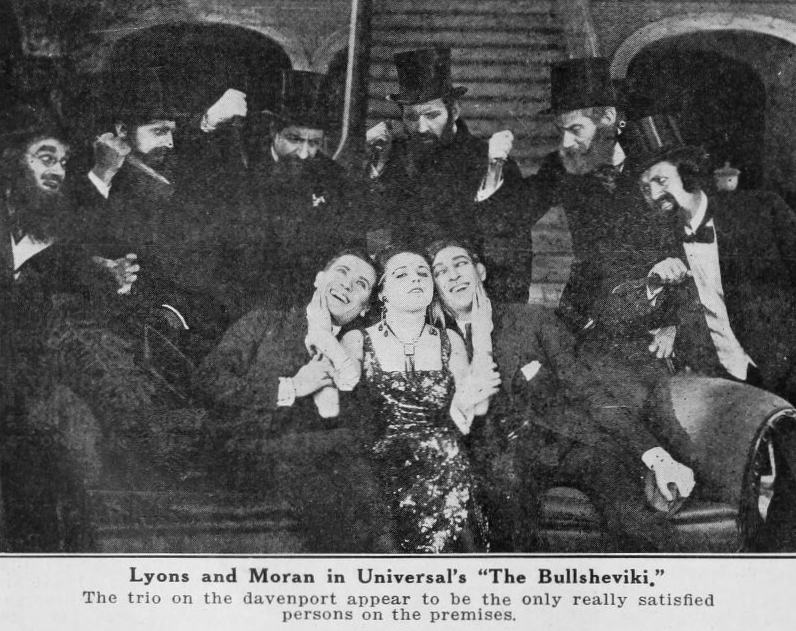
In the annals of early cinema, where experimentation often collided with nascent narrative forms, a peculiar gem known as 'The Bullshevicks' emerges, less a polished artifact and more a vibrant, chaotic burst of comedic energy. This 1917 offering, penned and performed by the prolific duo Eddie Lyons and Lee Moran, is a testament to the era's fascination with the absurd, the politically charged, and the convenient narrative escape hatch of the dream sequence. It's a film that, despite its seemingly straightforward premise—two reporters caught in a burlesque of crime—unfurls a surprisingly intricate, if ultimately ephemeral, tapestry of slapstick, satire, and social commentary. To dismiss it as merely a 'B-picture' without dissecting its unique charm would be to overlook a crucial piece of silent film's evolving comedic landscape.
Eddie Lyons and Lee Moran, the creative and performing forces behind 'The Bullshevicks,' were a formidable comedic pair in their time. Their chemistry, honed over numerous collaborations, is the undeniable engine driving this film's frantic pace. As newspaper reporters Eddie and Lee, they embody a kind of everyman innocence thrust into extraordinary circumstances. Lyons, often the more physically expressive, brings a wide-eyed bewilderment to the proceedings, his reactions frequently amplifying the absurdity of their plight. Moran, conversely, tends to project a slightly more grounded, albeit equally flustered, persona, often serving as the slightly more rational (or at least less overtly frantic) half of the duo, though rationality quickly dissipates under the weight of the escalating 'Bolsheviki' charade. Their comedic interplay relies heavily on exaggerated gestures, frantic chases, and the classic 'straight man' and 'fall guy' dynamic, yet it's infused with a genuine sense of camaraderie that makes their predicament, however outlandish, oddly relatable. This partnership echoes the great comedic duos that would follow, laying some groundwork for the physical comedy traditions that define the silent era. One might draw a parallel to the escalating predicaments faced by the iconic duo in Liberty, where a simple misunderstanding balloons into a gargantuan struggle against circumstance, though Lyons and Moran infuse their struggles with a distinctly political, if burlesque, flavor.
Central to the film's chaotic narrative is Mildred Moore's portrayal of the 'vamping Russian countess.' This character is less a nuanced individual and more a theatrical construct, a living embodiment of early 20th-century anxieties and stereotypes surrounding foreign intrigue and radical politics. Moore embraces the 'vamp' archetype with gusto, her performance likely a delightful exaggeration of the femme fatale popularized in the era. Her 'Bolsheviki burlesque' isn't meant to be a serious political statement, but rather a playful, almost mocking, appropriation of contemporary fears. The term 'Bolsheviki' itself, at this point in history, was laden with connotations of anarchism, revolution, and shadowy foreign plots, particularly in the wake of the Russian Revolution's early stages. The film leverages this public perception, transforming it into a stage for comedic mayhem. The countess, with her presumed exoticism and manipulative charm, becomes the catalyst for Eddie and Lee's unwilling descent into criminality. Her role is to be the glamorous, dangerous, and utterly captivating puppet master, her allure making the reporters' coerced actions seem almost understandable within the dream logic of the film. It's a performance that, while rooted in caricature, effectively serves the film's farcical intentions, providing a compelling, if superficial, antagonist.
The core of 'The Bullshevicks' plot revolves around the reporters' forced immersion into a life of crime. This isn't a gradual erosion of morality but an immediate, almost inexplicable, obligation to commit acts ranging from petty larceny to potentially more serious offenses. The brilliance of this setup lies in its complete disregard for conventional logic, leaning instead on the inherent absurdity of the situation. Eddie and Lee, innocent bystanders caught in a theatrical whirlwind, become unwitting participants in a grand spectacle of lawlessness. The film likely revels in the comedic potential of these forced transgressions, showing the duo's awkward attempts at villainy, their wide-eyed panic, and their desperate, often futile, efforts to escape the clutches of the 'Bolsheviki' plot. Each crime committed, each misstep taken, serves to heighten the tension and amplify the comedic effect, creating a snowballing series of unfortunate events. This escalating chaos mirrors the thematic progression found in films like A Wild Goose Chase, where characters find themselves increasingly entangled in a web of their own making or, in this case, a web spun by external, dream-like forces. The forced criminality also allows for a satirical jab at sensationalist journalism, as the very reporters who document crime are now forced to enact it, blurring the lines between observer and participant in a delightfully subversive manner.
The ultimate revelation—that the entire elaborate 'Bolsheviki' burlesque was merely a dream—is perhaps the most defining characteristic of 'The Bullshevicks.' The 'it was all a dream' trope, a narrative device both beloved and reviled, serves a particular purpose in early cinema. It allows filmmakers to explore fantastical, dangerous, or morally ambiguous scenarios without having to deal with the real-world consequences within the film's established reality. For Eddie and Lee, this means they can commit all sorts of 'crimes' and engage in frantic chases, only to wake up safe and sound, their reputations intact. This device functions as a comedic pressure release valve, permitting the film to push the boundaries of credulity and introduce elements of pure fantasy without breaking the audience's suspension of disbelief for too long. It also subtly comments on the anxieties of the time, allowing a safe space to play with fears of political upheaval and social chaos, ultimately reassuring the audience that such nightmares are just that—nightmares. While some might criticize this trope as a narrative cop-out, in 'The Bullshevicks,' it feels less like a weakness and more like an intentional embrace of the surreal. It underscores the film's burlesque nature, framing the entire criminal escapade as a grand, theatrical performance within the confines of a subconscious mind. The abrupt return to reality serves to highlight the sheer absurdity of what transpired, leaving the audience with a chuckle rather than lingering questions of plot holes. This approach is reminiscent of the escapist fantasies often found in the more lighthearted fare of the era, where complex problems are conveniently resolved, albeit with less psychological depth than, say, a film like The Lonely Woman, which might delve into more profound inner turmoil.
Beyond the slapstick and the dream conceit, 'The Bullshevicks' offers a fascinating, albeit lighthearted, glimpse into the socio-political climate of its production era. The 'Bolsheviki' theme, as mentioned, was ripe for both serious concern and satirical lampooning. In 1917, the world was gripped by the Great War, and the Russian Revolution was unfolding, sending ripples of fear and fascination across the globe. The film, through its comedic lens, taps into this nascent paranoia surrounding radical ideologies and foreign threats. It transforms abstract political anxieties into tangible, if ludicrous, comedic fodder. The 'burlesque' aspect is key here; it's not a genuine attempt at political commentary but a playful exaggeration, a way of defanging the terrifying unknown by making it ridiculous. The film, therefore, acts as a sort of cultural safety valve, allowing audiences to laugh at their fears rather than succumbing to them. This kind of social commentary, however veiled by humor, was not uncommon. Many films of the period, from the more dramatic to the overtly comedic, found ways to reflect societal concerns. While not as overtly dramatic as Where Are My Children? in its social critique, 'The Bullshevicks' still manages to capture a fragment of its era's zeitgeist, albeit through a funhouse mirror. The choice to make the protagonists newspaper reporters also adds a layer of meta-commentary, as reporters were the primary conduits of information and, often, sensationalism, regarding these very political events.
The fact that Eddie Lyons and Lee Moran also penned the screenplay for 'The Bullshevicks' speaks volumes about their understanding of their own comedic strengths and the demands of silent film storytelling. Their writing style, judging by the plot, prioritizes kinetic energy and visual gags over intricate dialogue or deep character development. They understood how to construct scenarios that would maximize physical comedy and rapid-fire action, essential for engaging an audience without spoken words. The structure of the film—a frantic build-up of absurd events culminating in a dream revelation—is a clever way to maintain momentum while providing a clean, satisfying (if simplistic) resolution. This self-awareness, where the performers are also the architects of their own comedic vehicle, often leads to a more cohesive and impactful execution. They knew precisely how to play to their strengths, crafting situations tailor-made for their established personas and comedic timing. This symbiotic relationship between writer and performer is often a hallmark of successful comedic duos, allowing for a seamless integration of concept and execution. The narrative, while simple, is effective in its construction of escalating stakes, even if those stakes are ultimately illusory. One can almost see the influence of early Vaudeville sketches in their rapid pacing and distinct characterizations, a common thread in many silent comedies, including those with slightly more dramatic undertones like The Midnight Man, which also relies on intricate plotting and character reactions to drive its narrative.
'The Bullshevicks' may not be a film that frequently appears on 'greatest of all time' lists, but its historical significance, particularly for enthusiasts of early American silent comedy, is undeniable. It represents a particular moment in cinematic history when comedic forms were still being defined, and filmmakers were unafraid to experiment with narrative conventions. The film's blend of slapstick, political caricature, and the dream sequence trope makes it a fascinating artifact. It reminds us that even in the nascent stages of cinema, creators were already exploring complex ideas, albeit through a comedic lens. The performances of Lyons, Moran, and Moore, while adhering to the broader strokes of silent film acting, contribute to a lively and entertaining experience. While it might not possess the timeless universal appeal of a Chaplin or Keaton masterpiece, it holds its own as a delightful, if fleeting, example of early 20th-century comedic craftsmanship. Its charm lies in its unpretentious embrace of the silly, the absurd, and the wonderfully outlandish. It's a film that asks little of its audience beyond a willingness to suspend disbelief and enjoy the ride, a ride that ultimately delivers a good-natured punchline with the dawn of a new, crime-free day. For those interested in the evolution of comedic storytelling and the creative daring of early cinema, 'The Bullshevicks' offers a glimpse into a world where even the most terrifying political specters could be transformed into a source of uproarious laughter, all within the safe confines of a vivid, albeit temporary, dream.
Final Verdict: A spirited, if somewhat anachronistic, comedic romp that perfectly encapsulates the freewheeling spirit of early silent cinema. Lyons and Moran deliver a robust performance, ably supported by Moore's theatrical countess, all culminating in a delightfully convenient, dream-induced resolution.
IMDb 4.3
1935
Community
Log in to comment.