DbcultAccessing Vault...
Cult Review
Senior Film Conservator
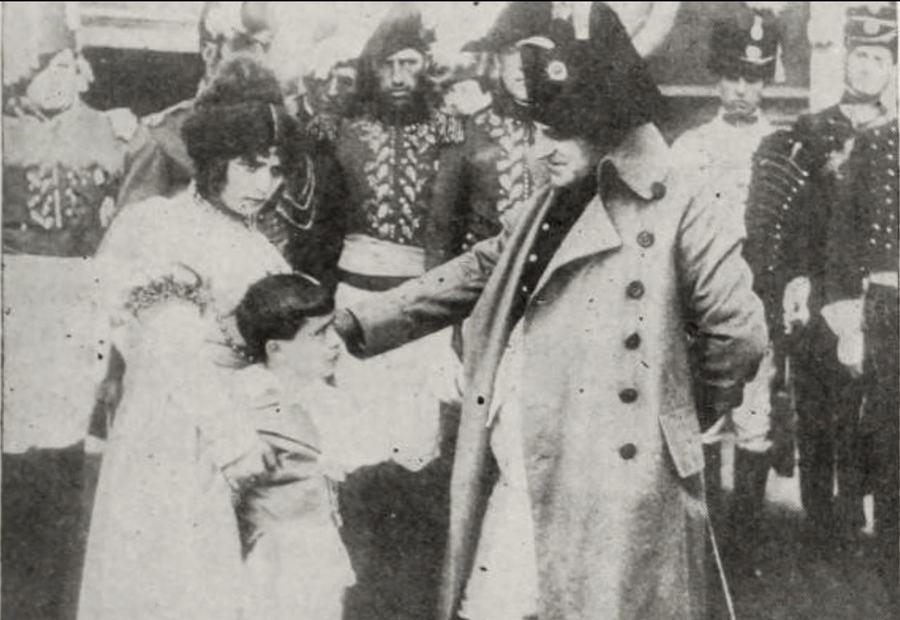
There are films that narrate history and films that bleed it; The Corsican arrives already clotted, a 1914 one-reel hurricane whose every hand-cranked frame drips oleander-scented hemlock. Shot on location in Ajaccio’s labyrinthine alleys and the granite sierras beyond, the picture weaponizes its landscape the way Colorado weaponized the frontier—only here the enemy is not outlaws but the ancestral demon of honor, that yellow-eyed fetish Corsicans nurse like a birthright.
Director Louis Feuillade, moonlighting from his serial-king throne at Gaumont, dispenses with narrative courtesies: no title cards announcing backstory, no soft dissolve to explicate kinship. We plunge straight into the bacchanal of a regimental fête, brass bands blaring Verdi while De Montfort paws Livia beneath lantern light. The camera, stationary yet predatory, frames her bodice like a crime scene. Feuillade’s cut is brutal—one smash-cut from a laughing drummer to Livia’s torn sleeve—and suddenly the film’s moral ledger is solvent only in blood.
What distinguishes The Corsican from other revenge yarns of the era—say Beatrice Cenci or In the Lion's Den—is its refusal to psychologize vendetta. Bastien’s dagger is not the extension of a wounded ego but of a communal script etched into church stones. When he kills, the act is filmed in a single long take: victim and avenger share the same diagonal, the same horizon of olive trees, as if the island itself exhales the blade. No close-up of remorse follows; instead, Feuillade pans to a goatherd munching bread, utterly unfazed. Violence here is weather.
The second act migrates from flinty melodrama to something bordering on ethnographic horror. Bastien’s flight into the maquis becomes a study in verticality: the camera tilts up scarps where wild figs claw the sky, then down ravines carpeted with asphodels. Critic André Bazin would later praise Italian neorealism for its "ontological equality" between man and milieu; Feuillade anticipates it by planting his fugitive amid thorn and thyme until human and scrubland merge into one trembling organism. Intertitles vanish—language itself seems cowed by the landscape—leaving only the rustle of maquis and the distant bugles of imperial pursuit.
Meanwhile, Colonel Maxence’s reprisals spiral into proto-fascist pageantry. The sequence where villagers are herded into the 15th-century citadel was shot at dawn with non-professional townsfolk; their dazed squints as bayonets prod them up the ramp conjure a newsreel that never existed. Compare this with the white-slavery terror of Traffic in Souls, whose urban shadows feel almost cozy beside Feuillade’s sunlit brutality. Daylight, usually the medium of comfort, becomes an interrogation lamp under which every wrinkle of complicity is exposed.
Livia’s predicament—pregnant, shunned, paraded as the cause of collective punishment—gives the film its rawest serration. Played by Greek tragedian-turned-silent-novice Irène Dario, she moves like a sleepwalker through candle-lit chapels, her veil trailing across flagstones worn smooth by centuries of penitents. In a scene that censors in Lyon snipped for "immoral languor," Livia breastfeeds her newborn while a French patrol stands at attention outside her cell. The montage crosscuts between the infant’s suckling mouth and the soldiers’ fixed bayonets—an audacious visual equation between nurture and violence that would make even Den hvide Slavehandels sidste Offer blush.
Technically, the film is a tour-de-force of pre-feature-length compression. At 38 minutes, it juggles vendetta, occupation, siege, and sacrificial catharsis without collapsing into tableau glut. Feuillade’s secret is rhythmic alternance: every horizontal chase (across ravines) is answered by a vertical stacking (bodies on scaffolds), each public spectacle balanced by a private apostasy. The tinting strategy—amber for day exteriors, cobalt for night, sulphur-yellow for interiors—amplifies the emotional oscillation. When Bastien finally descends from the cliffs, the print’s amber washes are scratched by archivists to resemble flint sparks, so the very celluloid appears to combust.
Performance hierarchies invert the star system. The nominal lead, Raphaël Liebhardt as Bastien, utters not a single intertitle; his acting is all clavicle and calf muscle, a kinetic fresco of guilt. The real anchor is Paul Manson’s Colonel Maxence—ice-blonde hair slicked to the scalp like a helmet, voiceless yet commanding via posture alone. Watch how he removes his gloves: one finger at a time, each pop a death knell. The gesture recurs thrice, and by the final iteration you flinch as if from a guillotine.
The finale, infamous in cine-club lore, stages death as civic carnival. Bastien, captured after a botched hostage exchange, is tied to a limestone block in the main square while the regiment forms a hollow square. Feuillade cranks the camera at a slightly slower speed, so when the saber arcs the motion feels aqueous, a ballet decelerated by moral viscosity. The blade lands off-frame—Hays Office precursors demanded it—but the actor’s convulsive slump and the spray of crimson tint on the lens leave zero doubt. Over the lifeless body, Livia raises her infant against a sky bleached white by over-exposure. The child’s swaddling clothes, hand-painted amber per distribution notes, flares like a comet: the next vendetta is already incubating.
Contemporary critics, drunk on the humanist opiates of Mrs. Wiggs of the Cabbage Patch, dismissed the film as "Mediterranean Grand Guignol." They missed the anti-colonial subtext pulsing beneath the blood. Released mere months before Europe would cannibalize itself, The Corsican prefigures the continental convulsions: arbitrary martial law, collective guilt, the rebranding of occupation as civilization. In hindsight, the lieutenant’s early flirtation reads less like seduction and more like imperial entitlement; the dagger that answers it is not justice but the shriek of a culture cornered.
Restoration buffs should note the 2022 2K scan by Gaumont-Pathé: nitrate shrinkage warped the edges, so the frame jitters like a heartbeat. Rather than stabilize, the archivists retained the tremor, arguing it vibrates in sympathy with the island’s seismic grudges. The tints were recreated via chromogenic analysis of marketing stills painted by Margaret Winkler’s atelier; the amber of the child’s blanket now throbs with such saturation it almost sings. The score, a new Corsican polyphonic arrangement recorded in a Sartène monastery, growls beneath the action like tectonic plates grinding granite.
Comparative lineage? Trace its DNA through Mysteries of Paris’s urban labyrinths, Fides’s martyred womanhood, and Ireland, a Nation’s anti-imperial ferment, yet none fuse the personal and political with such feral concision. Where Gambler's Gold moralizes that crime does not pay, The Corsican retorts that crime merely changes its uniform.
So why does this obscure one-reel scorcher matter in 2024? Because our screens still swarm with sanitized vendettas—algorithmic, franchiseable, emotionally deodorized. Feuillade offers the opposite: a cinema that still smells of goat dung and gunpowder, that remembers blood oxidizes black, not tasteful crimson. Watching it is less a nostalgia trip than a cauterization: the past brands its initials into your present sensibilities, and you leave the theater—virtual or otherwise—limping like a goatherd who has glimpsed his own extinction in a stranger’s dagger.
Verdict: mandatory viewing for anyone convinced silent cinema whispered. The Corsican does not whisper; it unsheathes, thrusts, and leaves you gawking at the wound, praying the next vendetta skips your bloodline.
IMDb 7
1925
Community
Log in to comment.