DbcultAccessing Vault...
Cult Review
Senior Film Conservator
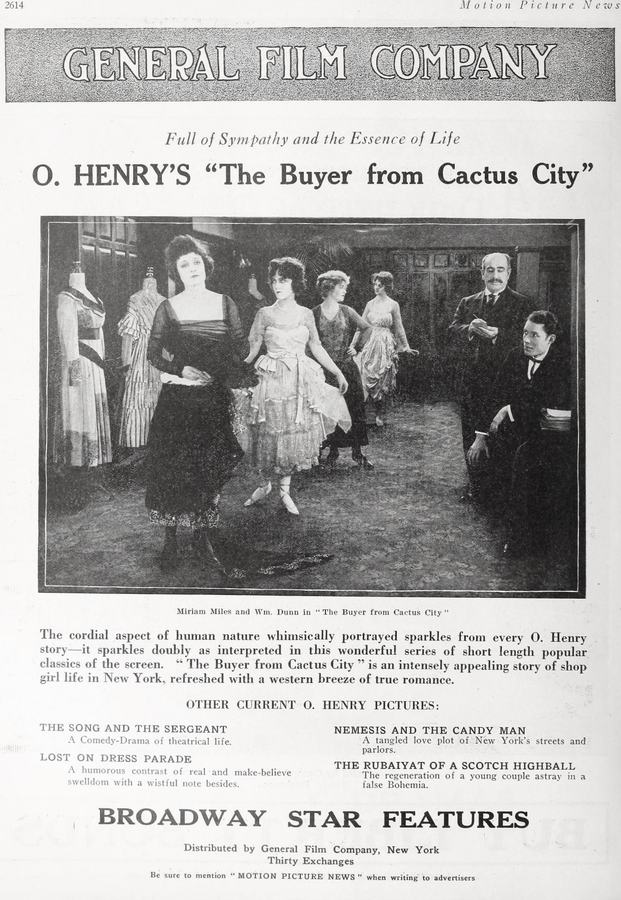
There’s a peculiar charm to early cinema, a raw honesty in its storytelling that often feels more immediate than the polished narratives we consume today. ‘The Buyer from Cactus City’, a delightful relic from 1916, exemplifies this, offering a vignette steeped in the quintessential O. Henry tradition of ironic twists and human foibles. It’s a film that, despite its brevity and the technological limitations of its era, manages to capture the enduring complexities of human connection, miscommunication, and the surprising turns life often takes.
The narrative, simple yet profound, introduces us to Platt, a junior partner in a firm hailing from the evocatively named Cactus City, Texas. His journey to the bustling, sophisticated milieu of New York isn't merely a business trip to acquire women's suits; it’s an unwitting pilgrimage into the heart of unexpected romance and profound misunderstanding. Platt, embodying the earnest, perhaps slightly naive, spirit of the American West, finds himself adrift in the metropolitan whirl, a world away from the familiar rhythms of Texas. His quest for ideal fashion soon morphs into a search for an ideal companion when he encounters Miss Ascher, a model for Zizzbaum and Co. She becomes, for him, a living embodiment of beauty and grace, sparking an immediate and intense admiration.
The film then pivots on this burgeoning connection. Platt, in a gesture that he believes is unequivocally clear, takes Miss Ascher to dine and, with a heart full of hope, presents her with a diamond ring. Herein lies the crux of the drama, the delicious tension inherent in O. Henry’s storytelling. Miss Ascher, interpreting his actions through a different lens—perhaps one colored by cynicism or prior negative experiences—misunderstands his earnest proposal. She perceives it as an insult, an presumptuous advance, rather than a genuine expression of affection and intent. Her swift, indignant departure from the restaurant sets in motion a delightful chase, a silent ballet of pursuit and evasion through the city’s thoroughfares.
The climax of this charming misunderstanding unfolds at Miss Ascher’s doorstep. Platt, undeterred, follows her, only to be met with a stinging slap across the face, a visceral rejection of what she perceives as his impropriety. It is at this precise, emotionally charged moment that the O. Henry twist, a hallmark of the writer’s craft, gracefully intervenes. A ring falls from Platt’s hand, but it is not the expected diamond of engagement; it is a simple wedding band. This tiny, metallic circle, falling at her feet, acts as a sudden, brilliant flash of illumination, shattering her preconceived notions and revealing the true, honorable nature of Platt’s intentions. The relief, the dawning comprehension on Miss Ascher’s face, is palpable, a silent testament to the power of a single object to unravel a web of misinterpretation. With the misunderstanding dissolved, she gladly embraces the prospect of returning with him to Texas, a journey from urban misjudgment to heartfelt union.
The beauty of ‘The Buyer from Cactus City’ lies not just in its clever plot but in its quiet exploration of human perception. How often do we project our assumptions onto others, creating narratives that deviate wildly from reality? Platt’s earnestness, perhaps a touch clumsy in its delivery, is initially obscured by Miss Ascher’s defense mechanisms. Her reaction, while seemingly harsh, is understandable within the context of societal expectations and the potential vulnerabilities of a young woman in a bustling city. The film, in its own charming way, asks us to look beyond the surface, to consider the deeper intentions behind actions that might, at first glance, appear inappropriate or unwelcome.
In the realm of silent cinema, the burden of conveying emotion rests heavily on the actors’ expressions and gestures. Charles Ransom, as Platt, likely infused his character with a blend of frontier sincerity and metropolitan awkwardness, making his pursuit both endearing and a little comical. Miriam Miles, as Miss Ascher, would have had the challenging task of portraying initial disdain, then confusion, and finally, joyous realization, all without uttering a single word. These performances, when viewed through the lens of early film, are a masterclass in physical storytelling, demanding a heightened sense of theatricality that modern audiences might find exaggerated yet undeniably effective for the medium.
Comparing this film to others of its era or similar thematic veins offers fascinating insights. While not a direct contemporary, the theme of a man’s journey leading to an unexpected romantic outcome or a profound change in perspective can be seen in films like ‘The Three Godfathers’, albeit with a vastly different tone and narrative arc. Both films explore a protagonist’s journey towards an unforeseen personal revelation. The comedic elements of misunderstanding and social faux pas might draw parallels to the farcical situations found in films like ‘The Merry Jail’, where characters frequently find themselves in pickles due to mistaken identity or misconstrued intentions. However, ‘The Buyer from Cactus City’ leans more into the romantic comedy genre, albeit a nascent form of it, grounded in a more realistic, albeit exaggerated, human interaction.
The film also subtly touches upon the cultural clash between the American West and the sophisticated East. Platt, with his diamond ring presented perhaps too directly, embodies a certain frontier straightforwardness that New York society might deem uncouth or overly aggressive. Miss Ascher, accustomed to the more nuanced social dances of the city, misreads his sincerity through her own urban filter. This dynamic of rural earnestness meeting urban skepticism is a timeless trope, one that continues to resonate in stories of cultural exchange and personal growth. It’s a gentle reminder that communication is not just about words, but about context, cultural understanding, and the unspoken language of intent.
The enduring appeal of O. Henry’s work, and by extension, this cinematic adaptation, lies in its ability to surprise and delight. His stories often hinged on a final, unexpected revelation that recontextualized everything that came before, leaving the audience with a smile or a thoughtful sigh. ‘The Buyer from Cactus City’ captures this essence perfectly. The wedding ring, so simple yet so powerful, becomes the key that unlocks not just the truth for Miss Ascher, but also a deeper understanding of Platt’s character for the audience. It’s a narrative device that, while seemingly straightforward, requires precise timing and execution to land effectively, a testament to the filmmakers’ grasp of storytelling.
In an era where films were still finding their voice, experimenting with visual grammar and narrative structure, ‘The Buyer from Cactus City’ stands as a charming example of how compelling stories could be told with minimal resources. It’s a film that doesn’t rely on grand spectacle or elaborate sets, but rather on the relatable human experience of wanting to connect, of making mistakes, and of ultimately finding understanding. The focus on character-driven conflict and resolution, even in a short format, speaks volumes about the foundations of cinematic storytelling.
The very idea of a “buyer” from a place like Cactus City coming to New York to purchase women's suits immediately sets up a delightful contrast. It’s a fish-out-of-water scenario that inherently brings with it comedic potential and opportunities for cultural observation. Platt isn't just buying clothes; he's immersing himself in a world that is, perhaps, alien to him, and in doing so, he opens himself up to experiences beyond mere commerce. This journey from the transactional to the deeply personal is what gives the film its heart. It’s a reminder that even in the most mundane of tasks, extraordinary encounters can occur, transforming our lives in unexpected ways.
Furthermore, the film’s conclusion, with Miss Ascher gladly planning to return to Texas with Platt, speaks to a broader theme of finding one’s place and embracing new horizons. It’s not just a resolution to a romantic misunderstanding; it’s a commitment to a shared future, an acceptance of a life that might be vastly different from what she had previously envisioned in New York. This willingness to adapt, to step outside one’s comfort zone for love, is a powerful and timeless message. It suggests that true connection can bridge geographical and cultural divides, transforming initial skepticism into willing partnership.
The simplicity of the title, ‘The Buyer from Cactus City’, belies the depth of human interaction and emotional journey contained within its frames. It’s a film that, despite its age, continues to offer a valuable lesson in empathy and the importance of looking beyond superficial appearances. The silent era, often underestimated, provided a fertile ground for these kinds of character studies, relying on the universal language of human emotion to tell stories that transcended spoken words. This film, with its charming O. Henry twist, is a testament to that enduring power, a small but significant piece of cinematic history that reminds us of the magic of a well-told tale.
In a world that constantly bombards us with complex narratives and intricate plotlines, there is something incredibly refreshing about a film that distills human experience to its most fundamental elements: desire, misunderstanding, and the eventual triumph of truth. ‘The Buyer from Cactus City’ manages to achieve this with remarkable grace and wit. It’s a story that, much like the best of O. Henry’s short fiction, leaves a lingering sense of satisfaction, a quiet appreciation for the cleverness of its construction and the warmth of its resolution. It’s a small gem, sparkling with the innocent charm of early cinema and the timeless appeal of a love story found in the most unexpected of circumstances.
The film, in its essence, is a delightful exploration of how easily intentions can be misconstrued and how a single, seemingly insignificant detail can unravel a mountain of misunderstanding. It’s a reminder that beneath the surface of initial impressions and perceived slights, there often lies a profound and sincere heart. The journey from the bustling streets of New York back to the wide-open spaces of Texas symbolizes not just a physical relocation, but a spiritual one, from confusion to clarity, from isolation to companionship. This transformation, catalyzed by a simple wedding band, is a testament to the film's enduring narrative power and its ability to connect with audiences across generations.
IMDb 5.2
1932
Community
Log in to comment.