DbcultAccessing Vault...
Cult Review
Senior Film Conservator
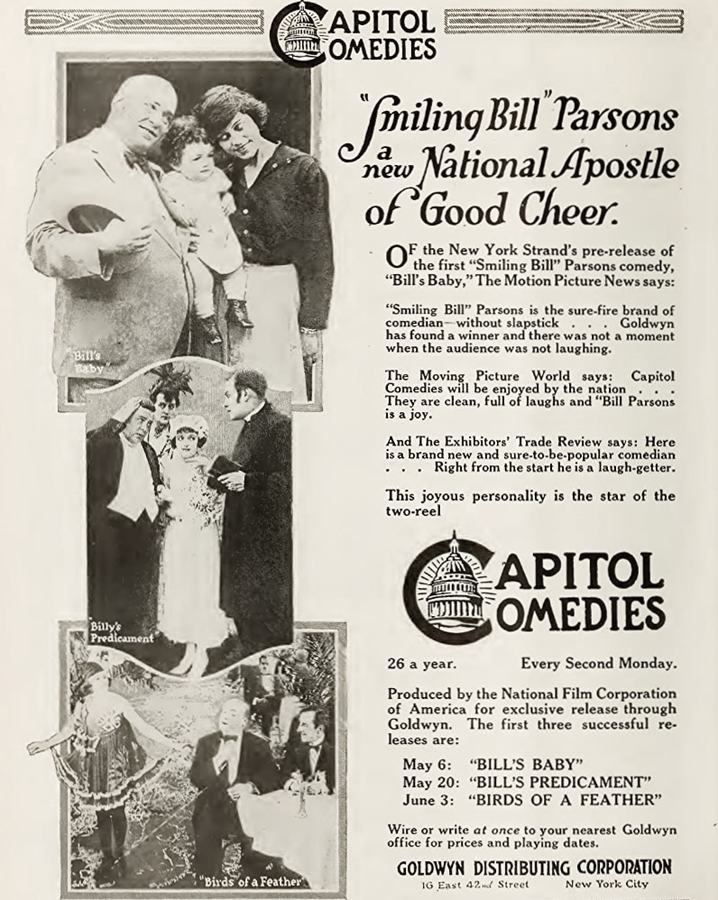
To watch Bill's Baby in the modern era is to step through a temporal portal into a world where the stakes of cinema were both incredibly simple and profoundly human. Released in 1917, a year defined by global upheaval and the maturation of the American film industry, this short feature stands as a quintessential example of the Christie Film Company’s output. While contemporaries like Sangre y arena explored the visceral depths of tragedy and bloodsport, Bill's Baby leaned into the effervescent charm of the domestic sphere, proving that a laundry basket and a well-timed double-take could be just as cinematic as a bullring.
William Parsons, an actor whose physical presence often dictated the rhythm of his scenes, plays Bill with a mixture of bewilderment and burgeoning affection. The premise—a bachelor finding a baby—is a trope that has been recycled into exhaustion, yet here it feels remarkably fresh, largely due to the lack of cynicism in Tom Bret’s writing. Unlike the convoluted plots found in The Unwritten Code, the narrative here is lean, focusing on the immediate, tactile challenges of childcare. There is a specific, almost tactile joy in watching Parsons navigate the complexities of diapers and feeding bottles, a pantomime of incompetence that eventually gives way to a rough-hewn competency.
One cannot discuss this film without acknowledging Billie Rhodes. Known as the "Smile Girl," Rhodes brings a levity to the screen that counterbalances Parsons’ heavier comedic beats. In an era where female roles were often bifurcated between the tragic waif and the high-society dame—seen in films like The Duchess of Doubt—Rhodes offered something more grounded. Her interaction with the titular baby and Bill provides the film with its emotional marrow. She isn't just a romantic interest; she is the catalyst for Bill’s transition from a solitary figure to a man integrated into the social fabric of his community.
Jay Belasco’s supporting performance further enriches the ensemble. Belasco, who often appeared in these Christie comedies, had a knack for playing the sophisticated foil. His presence here serves to highlight Bill's relative rusticity, creating a dynamic that feels far more lived-in than the melodramatic confrontations of Hell's Crater. The chemistry between the trio is palpable, even through the grainy texture of preserved celluloid, suggesting a collaborative environment where improvisation likely flourished under the bright lights of the California sun.
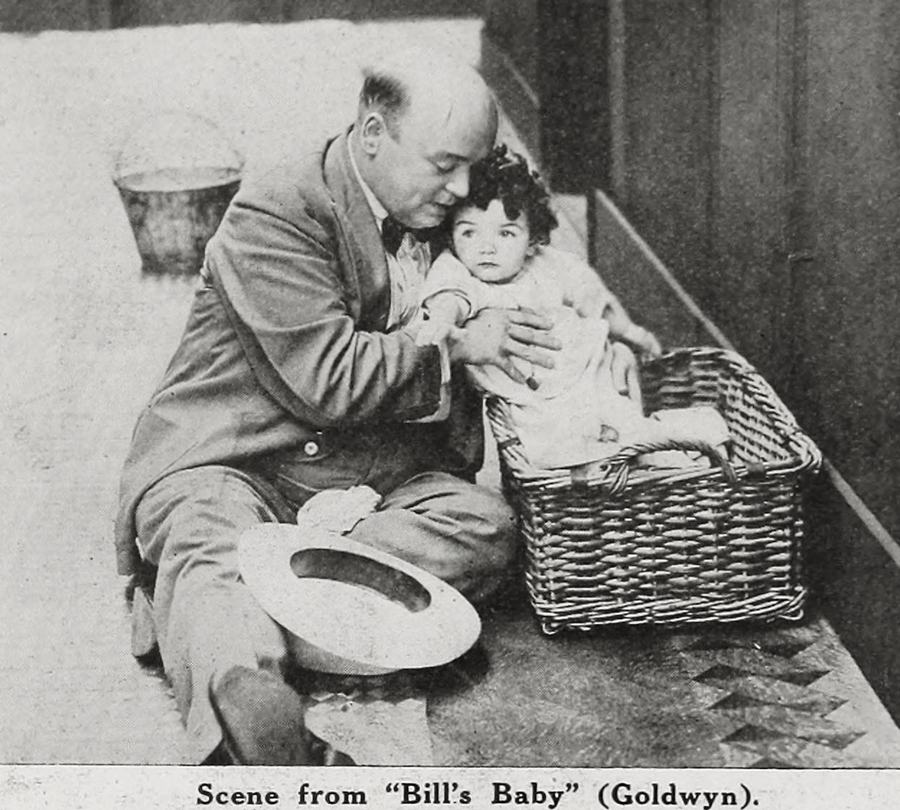
The inciting incident—the discovery of the baby in a laundry basket—is a masterclass in silent storytelling. There is no need for intertitles to explain the shock or the immediate surge of responsibility that washes over Bill. It is a visual synecdoche for the unexpected burdens of life. While films like The Fuel of Life dealt with the high-octane pressures of industry and survival, Bill's Baby finds its friction in the mundane. The laundry basket represents the domesticity that Bill has perhaps avoided, now literally dropped at his doorstep.
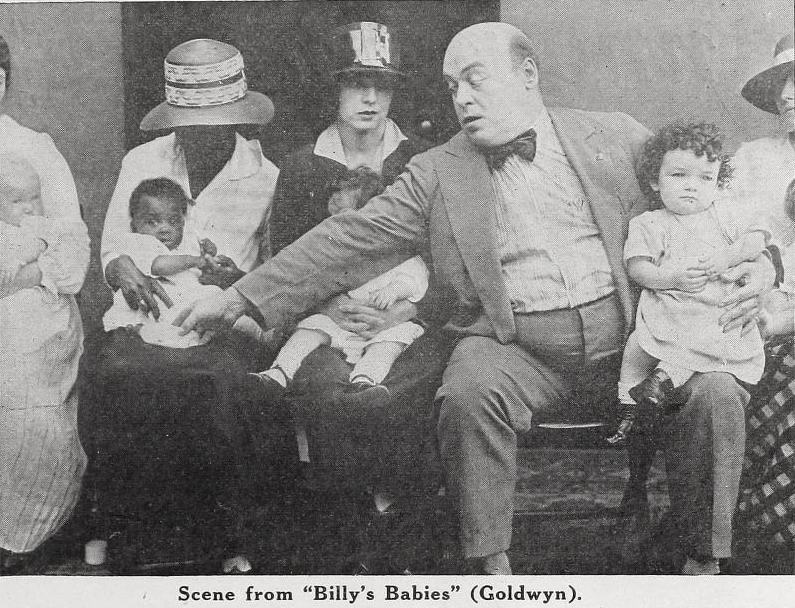
As the film progresses toward the baby contest, the pacing accelerates. This sequence is perhaps the most culturally revealing part of the movie. Baby contests were a genuine phenomenon in the early 20th century, often linked to the eugenics movement and the "Better Babies" initiatives. However, Bret’s script strips away the clinical coldness of these historical events, replacing them with a sense of community carnival. The contest serves as the arena where Bill must prove his worth. It is a far cry from the existential brooding of The Silent Man, opting instead for a climax that is both heartwarming and hilariously absurd.
Visually, the film adheres to the bright, high-key lighting that was the hallmark of the Christie studio. The sets are functional yet detailed, evoking a sense of middle-class Americana that feels both aspirational and accessible. The camera work is mostly static, as was the custom, but the blocking within the frame is sophisticated. When Bill is shown in the same frame as the baby, the juxtaposition of his large, clumsy frame with the infant’s fragility creates a visual tension that drives the comedy. This is a subtle contrast to the more sprawling, atmospheric visuals of Little Eve Edgarton, which utilized its setting to reflect the internal states of its characters.
The editing in the contest scene is particularly noteworthy. The quick cuts between the various contestants—the crying babies, the nervous mothers, and the stoic Bill—create a rhythmic energy that mirrors the pulse of a real event. It’s this attention to the "lived" quality of the scene that makes the film more than just a historical curiosity. It captures a specific frequency of human anxiety and pride that remains unchanged a century later. It reminds me of the comedic timing found in Three Hours Late, where the humor is derived from the collision of human intent and the stubborn refusal of the world to cooperate.
Why does Bill's Baby resonate when so many other shorts from 1917 have faded into the ether? Perhaps it is because it touches on the universal desire for belonging. Bill is an outsider who finds a purpose through an act of radical kindness. While the film doesn't delve into the darker psychological territory of Body and Soul, it doesn't need to. Its power lies in its simplicity. The resolution, where the baby wins the first prize, is a literal crowning of Bill’s efforts. It’s a moment of pure, unadulterated cinematic joy.
Comparing this to the more structured social satires like Mrs. Plum's Pudding, one can see how Bill's Baby prioritizes character over message. Tom Bret wasn't trying to change the world; he was trying to make it feel a little warmer for twenty minutes. This lack of pretension is what makes the film so durable. It doesn't carry the heavy-handed moralizing found in Mit Herz und Hand fürs Vaterland, nor does it seek the epic scope of When We Were Twenty-One. It is a miniature portrait of a man, a baby, and a basket.
Looking back at the career of William Parsons, Bill's Baby serves as a vital chapter. Parsons had a unique ability to make the audience root for him, even when he was at his most ridiculous. This film allowed him to showcase a softer side, a departure from the more aggressive slapstick that dominated the era. It also cemented Billie Rhodes as a star who could carry the emotional weight of a scene with nothing more than a glance and, of course, that famous smile. In the landscape of 1917, where films like The Love Route were pushing the boundaries of narrative structure, Bill's Baby was a reminder that the most compelling stories are often the ones that happen in our own backyards—or our own laundry rooms.
In the final analysis, the film is a testament to the power of the silent medium to convey complex emotions through simple actions. The ending doesn't just provide a happy conclusion for the characters; it provides a sense of closure for the audience. We leave Bill not as the lonely bachelor we met at the beginning, but as a man who has found his place in the world through the most unexpected of circumstances. It is a small, perfectly formed gem of a movie that deserves its place in the pantheon of early American comedy. If you find yourself wandering through the archives of 1910s cinema, do not pass this one by. It has more heart in its few reels than many modern blockbusters have in their entire three-hour runtimes.
Reviewer's Note: For those interested in the evolution of the domestic comedy, comparing this work to the more dramatic undertones of Il processo Clémenceau offers a fascinating look at how different cultures handled the theme of family and scandal during the same period.
IMDb —
1918
Community
Log in to comment.