DbcultAccessing Vault...
Cult Review
Senior Film Conservator
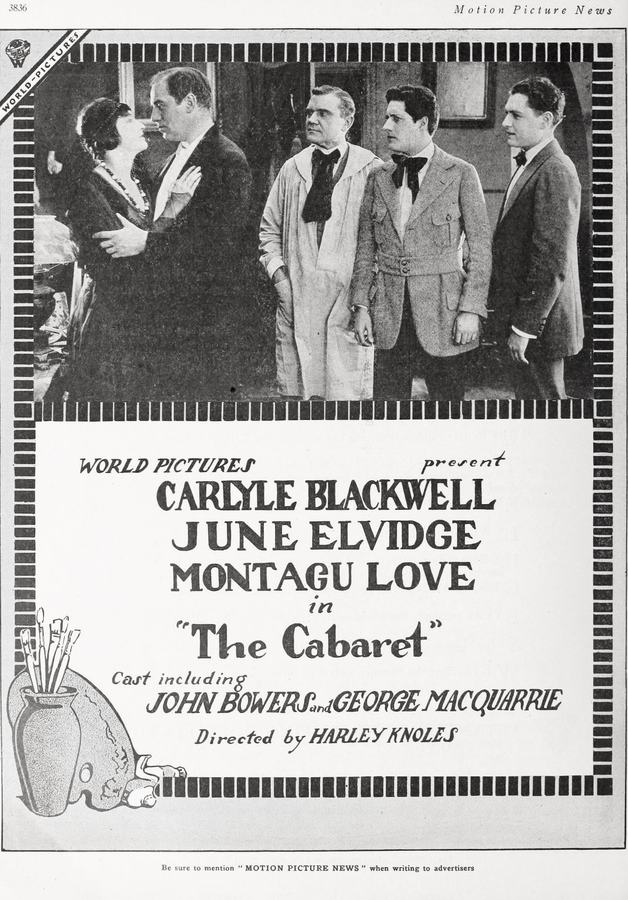
The opening scenes of The Cabaret establish Helene (Minta Durfee) not merely as a performer but as a vessel of ancestral rhythm. Her grandfather’s violin, a relic pulsing with the ghost of his presence, becomes the film’s silent narrator. When his death fractures her world, the abrupt silence of his last note mirrors the abrupt silence of her career. The directors, J.U. Giesy and Virginia Tyler Hudson, employ a stark visual motif here: close-ups of the violin’s empty case, the stage lights dimming, and Helene’s hands—once fluid in motion—now trembling over her own reflection. This is not a narrative of mere survival but of artistic reinvention, as she migrates from the cabaret’s velvet curtains to the stark white canvas of an artist’s studio.
The quartet of artists—Jaffrey Darrel (Montagu Love), Ned Lorrimer (Carlyle Blackwell), Dick Turner (Charles W. Charles), and Stanley Sargent (George MacQuarrie)—are rendered with a blend of romantic idealism and existential dread. Their collective fascination with Helene is not romantic but almost scientific, as if her presence could unlock some ineffable truth about their craft. The dialogue, sparse yet laden with subtext, crackles with the tension of men who see themselves in her movements. Jaffrey, in particular, becomes a tragic figure of purism, his refusal to commodify his art paralleling Helene’s own struggle to maintain authenticity as she ascends the theatrical world.
Greenwich Village in this film is less a geographical setting and more a state of mind—a crucible where art and disillusionment simmer. The directors juxtapose the village’s bohemian energy with its undercurrents of decay. When Helene returns after her stardom, the once-bustling streets are now eerily quiet, their vitality siphoned by commercialization. This visual irony mirrors the fate of Jaffrey, whose studio, now a relic of a bygone era, is filled with half-finished canvases that seem to weep with the weight of unrealized potential. The film’s most poignant moment occurs when Helene, now a stage icon, walks past a theater marquee advertising a musical comedy. The camera lingers on the marquee’s garish lights, a sly critique of the very industry she helped fuel.
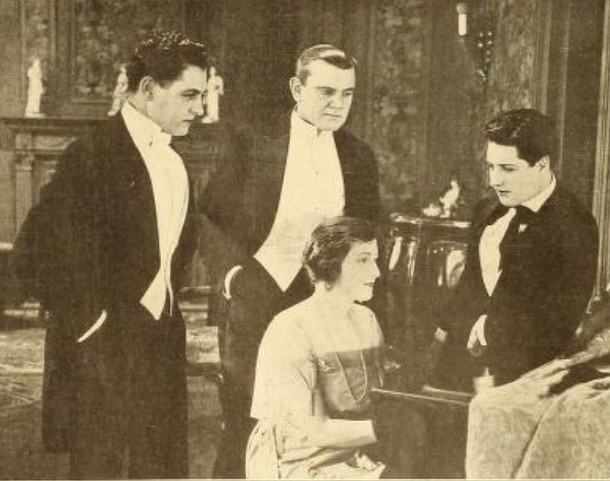
Comparisons to La Dame aux Camélias (1920) are inevitable, as both films explore the intersection of art and mortality. However, The Cabaret diverges by framing its protagonist not as a doomed courtesan but as an artist in perpetual becoming. The film’s silent language—its reliance on expressionistic lighting and deliberate pacing—is reminiscent of Die Gespensterstunde (1925), yet it avoids the Germanic fatalism of its counterpart. Instead, it opts for a more introspective tone, as though the characters themselves are performing for an audience beyond the screen, aware of their roles in a narrative they cannot control.
Jaffrey’s arc is the film’s emotional keystone. Unlike Ned, whose jealousy manifests in overt hostility, Jaffrey’s conflict is internal, a war between his artistic integrity and societal expectations. His refusal to teach at a commercial art school—a subplot that feels anachronistically modern—highlights the film’s prescient critique of creative homogenization. The final scene, where Helene proposes marriage to Jaffrey in his dilapidated studio, is a masterclass in visual storytelling. The camera circles slowly, capturing the dust motes in the air and the faint smile on Jaffrey’s lips, as if to suggest that love, in its purest form, is an act of resistance against entropy.
Helene’s decision to abandon her stardom for a life with Jaffrey is not a regression but a reclamation of agency. The film’s final moments, set against the backdrop of a New York skyline, juxtapose the city’s relentless verticality with the horizontal intimacy of the couple’s embrace. This is a love story not of passion but of shared purpose, a quiet rebellion against the chaos of modern life. The directors, through their meticulous attention to set design and costuming, underscore the contrast between Helene’s opulent stage attire and the frayed edges of Jaffrey’s painter’s smock—a visual metaphor for the choice between spectacle and substance.
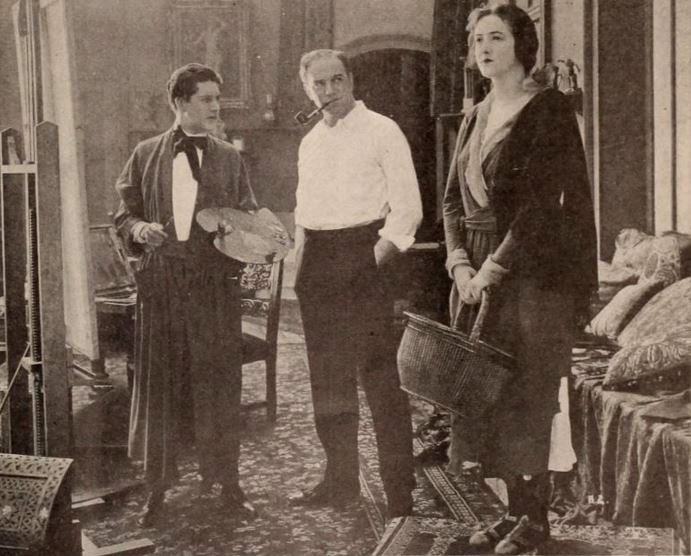
Though The Cabaret was largely overshadowed by the talkie revolution, its exploration of artistic integrity remains strikingly resonant. The film’s themes echo in contemporary works like With Serb and Austrian (1918), where political and creative ideologies clash, and Cameo Kirby (1929), which similarly interrogates the commodification of art. What sets The Cabaret apart is its unflinching portrayal of the human cost of artistic ambition. The characters are not heroes or villains but flawed individuals navigating a world where survival often demands compromise.
For modern audiences, the film serves as a meditation on the fragility of artistic identity in an age of algorithmic consumption. Helene’s journey—from dancer to muse to star to partner—mirrors the fluidity of contemporary creative careers, where visibility is both a boon and a burden. The directors’ decision to leave the narrative unresolved, ending with Helene and Jaffrey’s quiet union rather than a triumphant return to the stage, is a bold rejection of the traditional Hollywood arc. It is a film that trusts its audience to find meaning in ambiguity, much like the best works of Durand of the Bad Lands (1922), where the horizon is always just out of reach.
In essence, The Cabaret is a forgotten masterpiece that rewards repeat viewings. Its silence is not an absence but a language in itself—a reminder that the most profound stories are often told without words. The final shot, of Helene and Jaffrey walking into the Village’s twilight, their shadows merging into the pavement, lingers like a question mark in a world too hurried to pause.
IMDb —
1918
Community
Log in to comment.