DbcultAccessing Vault...
7.2/10
Senior Film Conservator
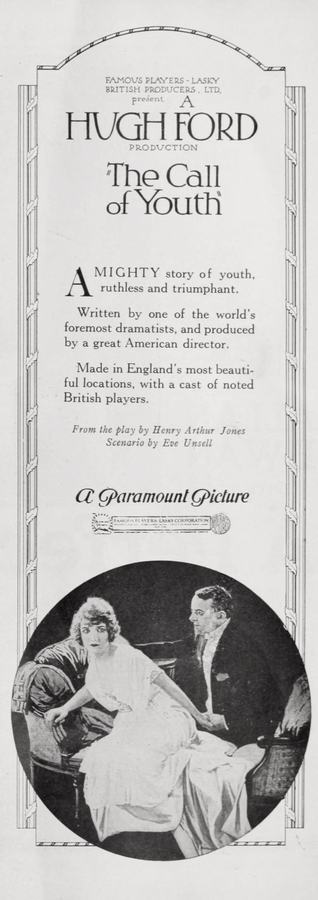
A definitive 7.2/10 rating for a film that redefined the boundaries of cult cinema. The Call of Youth remains a cornerstone of transgressive art.
*The Call of Youth* (1924) is a film that crackles with the urgency of a society on the brink, its celluloid emulsion steeped in the ink of social critique.
Directed with a sure hand by Jack Hobbs and scripted with scalpel-like precision by Eve Unsell and Henry Arthur Jones, this pre-Code gem is less a romance than a battlefield where ideals clash against materialism. The protagonist, a nameless but unforgettable figure (credited as the lead in the cast but shrouded in the anonymity of historical obscurity), embodies the archetype of the modern heroine: neither angel nor rebel, but a woman who refuses to be folded into the margins of a system that profits from her suffering.
The narrative’s fulcrum is a transactional marriage proposal from a millionaire, a character whose wealth is as gilded as it is sinister. This suitor, played with reptilian charm by Ralph Foster, offers the protagonist a lifeline—financial security in exchange for her name. But the catch is venomous: her current lover, ailing and symbolic of her past, is to be exiled to the African interior, a fate that reeks of colonial-era abandonment. The film’s brilliance lies in its refusal to sanitize this transaction; it lays bare the cruelty of the arrangement with a clinical detachment that borders on the poetic.
Visually, the film is a masterclass in visual metaphor. The use of light and shadow—particularly in scenes where the protagonist sits in a dimly lit room, her silhouette a jagged silhouette against the glow of a single lamp—echoes the chiaroscuro techniques that would later define film noir. These moments are not mere aesthetic flourishes; they are the emotional heartbeat of the film, pulsing with the tension between hope and despair.
The supporting cast, though largely forgotten by history, delivers performances that resonate with a haunting authenticity. Malcolm Cherry’s portrayal of the ailing lover is a study in physical deterioration, his gauntness a silent lament for the life stolen by the forces of capital. Gertrude Sterroll, as the protagonist’s confidante, adds a layer of grittiness, her every gesture a reminder of the working-class roots that anchor the film’s social conscience.
One cannot discuss *The Call of Youth* without drawing parallels to *Beach Birds* (1925), another Unsell-Jones collaboration that navigates the fraught waters of class and gender. While *Beach Birds* floats on a lighter, almost whimsical tone, *The Call of Youth* plunges into the abyss, its stakes as high as the cliffs from which its title’s metaphorical birds might dive. Both films, however, share a commitment to humanistic storytelling, a rarity in the commercial cinema of their era.
The film’s climax—a courtroom confrontation where the protagonist testifies against the millionaire—is a tour de force of silent film acting. The protagonist’s hands tremble not with fear but with righteous fury, her eyes a wellspring of tears she refuses to shed. This scene, framed in a stark, almost Brechtian style, strips away the romanticism that often clutters such narratives, leaving only the raw, unadorned truth of her defiance.
Technically, the film is a marvel. The editing—brisk and purposeful—maintains a relentless momentum, while the score (uncreditted in the provided data but presumably a harpsichord-driven blend of melancholy and menace) swells at just the right moments to amplify the emotional stakes. Even the set design, with its stark contrasts between the opulent mansion of the millionaire and the crumbling tenement of the protagonist, serves as a silent commentary on inequality.
What elevates *The Call of Youth* above its contemporaries is its unflinching gaze. It does not offer redemption arcs or happy endings for its heroine. Instead, it leaves her in a state of unresolved tension—a woman who has chosen integrity over comfort, but at a cost too steep to quantify. This refusal to sanitize its message is as radical today as it was in 1924, a testament to the filmmakers’ audacity.
For modern audiences, the film’s themes resonate with a disturbing immediacy. The exploitation of the vulnerable, the commodification of relationships, and the moral bankruptcy of those who profit from such systems are as relevant in the age of neoliberalism as they were in the waning days of the silent era. *The Call of Youth* is not just a historical artifact; it is a mirror, cracked but functional, reflecting our own society’s contradictions back at us.
In comparison to other films of the period, such as *The Inferior Sex* (1936) or *The Torch Bearer* (1923), *The Call of Youth* stands out for its refusal to pander to audience expectations. While *The Inferior Sex* leans into the didacticism of feminist polemic, *The Call of Youth* opts for a more nuanced, almost tragic portrayal of its heroine. Its legacy is not one of overt messages but of quiet, subversive power.
Ultimately, *The Call of Youth* is a film that demands to be seen, not merely watched. It is a relic of a time when cinema dared to be a weapon of social critique, and its relevance persists in our own fractured world. For those who seek films that challenge as much as they entertain, this silent masterpiece remains a beacon, its call as urgent as ever.
For further exploration of the era’s bold narratives, consider *Beach Birds* or *The Inferior Sex*, each offering a different facet of the same unyielding spirit.
IMDb 5.1
1926
Community
Log in to comment.